
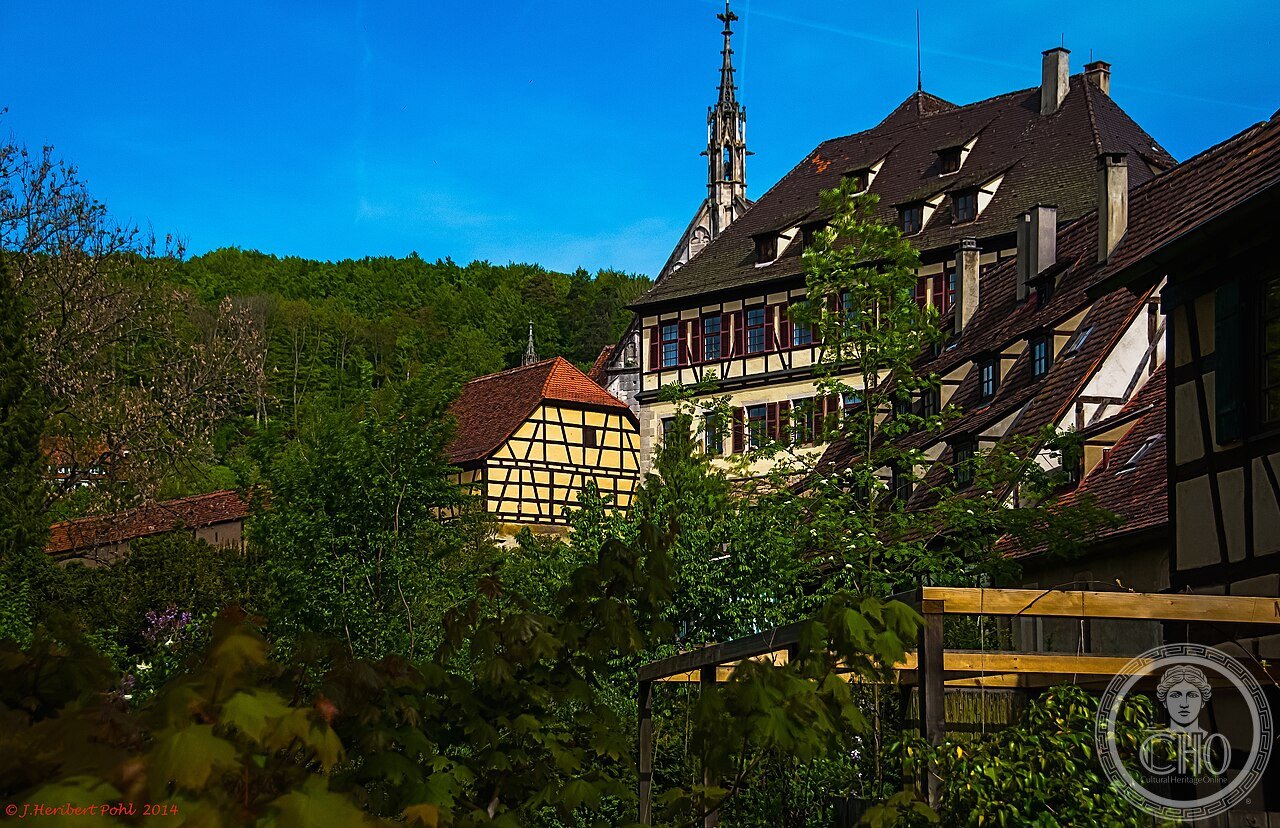
Fondato tra il 1180 e il 1183 e ceduto ai cistercensi nel 1190, il monastero di Bebenhausen divenne presto uno dei più ricchi della regione, con fino a 130 fratelli laici al lavoro nei campi nel Duecento. Dal 1342 passò sotto la sovranità della contea del Württemberg, che ne fece meta di battute di caccia nella vicina foresta dello Schönbuch. Dal 1868 parte del complesso fu trasformata in residenza venatoria reale — e qui, dopo la fine della monarchia nel 1918, l’ultimo re del Württemberg, Guglielmo II, visse insieme alla moglie fino alla morte.
About Kloster Bebenhausen
Kloster Bebenhausen was founded between 1180 and 1183 by Rudolf, Count Palatine of Tübingen, initially as a Premonstratensian house before being ceded to the Cistercian order in 1190, when the order’s General Chapter formally accepted the community. The monastery rapidly developed into one of the wealthiest religious houses in the region, its estates worked under the Rule of Saint Benedict by lay brothers who numbered up to 130 during the 13th century, supplemented by a further 80 choir monks devoted to liturgical life. In 1342, sovereignty over Bebenhausen and the surrounding Schönbuch forest passed to the County of Württemberg, and because the Schönbuch was a favoured hunting ground, the Counts of Württemberg became increasingly frequent guests at the monastery from that point onward, establishing a long-standing association between the religious house and the region’s ruling dynasty. This connection deepened significantly from 1868, when parts of the monastery complex were converted into a royal hunting lodge that became a favourite venue for the Württemberg monarchs and their entourages; Friedrich I, the first King of Württemberg, held lavish court hunts at Bebenhausen and had several of the monastery’s outbuildings converted for this purpose. The site’s final royal chapter came after the collapse of the German monarchies at the end of the First World War: Wilhelm II, the last King of Württemberg, and his wife Charlotte made the former hunting lodge their permanent residence following his abdication in 1918, living out the remainder of their lives at Bebenhausen after the end of the Württemberg monarchy.
Key facts
- 1180-1183: founded by Rudolf, Count Palatine of Tübingen
- 1190: ceded to the Cistercian order
- 13th century: up to 130 lay brothers and 80 choir monks in residence
- 1342: sovereignty passes to the County of Württemberg
- 1868: parts of the complex converted into a royal hunting lodge
- 1918: Wilhelm II, last King of Württemberg, abdicates
- Post-1918: Wilhelm II and Queen Charlotte make Bebenhausen their permanent residence
History
Bebenhausen’s long transformation from a working Cistercian monastery, sustained by well over 200 lay brothers and choir monks at its medieval peak, into a royal hunting retreat and finally the retirement residence of a deposed monarch traces an unusually complete arc across the full span of German territorial and political history, from medieval monastic economy through princely sovereignty to the collapse of monarchy itself in 1918. Wilhelm II’s choice to spend his post-abdication years at Bebenhausen, rather than in exile abroad as many deposed German monarchs did, gives the site a distinctive place in the history of the German monarchies’ dissolution — a former abbey serving as the final home of a king who chose to remain within his own former kingdom.
The monastery’s 1342 transfer to Württemberg sovereignty and subsequent centuries-long association with the ruling dynasty’s hunting activities in the Schönbuch forest illustrates a broader pattern of medieval monastic institutions gradually absorbed into the administrative and recreational infrastructure of neighbouring secular rulers, well before any formal Reformation-era dissolution took place.
What you see
The complex today presents a layered architectural ensemble combining the surviving medieval Cistercian monastery buildings, including the church and cloister, with the later royal hunting lodge additions built from 1868 onward. The rooms once occupied by Wilhelm II and Queen Charlotte after 1918 remain part of the site’s visitor experience, offering a direct connection to the final chapter of the Württemberg monarchy alongside the older monastic architecture.
Practical information
- Opening hours: generally open daily with seasonal variation; check current hours before visiting; admission fee applies
- Address: Beim Schloß, 72074 Tübingen-Bebenhausen, Germany
Getting there
Kloster Bebenhausen is located in the village of Bebenhausen, a district of Tübingen in Baden-Württemberg, reachable by road or bus from Tübingen city centre. GPS: 48.5614° N, 9.0600° E.
Nearby
- Schönbuch Nature Park — the forested area surrounding the monastery
- Tübingen — the nearby university city
- Bebenhausen village — the small settlement surrounding the monastery complex
Sources
- Wikipedia — “Bebenhausen Abbey” (en.wikipedia.org)
- Staatliche Schlösser und Gärten Baden-Württemberg — “Monastery & palace” (kloster-bebenhausen.de)
- Visit Tübingen — “Bebenhausen Monastery and Palace” (visit-tubingen.co.uk)
Find it on the map
See this place and what’s around it →📷 Become a Cultural Heritage Online photographer
Share your photos of places: they stay published under your name as the author. The more they're seen, the more you get noticed — and soon a contest will reward the most appreciated photos.
Log in or sign up free to add a photo