
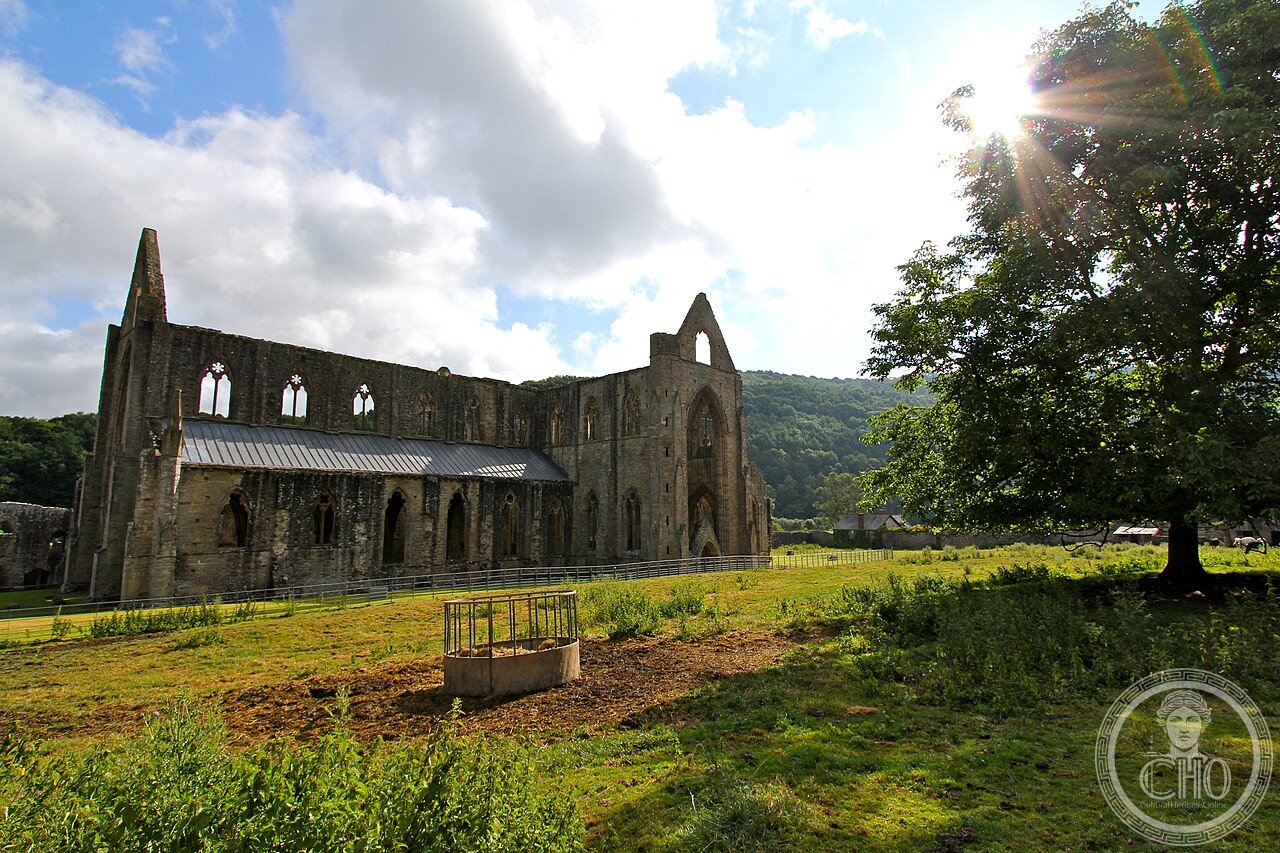
Fondata nel 1131, Tintern fu la prima abbazia cistercense del Galles. Soppressa nel 1536 durante la dissoluzione dei monasteri voluta da Enrico VIII, il piombo del tetto fu venduto e la pietra saccheggiata per altre costruzioni: la natura riprese lentamente possesso di uno dei centri spirituali più importanti del Galles medievale. Duecentosessant’anni dopo, nel 1798, William Wordsworth camminò lungo il fiume Wye insieme alla sorella Dorothy e ne trasse l’ultima poesia della raccolta “Lyrical Ballads”, rendendo quelle rovine uno dei simboli del Romanticismo inglese.
About Tintern Abbey
Tintern Abbey was founded for Cistercian monks on 9 May 1131 by Walter de Clare, Lord of Chepstow, who gifted land to monks arriving from L’Aumône Abbey in France; the new foundation was only the second Cistercian house established in Britain, and the first in Wales, its earliest buildings modest wooden structures reflecting the Cistercian order’s commitment to austerity and simplicity. The abbey was almost entirely rebuilt and enlarged between 1220 and 1287, with a new abbey church begun in 1269 that became one of the acknowledged masterpieces of British Gothic architecture; construction was largely completed, aside from minor later additions, by the early 14th century. This flourishing came to an abrupt end on 3 September 1536, when Abbot Wych surrendered the abbey and its estates to King Henry VIII’s visitors as part of the wider Dissolution of the Monasteries, bringing to a close roughly four centuries of continuous monastic life at the site. Following the dissolution, the abbey’s lead roof was stripped and sold, and its stone was plundered for local building projects, leaving the structure to gradually fall into picturesque ruin as nature reclaimed what had been one of Wales’s most significant spiritual centres. The abbey’s ruins gained lasting cultural fame through William Wordsworth, who composed the closing poem of his and Samuel Taylor Coleridge’s 1798 collection “Lyrical Ballads” following a walking tour along the River Wye with his sister Dorothy, five years after his first visit to the site in 1793; Wordsworth later recalled composing the poem mentally on 13 July 1798, and its publication helped establish Tintern Abbey as one of the defining images of the English Romantic movement’s fascination with ruins, nature, and memory.
Key facts
- 9 May 1131: founded by Walter de Clare, the first Cistercian abbey in Wales
- 1220-1287: abbey almost entirely rebuilt and enlarged
- 1269: construction begins on the new Gothic abbey church
- 3 September 1536: Abbot Wych surrenders the abbey during the Dissolution of the Monasteries
- 1793 and 1798: Wordsworth’s two visits, the second producing his celebrated poem
- 13 July 1798: Wordsworth composes the poem after his Wye Valley walking tour
- Today: managed by Cadw, receiving around 17,000 visitors annually
History
Tintern’s status as the first Cistercian foundation in Wales situates it at the very beginning of the order’s expansion into the region, part of a broader wave of Cistercian monastic settlement across 12th-century Britain that brought a distinctively austere architectural and spiritual tradition into the Welsh borderlands. The abbey’s 1536 dissolution and subsequent centuries of decay, followed by its transformation into a celebrated site of Romantic pilgrimage through Wordsworth’s poem, exemplifies a broader 18th-century British cultural shift in which ruined medieval monasteries, once objects of political and religious erasure, were reimagined as picturesque and spiritually resonant landscapes.
Wordsworth’s poem, technically titled “Lines Written a Few Miles above Tintern Abbey” but almost universally known simply as “Tintern Abbey,” never actually describes the ruins themselves in detail — the poem’s reflections are set within view of the abbey rather than inside it — yet its title permanently linked the site’s name to one of the most influential poems of the English Romantic canon.
What you see
The roofless abbey church, its great east and west windows still standing without glass or tracery infill, remains the site’s most photographed feature, its Gothic proportions still legible despite four centuries of exposure to the elements. Surrounding ruined cloister buildings, chapter house, and other monastic structures trace the fuller footprint of the medieval Cistercian complex, set within the wooded landscape of the lower Wye Valley that so captivated Wordsworth and other Romantic-era visitors.
Practical information
- Opening hours: generally open daily with seasonal variation; check current hours before visiting; admission fee applies
- Address: A466, Tintern, Monmouthshire NP16 6TE, Wales, United Kingdom
Getting there
Tintern Abbey is located on the west bank of the River Wye in Monmouthshire, Wales, reachable by road along the A466. GPS: 51.6971° N, -2.6767° E.
Nearby
- Wye Valley — the scenic river valley surrounding the abbey
- Chepstow Castle — a nearby medieval fortress
- Tintern village — the surrounding settlement
Sources
- Encyclopaedia Britannica — “Tintern Abbey” (britannica.com)
- Historic UK — “Tintern Abbey” (historic-uk.com)
- VisitWales — “Tintern Abbey” (visitwales.com)
Find it on the map
See this place and what’s around it →📷 Become a Cultural Heritage Online photographer
Share your photos of places: they stay published under your name as the author. The more they're seen, the more you get noticed — and soon a contest will reward the most appreciated photos.
Log in or sign up free to add a photo