
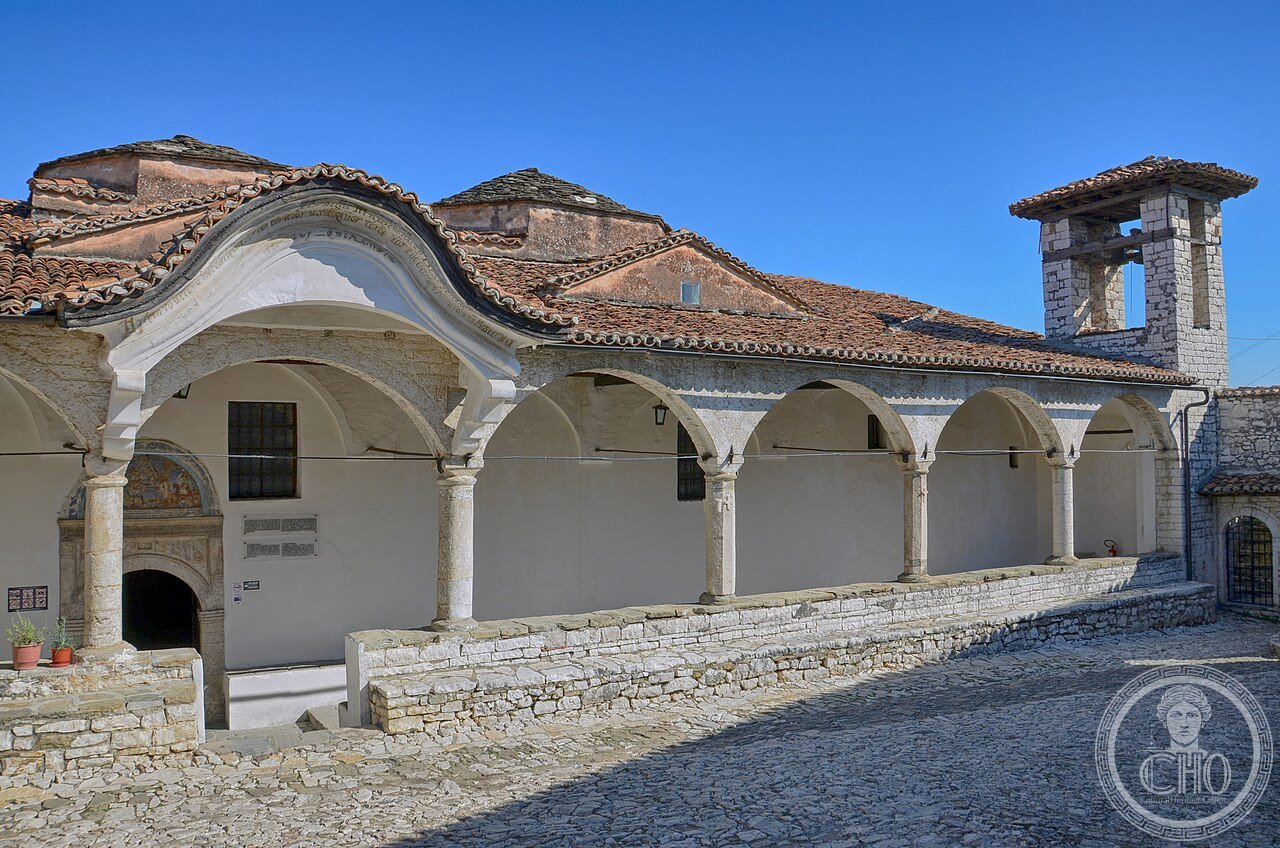
Nel castello di Berat, sopra i resti di una cappella del X secolo, sorge una chiesa ricostruita nel 1797 che dal 1986 è diventata il Museo Iconografico Onufri, dedicato al più celebre pittore albanese del Cinquecento. Onufri è ricordato soprattutto per una particolare tonalità di rosso, oggi chiamata «rosso di Onufri», il cui procedimento esatto di preparazione resta ancora oggi un mistero per gli storici dell’arte.
About the Church of the Dormition of Saint Mary
The present Church of the Dormition of Saint Mary, standing within the citadel of Berat Castle, was built in 1797 on the foundations of an earlier 10th-century chapel, and its elaborately gilded iconostasis was completed in 1807 by craftsmen from the villages of Mbrisht (Misrasi) and Lavdar (Lavdari) in the Opar region, blending traditional Orthodox forms with Baroque decorative influences. In 1986 the church was converted into the Onufri Iconographic Museum, honouring Onufri, the leading Albanian icon painter of the 16th century, whose work is distinguished by its post-Byzantine style and Venetian influences and, above all, by a uniquely vivid shade of red that has come to be known as “Onufri red” — a pigment whose exact preparation method has never been fully reconstructed by modern conservators and art historians. The museum displays 173 objects selected from a wider collection of some 1,500 items gathered from Albanian churches and monasteries across the country, including 106 icons and 67 liturgical objects created by Albanian iconographers working between the 14th and 20th centuries, among them Onufri’s own son Nikolla, as well as David Selenica, Kostandin Shpataraku, and members of the Çetiri family of painters. Behind the iconostasis, a small chapel preserves a painted cupola whose frescoes have faded almost to invisibility with age, offering a striking visual contrast to the museum’s better-preserved icon collection displayed nearby.
Key facts
- 10th century: an earlier chapel exists on the site within Berat Castle
- 1797: present church built
- 1807: gilded iconostasis completed by craftsmen from Opar region villages
- 1986: church converted into the Onufri Iconographic Museum
- Collection: 173 objects (106 icons, 67 liturgical items) from a wider 1,500-piece holding
- “Onufri red”: a distinctive 16th-century pigment never fully reconstructed
- Featured painters: Onufri, his son Nikolla, David Selenica, Kostandin Shpataraku, the Çetiri family
History
The unresolved mystery of “Onufri red” places the Berat museum’s namesake within the same rare category as Romania’s “Voronet blue” — a signature pigment from a major medieval or early modern painting tradition that modern chemistry has never fully succeeded in reproducing, leaving Onufri’s 16th-century originals with a technical distinction no later copy has matched. The church’s 1986 conversion into a dedicated iconographic museum reflects a broader pattern across the Balkans of repurposing historic ecclesiastical buildings as custodians of a nation’s wider devotional art heritage, consolidating works gathered from churches and monasteries across Albania into a single protected site within the fortified security of Berat Castle.
The presence of the museum’s collection inside a still-consecrated Orthodox church, retaining its original 1807 iconostasis and altar space, gives visitors a rare opportunity to view centuries of Albanian icon painting within something close to its original devotional architectural setting, rather than in a purpose-built secular gallery.
What you see
The church’s exterior preserves the simple form typical of Ottoman-era Orthodox churches built under restrictions on ecclesiastical architecture, standing within the fortified walls of Berat Castle’s citadel quarter. Inside, the elaborately carved and gilded 1807 iconostasis dominates the nave, while the museum’s displayed icons — including numerous works attributed to Onufri himself — line the surrounding walls. The faded frescoed cupola of the chapel behind the iconostasis offers a further, more fragmentary layer of the building’s decorative history.
Practical information
- Opening hours: generally open daily with seasonal variation; check current hours before visiting; admission fee applies
- Address: Rruga Lagje Kala, Berat Castle, 5001 Berat, Albania
Getting there
The church is located within the citadel of Berat Castle, in the historic town of Berat, reachable on foot via the castle’s fortified access roads. GPS: 40.7090° N, 19.9452° E.
Nearby
- Berat Castle — the fortified citadel surrounding the church
- Mangalem quarter — Berat’s Ottoman-era old town, known for its Thousand Windows houses
- Gorica quarter — the historic district across the Osum River
Sources
- Wikipedia — “Onufri Iconographic Museum” (en.wikipedia.org)
- Albanian Tourism official site — “Cathedral of the Assumption of the Blessed Virgin Mary” (new.akt.gov.al)
- Qendra Muzeore Berat — “Onufri Iconographic Museum” (muzeumet-berat.al)
Find it on the map
See this place and what’s around it →📷 Become a Cultural Heritage Online photographer
Share your photos of places: they stay published under your name as the author. The more they're seen, the more you get noticed — and soon a contest will reward the most appreciated photos.
Log in or sign up free to add a photo