
Nel 1524, il conte Giacomo Alfonso Ferrillo e sua moglie Maria Balsa fecero ristrutturare la cripta della cattedrale di Acerenza, decorandola con sirene, tritoni e fauni. Secondo la tradizione locale, Maria Balsa era figlia del voivoda valacco Vlad III, detto l’Impalatore — il Dracula storico — orfana a sette anni e adottata dal re di Napoli. Lo stemma dei Balsa, un drago alato sormontato da una stella, campeggia ancora oggi sulla facciata della cattedrale.
About Acerenza Cathedral
The present cathedral of Acerenza, dedicated to Santa Maria Assunta and to Saint Canius, was begun in the late 11th century at the initiative of the Norman archbishop Arnaldo of Saint-Évroult, a trusted figure of Robert Guiscard, and completed in the early decades of the 12th century with the help of French craftsmen supplied by the Normans, rising on the site of an earlier paleochristian cult building recorded from 1059. According to tradition, not fully verified by historical sources, the relics of Saint Canius — a bishop of Acerenza martyred in the 4th or 5th century — were transferred to the church from Atella in Campania in 799 under Bishop Leone II; his sarcophagus in the crypt has long been associated with local devotional legends, including reports of a miraculous “holy manna” said to have oozed from it and of his pastoral staff relic moving on its own. In the first half of the 1500s, the crypt beneath the presbytery was entirely restructured and consecrated in 1524 by Count Giacomo Alfonso Ferrillo, lord of Acerenza, and his wife Maria Balsa, whose combined patronage left the crypt decorated with an unusual mixture of Christian and classical iconographic motifs — sirens, tritons, a Christ Confessor, and fauns playing the flute. Local tradition holds that Maria Balsa was the daughter of a Balkan despot, orphaned at the age of seven and brought to Italy under the protection of King Alfonso of Aragon in Naples, who arranged her later marriage to Count Ferrillo; a persistent regional legend identifies her father as Vlad III of Wallachia, the historical prince behind the Dracula legend, pointing to the Balsa family’s heraldic device — a winged dragon surmounted by a star, a symbol associated with the Order of the Dragon into which Vlad’s own father had been inducted — still visible on the cathedral’s facade today.
Key facts
- 1059: earlier paleochristian cult building recorded on the site
- Late 11th century: present cathedral begun under Archbishop Arnaldo of Saint-Évroult
- 799 (traditional): relics of Saint Canius said to be transferred from Atella
- 1524: crypt restructured and consecrated by Count Ferrillo and Maria Balsa
- Legend: Maria Balsa said locally to be a daughter of Vlad III (“Dracula”)
- Heraldry: Balsa family’s winged dragon and star device on the facade
History
The Norman patronage behind the cathedral’s original construction, entrusted to Archbishop Arnaldo under Robert Guiscard’s rule, situates Acerenza within the broader wave of Norman ecclesiastical building projects that reshaped southern Italian church architecture in the decades following the Norman conquest of the region. The later Ferrillo-Balsa restructuring of the crypt in 1524, blending Christian and classical pagan imagery in a single decorative programme, reflects the wider Renaissance-era fashion for reintroducing classical motifs into sacred spaces, executed here by a noble family whose own genealogical legend — however unverified — links the cathedral to one of the most internationally recognisable figures of medieval Balkan and later popular culture history.
Whether or not the Dracula connection reflects verified genealogy, its persistence in local tradition, reinforced by the visible dragon-and-star heraldry on the building itself, has made Acerenza Cathedral a notable point of interest for visitors drawn by the intersection of documented medieval architecture and enduring regional legend.
What you see
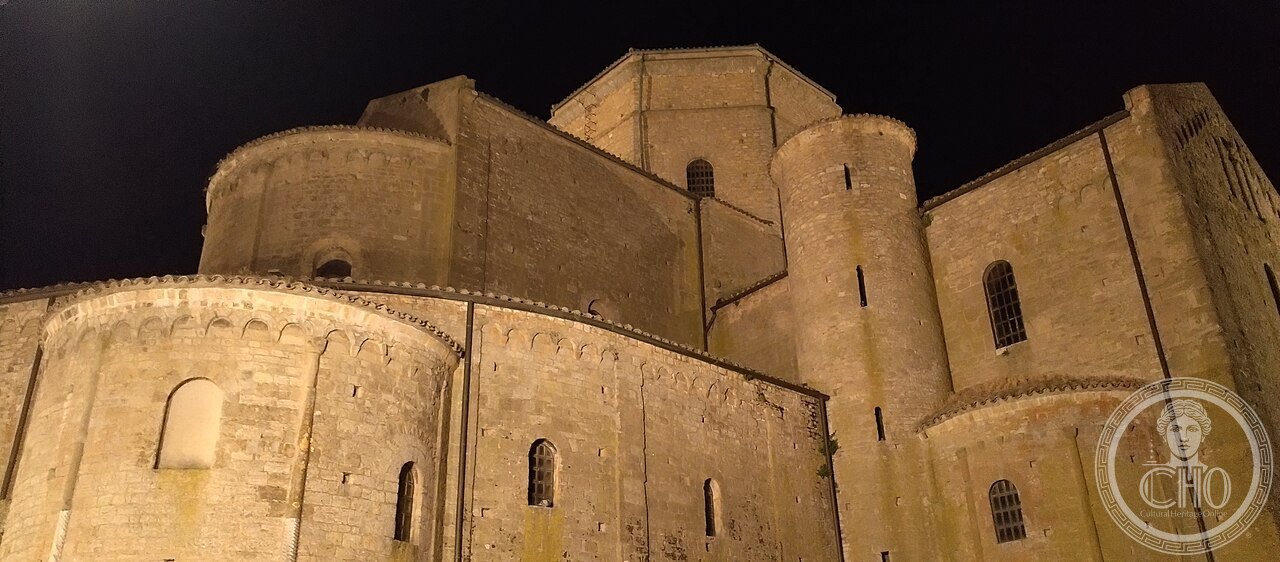
The cathedral’s exterior preserves its Norman-Romanesque origins, with the Balsa family’s winged dragon and star heraldic device visible on the facade. The crypt beneath the presbytery, restructured in 1524, presents an unusual decorative programme mixing Christian religious imagery with classical motifs including sirens, tritons, and flute-playing fauns, alongside the sarcophagus traditionally associated with Saint Canius.
Practical information
- Opening hours: generally open daily with seasonal variation; check current hours before visiting; free admission
- Address: Via Regina Elena, 85011 Acerenza, Italy
Getting there
Acerenza Cathedral is located in the historic hilltop town of Acerenza, in the province of Potenza, Basilicata. GPS: 40.7972° N, 15.9421° E.
Nearby
- Acerenza historic centre — the surrounding hilltop old town
- Venosa — a nearby town with its own significant historic monuments
- Potenza — the provincial capital of Basilicata
Sources
- Wikipedia — “Acerenza Cathedral” (en.wikipedia.org)
- Basilicata Sacra — “Cattedrale di Santa Maria Assunta e San Canio” (basilicatasacra.it)
- Regione Basilicata — “Acerenza-Dracula, in Italia le tracce di Vlad Tepes” (regione.basilicata.it)
Find it on the map
See this place and what’s around it →📷 Become a Cultural Heritage Online photographer
Share your photos of places: they stay published under your name as the author. The more they're seen, the more you get noticed — and soon a contest will reward the most appreciated photos.
Log in or sign up free to add a photo