
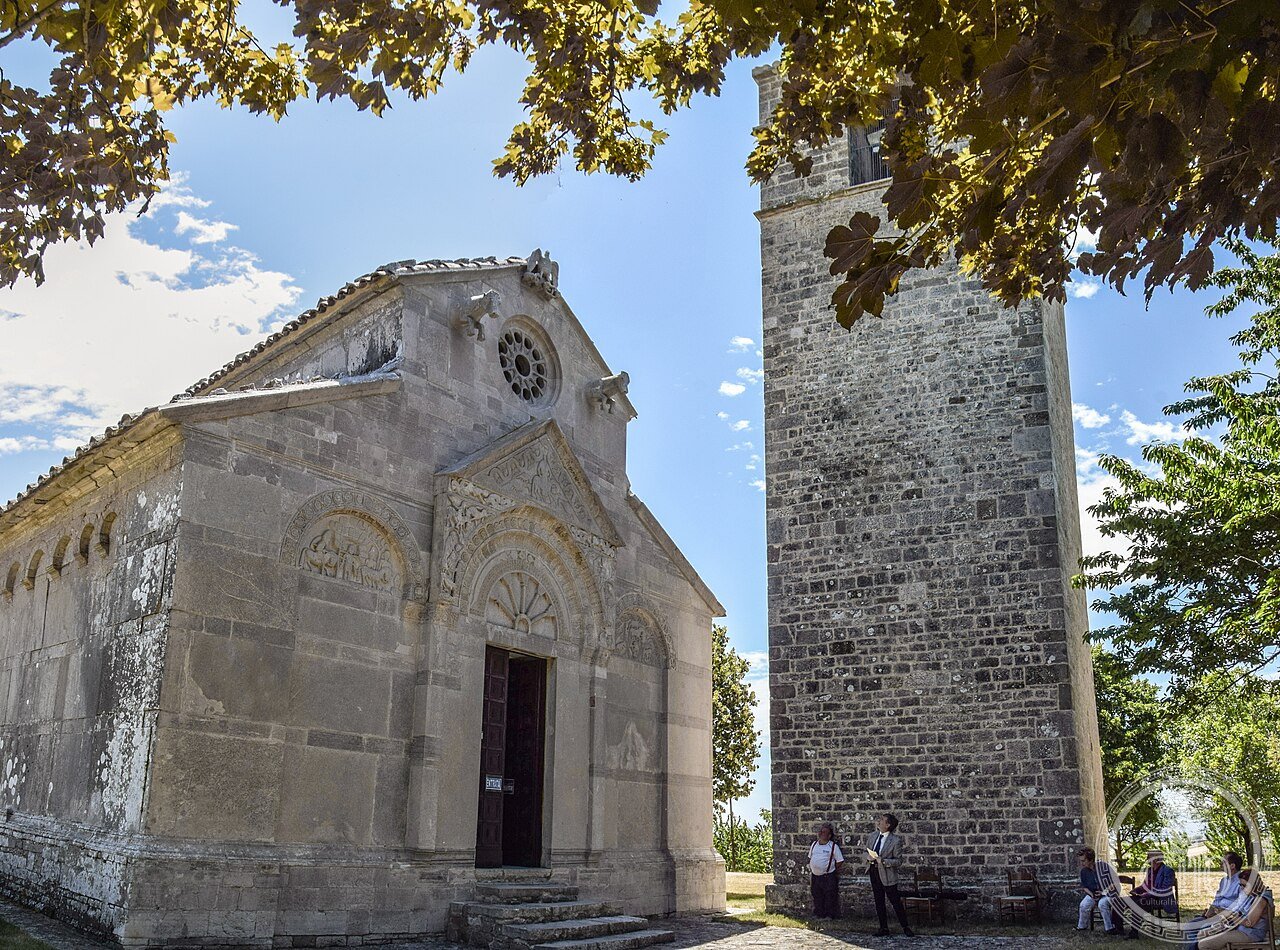
On the facade of this small Benedictine abbey in the Molise countryside, a carved relief tells the legendary “flight of Alexander the Great”, lifted into the sky by griffins; around it, eagles, lions, deer, knights, pilgrims and wrestlers make up one of the richest and, still today, most debated Romanesque bestiaries in Italy. Consecrated in 1148 by the archbishop of Benevento, it is considered the “mother” of the Molise Romanesque.
About Santa Maria della Strada
Santa Maria della Strada, a former Benedictine abbey in the countryside north of Matrice, in the province of Campobasso, was formally consecrated in August 1148 by Pietro, Archbishop of Benevento, though the exact origins of the site remain debated among scholars; a parchment purportedly dating to 1039 mentions the location, but its authenticity is disputed, with some historians instead attributing it to the late 12th century. The abbey may have followed the Benedictine Rule associated with Montecassino, though direct dependency on that great monastery has never been definitively proven; Roberto Avalerio, lord of Matrice around the time of the 1148 consecration, is thought to have donated the land for the foundation. The church’s facade bears an extensive and still scholarly contested carved decorative programme, considered one of the finest achievements of Romanesque art anywhere in Molise: eagles, lions, deer, ox heads, and serpents appear alongside carved figures of horsemen, pilgrims, wrestlers, and huntsmen, while a lunette above a lateral portal depicts the celebrated legend of the “Flight of Alexander the Great,” in which the Macedonian king is carried aloft by griffins — a popular medieval motif drawing on chansons de geste traditions. An eagle crowning the facade is understood to symbolise Christ’s victory. The church was recognised as an Italian national monument in 1889. Restoration work in 1968 removed later medieval barrel vaults to recover the building’s original appearance, and further repairs were carried out between 2007 and 2011 to address damage from the 2002 Molise earthquake; some sculptural elements, including lion supports from a sarcophagus, have been lost to theft over the centuries. Today, Santa Maria della Strada is widely regarded as the founding masterpiece — the “mother” — of Molisan Romanesque architecture.
Key facts
- August 1148: consecrated by Pietro, Archbishop of Benevento
- Contested origins: a disputed 1039 parchment reference; possibly late 12th century instead
- Facade decoration: eagles, lions, deer, ox heads, serpents, horsemen, pilgrims, wrestlers, huntsmen
- “Flight of Alexander the Great”: carved lunette showing Alexander lifted by griffins
- 1889: declared an Italian national monument
- 1968: restoration removes later medieval barrel vaults, restoring original appearance
- 2007-2011: repairs following damage from the 2002 Molise earthquake
- Status: considered the founding masterpiece of Molisan Romanesque architecture
History
The scholarly dispute over Santa Maria della Strada’s true founding date — whether an authentic 1039 reference predates its 1148 consecration by a century, or whether that document is a later forgery pointing instead to a genuinely later 12th-century origin — reflects the broader difficulty of establishing precise chronologies for many rural Romanesque foundations in medieval Molise, a region whose documentary record is considerably thinner than that of neighbouring Lazio or Campania. The facade’s carved “Flight of Alexander the Great,” drawing on a legend more commonly associated with secular chivalric literature than church decoration, illustrates how thoroughly Romanesque sculptors could blend classical and legendary narrative material with explicitly Christian symbolism — the same facade using an eagle to represent Christ’s triumph while also depicting a pagan king’s mythical ascent to the heavens.
The church’s repeated cycle of damage and restoration — the loss of medieval barrel vaults later reversed in 1968, the theft of sculptural elements over the centuries, and structural repairs following the 2002 Molise earthquake — illustrates how even a building formally protected as a national monument since 1889 remains vulnerable to both natural disaster and human interference, requiring sustained conservation effort to preserve its status as the acknowledged origin point of the region’s Romanesque architectural tradition.
What you see
The facade’s extensive carved bestiary — eagles, lions, deer, ox-head protomes, and serpents interspersed with human figures including horsemen, pilgrims, wrestlers, and huntsmen — remains the church’s most distinctive feature, crowned by an eagle symbolising Christ’s victory. The lateral portal’s lunette preserves the celebrated relief of Alexander the Great’s legendary flight, borne aloft by griffins. Following the 1968 restoration removing later barrel vaults, the interior retains its recovered original Romanesque form.
Practical information
- Opening hours: generally open daily with seasonal variation; check current hours before visiting; free admission
- Address: Strada Provinciale 140 Matrice-Santa Maria della Strada, 86030 Matrice, Italy
Getting there
Santa Maria della Strada is reachable by car from Campobasso (approximately 20 minutes) in the countryside north of Matrice, Molise. GPS: 41.6362° N, 14.7141° E.
Nearby
- Matrice — the nearby town giving the abbey its common name
- Campobasso — approximately 20 minutes away; the regional capital of Molise
- Larino — a nearby historic town with its own Romanesque cathedral
Sources
- Wikipedia — “Chiesa di Santa Maria della Strada (Matrice)” (it.wikipedia.org)
- LovelyMolise — “The church of Santa Maria della Strada in Matrice” (lovelymolise.com)
- Franco Valente — “S. Maria della Strada. Una basilica longobarda in agro di Matrice” (francovalente.it)
Find it on the map
See this place and what’s around it →📷 Become a Cultural Heritage Online photographer
Share your photos of places: they stay published under your name as the author. The more they're seen, the more you get noticed — and soon a contest will reward the most appreciated photos.
Log in or sign up free to add a photo