
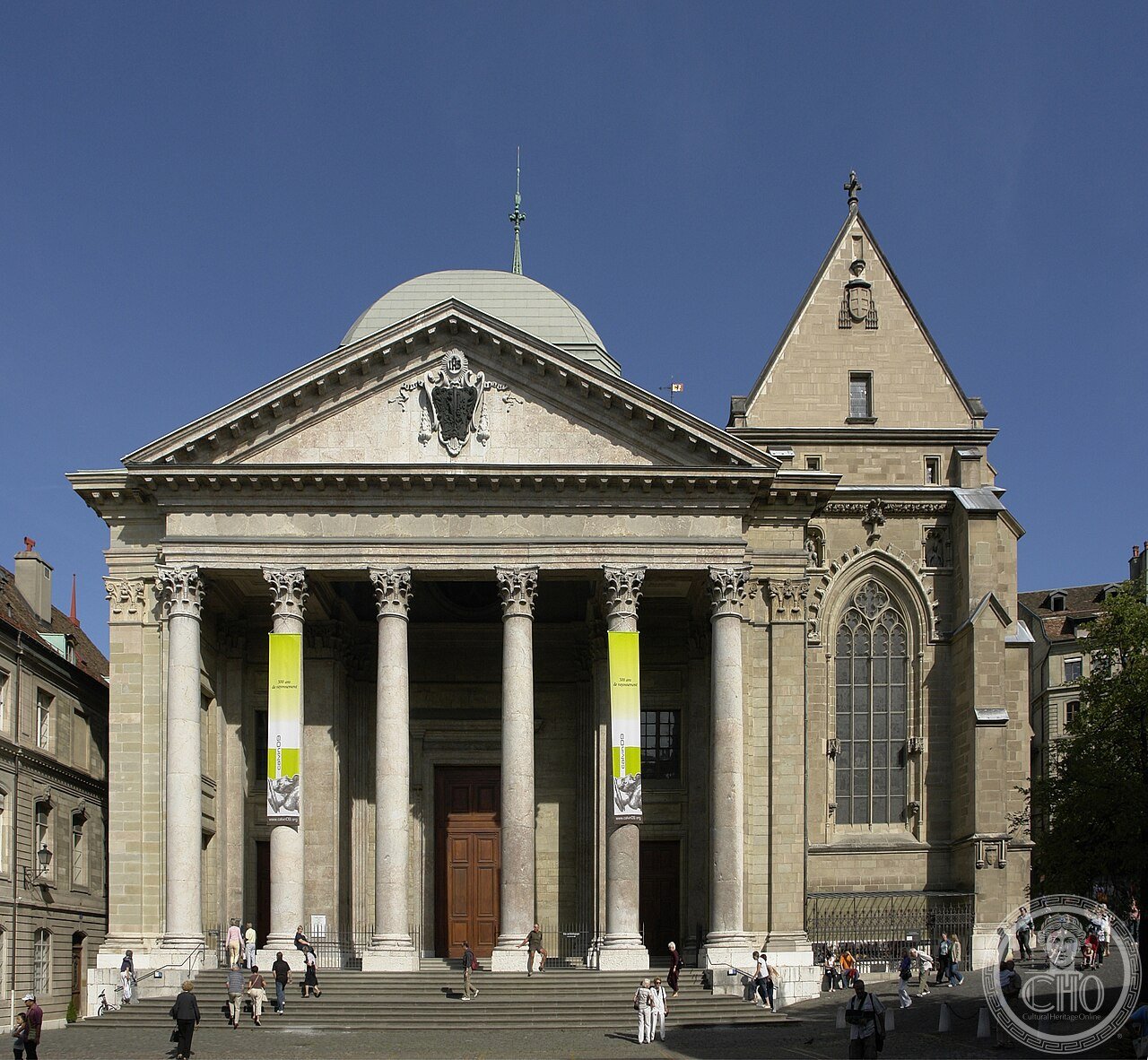
Durante la Riforma, le folle smantellarono altari, distrussero statue e dipinti, frantumarono gli organi — fusi per farne calici e vasi per la comunione. Nel 1541 Giovanni Calvino, tornato dall’esilio di Strasburgo, prese possesso del pulpito di San Pietro e vi predicò fino alla morte, nel 1564. Il pulpito e la sedia su cui sedeva restano ancora oggi al loro posto, nella cattedrale che dal 1535 è la chiesa principale del protestantesimo ginevrino.
About St. Pierre Cathedral, Geneva
The present St. Pierre Cathedral was begun around 1160 in Gothic style, with construction finally completed in 1230. Since 1535, it has served as the principal church of the Protestant Church of Geneva and one of the central sites of the Protestant Reformation in the French-speaking world. During the Reformation, crowds dismantled the cathedral’s numerous altars, smashed the statues and paintings that adorned them, shattered the organs — later melted down and recast into vases and communion cups — and removed the rood screen and jubé that had traditionally separated nave from choir. John Calvin arrived in Geneva in 1541, following his period of exile in Strasbourg, and remained associated with St. Pierre Cathedral until his death in 1564. In 1543, the pulpit was placed in the exact position where it still stands today, built into the wall atop a set of stairs; the chair Calvin used while waiting to preach also survives in place. Beneath the cathedral, an accessible archaeological site preserves layers of the building’s history going back to antiquity, including the 1st-century-BC tomb of an ancient Allobrogian chieftain — physical evidence of the pre-Christian settlement that long predated the cathedral itself.
Key facts
- Construction: begun c. 1160, completed 1230, Gothic style
- Protestant church: since 1535, principal church of the Protestant Church of Geneva
- Reformation iconoclasm: altars dismantled, statues and paintings destroyed, organs melted down for communion vessels, rood screen removed
- John Calvin: arrived 1541 from exile in Strasbourg; preached at St. Pierre until his death in 1564
- Calvin’s pulpit and chair: pulpit placed in its present position in 1543; both pulpit and chair survive in situ
- Archaeological site: beneath the cathedral, including a 1st-century-BC Allobrogian chieftain’s tomb
History
John Calvin’s twenty-three-year association with St. Pierre Cathedral, from his 1541 return from Strasbourg exile until his 1564 death, situates the building at the very centre of the Reformed (Calvinist) branch of the Protestant Reformation, whose theological and institutional development Calvin shaped more directly from this pulpit than from almost any other single location in Europe — Geneva’s transformation into the “Protestant Rome” of Reformed Christianity during this period owed directly to Calvin’s sustained preaching and institutional leadership centred on this specific building. The systematic Reformation-era destruction of the cathedral’s Catholic-era altars, statues, and organs reflects the broader iconoclastic violence that swept Reformed Protestant territories during the 16th century, driven by theological objections to devotional imagery understood as idolatrous — Geneva’s particularly thorough iconoclasm, including the notable detail of melted-down organ pipes recast as communion vessels, reflects the city’s status as an unusually committed centre of Reformed doctrinal rigour under Calvin’s influence.
The archaeological site beneath the cathedral, preserving the tomb of a 1st-century-BC Allobrogian chieftain, connects the building to Geneva’s pre-Roman Gallic history, situating the site’s continuous significance across more than two thousand years — from Celtic-era Allobrogian settlement, through Roman and early Christian building phases, to the medieval Gothic cathedral and its subsequent Reformation-era transformation into a Reformed Protestant church.
What you see
Calvin’s pulpit and chair, preserved in their historic positions since 1543, offer visitors direct physical access to one of the Reformation’s most consequential sites of religious leadership. The archaeological site beneath the cathedral, with its Allobrogian tomb and layered building history, extends the site’s significance back over two millennia. The cathedral’s neoclassical west facade, added later over the Gothic structure, gives the building a distinctive architectural contrast between its 18th-century entrance and its medieval core.
Practical information
- Opening hours: generally open daily, check current hours before visiting; small fee for the archaeological site and tower
- Address: Cour de Saint-Pierre 8, 1204 Geneva, Switzerland
Getting there
Geneva has direct rail connections from Lausanne (approximately 40 minutes) and Zurich (approximately 2.5 hours). The cathedral stands in Geneva’s old town (Vieille-Ville), a short walk from the lakefront. GPS: 46.2011° N, 6.1485° E.
Nearby
- Geneva old town (Vieille-Ville) — surrounding the cathedral, with the International Museum of the Reformation
- Reformation Wall (Mur des Réformateurs) — a monumental memorial to Calvin and other Reformation leaders, in the nearby Parc des Bastions
- Lake Geneva (Lac Léman) — the lakefront, a short walk from the old town
Sources
- Wikipedia — “St. Pierre Cathedral” (en.wikipedia.org)
- Fondation des Clefs de St-Pierre — “The modern era” (cathedrale-geneve.ch)
- Ligonier Ministries — “St. Pierre’s Cathedral” (learn.ligonier.org)
Find it on the map
See this place and what’s around it →📷 Become a Cultural Heritage Online photographer
Share your photos of places: they stay published under your name as the author. The more they're seen, the more you get noticed — and soon a contest will reward the most appreciated photos.
Log in or sign up free to add a photo