
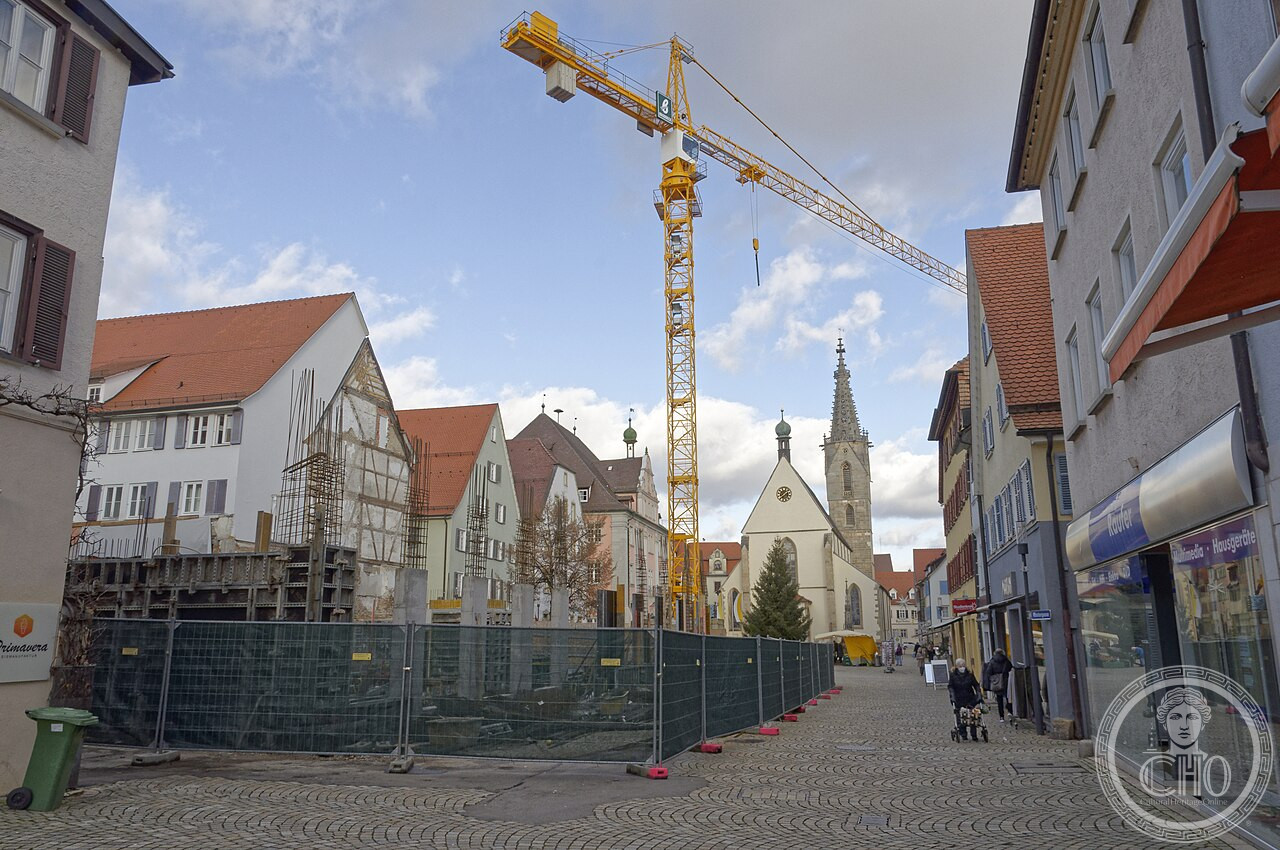
Nel 1280 sorgeva qui una cappella al servizio del villaggio di Sülchen, poi assorbito dalla città di Rottenburg. Un incendio nel 1644 distrusse l’edificio medievale; la ricostruzione, completata nel 1655, lo trasformò in una chiesa barocca. Solo nel 1821, con la bolla papale “De salute animarum”, divenne cattedrale della neonata diocesi di Rottenburg, oggi Rottenburg-Stoccarda.
About Rottenburg Cathedral
Rottenburg Cathedral (Dom St. Martin), dedicated to Martin of Tours, began as a chapel built in 1280, serving as the parish church of the village of Sülchen before that settlement was incorporated into the growing city of Rottenburg am Neckar. Its most distinctive surviving medieval feature is the late Gothic openwork spire, 58 metres tall, which remains the cathedral’s most prominent visual landmark and an iconic symbol of Rottenburg’s skyline. A fire in 1644 devastated the building, and a fundamental reconstruction — completed on 8 September 1655 — transformed it into a Baroque church, with strengthened pillars supporting the rebuilt structure. The diocese itself has a comparatively recent history: its first vicariate seat was at Ellwangen Abbey, moved to Rottenburg in 1817, and the Diocese of Rottenburg was formally established on 16 August 1821 by the papal bull “De salute animarum,” carved from territory of the suppressed Diocese of Konstanz; Johann Baptist Keller was enthroned as its first bishop in 1828. Since then, the cathedral has undergone a further remarkable sequence of stylistic renovations reflecting each era’s prevailing taste — Neo-Gothic in 1867/1868 and 1897, Neo-Baroque in 1927/1928, Purist in 1955/1956, and Neo-Baroque/Eclectic again in 1977/1978 — with the most recent renovation, carried out from 2001 to 2003 by the Aachen architectural firm Hahn Helten, marking the diocese’s 175th anniversary.
Key facts
- Origins: chapel built 1280, serving the village of Sülchen before its incorporation into Rottenburg
- Late Gothic spire: openwork design, 58 metres tall, the cathedral’s most prominent feature
- 1644 fire and rebuild: Baroque reconstruction completed 8 September 1655
- Diocese established: 16 August 1821, by papal bull “De salute animarum,” from territory of the suppressed Diocese of Konstanz; first bishop Johann Baptist Keller enthroned 1828
- Repeated stylistic renovation: Neo-Gothic (1867/1868, 1897), Neo-Baroque (1927/1928), Purist (1955/1956), Neo-Baroque/Eclectic (1977/1978)
- Most recent renovation: 2001-2003, by Hahn Helten (Aachen), marking the diocese’s 175th anniversary
- Current status: cathedral of the Diocese of Rottenburg-Stuttgart
History
The cathedral’s origin as a modest village parish chapel, only later inheriting cathedral status through the essentially administrative act of a new diocese’s 1821 creation, illustrates a pattern distinct from the ancient Ottonian and Carolingian episcopal foundations common elsewhere in Germany: rather than a purpose-built seat of ancient ecclesiastical power, Rottenburg’s cathedral status reflects the early-19th-century reorganisation of Catholic dioceses across German territories following the Napoleonic-era secularisations and territorial reshuffling that dissolved older sees like Konstanz and required new administrative arrangements for Catholic populations within the emerging Kingdom of Württemberg.
The building’s unusually dense sequence of stylistic renovations across the 19th and 20th centuries — cycling through Neo-Gothic, Neo-Baroque, Purist, and Neo-Baroque/Eclectic phases within roughly a century — reflects both the diocese’s continued institutional investment in its cathedral as a symbol of Catholic identity within a historically mixed-confession region of southern Germany, and the broader pattern by which relatively young cathedrals, lacking centuries of settled medieval architectural identity, often underwent more frequent and more visible stylistic revision than older, more architecturally “fixed” cathedrals elsewhere.
What you see
The 58-metre late Gothic openwork spire, the cathedral’s oldest and most visually distinctive surviving element, rewards attention from across Rottenburg’s Marktplatz, where the building forms the square’s dominant landmark. The Baroque interior, product of the 1644-1655 post-fire reconstruction and subsequently modified across the later stylistic renovation cycles, offers a legible record of the cathedral’s repeated 19th- and 20th-century updates. The 2001-2003 renovation’s specific contributions mark the building’s most recent significant intervention.
Practical information
- Opening hours: generally open daily, check current hours before visiting; free admission
- Address: Marktplatz 1, 72108 Rottenburg am Neckar
Getting there
Rottenburg am Neckar has direct rail connections from Tübingen (approximately 15 minutes) and Stuttgart (approximately 1 hour). By car, Rottenburg sits on the B28/B27 road network. The cathedral stands on the Marktplatz in the historic centre. GPS: 48.4774° N, 8.9342° E.
Nearby
- Rottenburg Marktplatz — the historic market square surrounding the cathedral
- Diözesanmuseum Rottenburg — the diocesan museum, with material on the Sülchen church’s early history
- Tübingen — approximately 15 minutes by train; historic university town on the Neckar
Sources
- Wikipedia — “Rottenburg Cathedral” and “Roman Catholic Diocese of Rottenburg-Stuttgart” (en.wikipedia.org)
- Diözesanmuseum Rottenburg — “The history of the Sülchen church” (dioezesanmuseum-rottenburg.de)
Find it on the map
See this place and what’s around it →📷 Become a Cultural Heritage Online photographer
Share your photos of places: they stay published under your name as the author. The more they're seen, the more you get noticed — and soon a contest will reward the most appreciated photos.
Log in or sign up free to add a photo