
The Dreihasenfenster, the “window of the three hares”, shows three animals set in a triangle: each has two ears, but in the design only three can be seen in all, shared in pairs. Carved in red sandstone in the early sixteenth century, it remains one of the best-known visual puzzles in German art, suspended above a building whose roots reach back to Charlemagne’s palace chapel of 777.
About Paderborn Cathedral
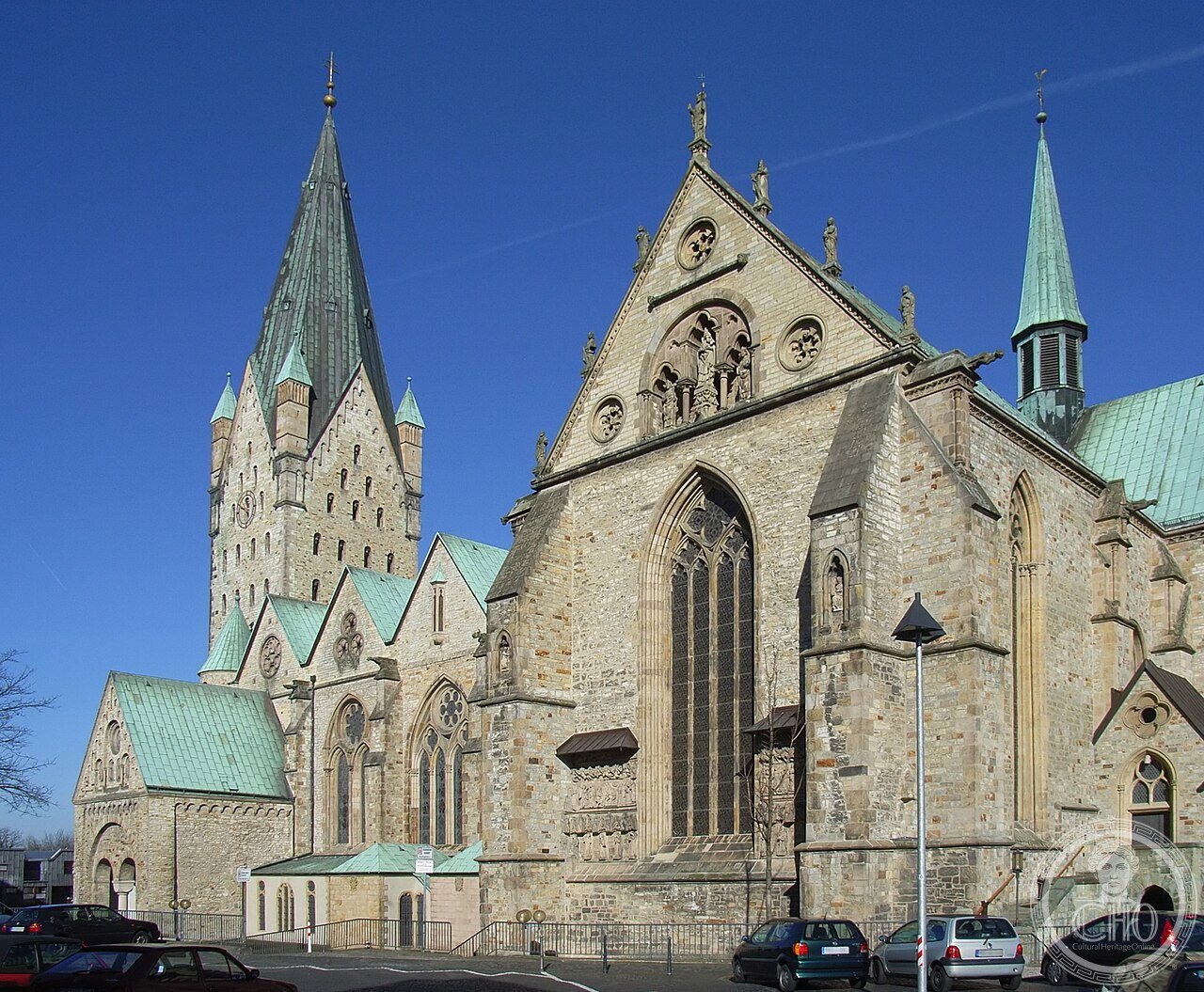
Paderborn Cathedral occupies a site with ecclesiastical structures dating to 777, when Charlemagne had an imperial palace (Kaiserpfalz) built near the springs of the river Pader, with a palace chapel dedicated to Christ and Saint Brigit attached from the start. In 799, Pope Leo III met Charlemagne at Paderborn and personally consecrated an altar to Saint Stephen. A second cathedral was consecrated in 1015 under Bishop Meinwerk, but was destroyed by fire in 1058; his nephew Bishop Imad then oversaw a significantly larger third cathedral, with two transepts, already very similar in plan to today’s building — its crypt, still standing, dates from around 1100. A complete reconstruction began in the 13th century, combining late Romanesque and early Gothic elements and finishing with High Gothic features by the century’s end, producing the Romanesque-Gothic hybrid visible today: 104 metres long, 52 metres wide, 28 metres high, with a west tower rising 93 metres. Saint Bartholomew’s Chapel, built after 1015 reportedly by Greek monks, adjoins the cathedral. Its most visually enigmatic feature is the Dreihasenfenster (Window of the Three Hares), carved from red Weser sandstone in the early 16th century and showing three hares in circular motion arranged in a triangle, each hare drawn with two ears yet only three ears visible in the whole composition — a shared-ear optical trick whose original panel is preserved in the adjacent Diocesan Museum. That museum also houses the Romanesque Imad Madonna from the 1050s, one of the oldest surviving depictions of Mary in Western art, among more than 12,000 artefacts. The cathedral was elevated to an archdiocese in 1930, suffered severe bombing damage in 1945, was reconstructed through the 1950s, and underwent major restoration from 1978 to 1981.
Key facts
- Earliest structure: palace chapel attached to Charlemagne’s Kaiserpfalz, from 777; Pope Leo III consecrated an altar here in 799
- Second cathedral: consecrated 1015 under Bishop Meinwerk; destroyed by fire 1058
- Third cathedral: built under Bishop Imad after 1058, already close to the present plan; crypt dates to c. 1100
- 13th-century rebuilding: late Romanesque to High Gothic; present dimensions 104m long, 52m wide, 28m high; west tower 93 metres
- Dreihasenfenster: early 16th-century red Weser sandstone window depicting three hares sharing three ears among them, in the cathedral cloister
- Imad Madonna: Romanesque sculpture, 1050s, one of the oldest Marian depictions in Western art, in the Diocesan Museum
- Setting: above the source springs of the Pader, Germany’s shortest river at roughly 4 km
- Modern history: archdiocese since 1930; severely bomb-damaged 1945, rebuilt through the 1950s, major restoration 1978-1981
History
Charlemagne’s decision to build his Kaiserpfalz at Paderborn specifically, and Pope Leo III’s personal 799 visit to consecrate an altar there, situate the site within one of early medieval Europe’s genuinely pivotal diplomatic episodes: the 799 Paderborn meeting between pope and emperor took place amid the political crisis that would culminate the following year in Leo III crowning Charlemagne Holy Roman Emperor in Rome, making Paderborn an unusually direct physical link to the negotiations preceding that epochal coronation. The cathedral’s subsequent building history — a 1015 structure destroyed by fire in 1058, immediately replaced by Bishop Imad’s larger third cathedral already anticipating the present plan — reflects a pattern of rapid, ambitious rebuilding following disaster that several major German cathedrals of the same period display, suggesting well-resourced episcopal patronage able to respond quickly to structural loss.
The Dreihasenfenster’s genuinely puzzling shared-ear design, appearing at cathedrals, churches, and synagogues across a surprisingly wide geographic range from England to China, situates Paderborn’s specific 16th-century example within one of art history’s more intriguing recurring visual motifs, whose ultimate origin and precise symbolic meaning remain genuinely debated among scholars despite the motif’s wide distribution. The Imad Madonna’s mid-11th-century date, considered among the oldest surviving Marian depictions in Western art, gives Paderborn’s Diocesan Museum an object of genuinely exceptional art-historical significance independent of the cathedral building itself.
What you see
The Dreihasenfenster, in the cathedral cloister, rewards close visual inspection specifically to trace how the three hares share only three ears among them — a detail easy to miss without deliberately looking for it. The cathedral’s long architectural history, from the 777 palace chapel through the 1015, post-1058, and 13th-century rebuilding phases, gives the 93-metre west tower and the building’s Romanesque-Gothic combination a legible multi-century record. The adjacent Diocesan Museum, housing the Imad Madonna and over 12,000 further artefacts, extends the site’s significance well beyond the cathedral’s own walls.
Practical information
- Opening hours: generally open daily, check current hours before visiting; free admission to the cathedral, Diocesan Museum has separate admission
- Address: Domplatz 3, 33098 Paderborn
Getting there
Paderborn has direct rail connections from Hanover (approximately 1.5 hours) and Dortmund (approximately 1 hour). By car, Paderborn sits on the A33/A44 motorway network. The cathedral stands on Domplatz above the Pader springs. GPS: 51.7190° N, 8.7558° E.
Nearby
- Pader springs (Paderquellgebiet) — over 200 springs feeding Germany’s shortest river, directly beside the cathedral
- Kaiserpfalz Paderborn — reconstructed Carolingian imperial palace, a short walk away
- Externsteine — approximately 30 minutes by car; a striking sandstone rock formation with medieval religious carvings
Sources
- Wikipedia — “Paderborn Cathedral” (en.wikipedia.org)
- Ancient History Sites — “Paderborn Cathedral: Medieval Episcopal Church” (ancient-history-sites.com)
- Restexpert — “Three hares in the Paderborn Cathedral” (tourism.restexpert.com)
Find it on the map
See this place and what’s around it →📷 Become a Cultural Heritage Online photographer
Share your photos of places: they stay published under your name as the author. The more they're seen, the more you get noticed — and soon a contest will reward the most appreciated photos.
Log in or sign up free to add a photo