
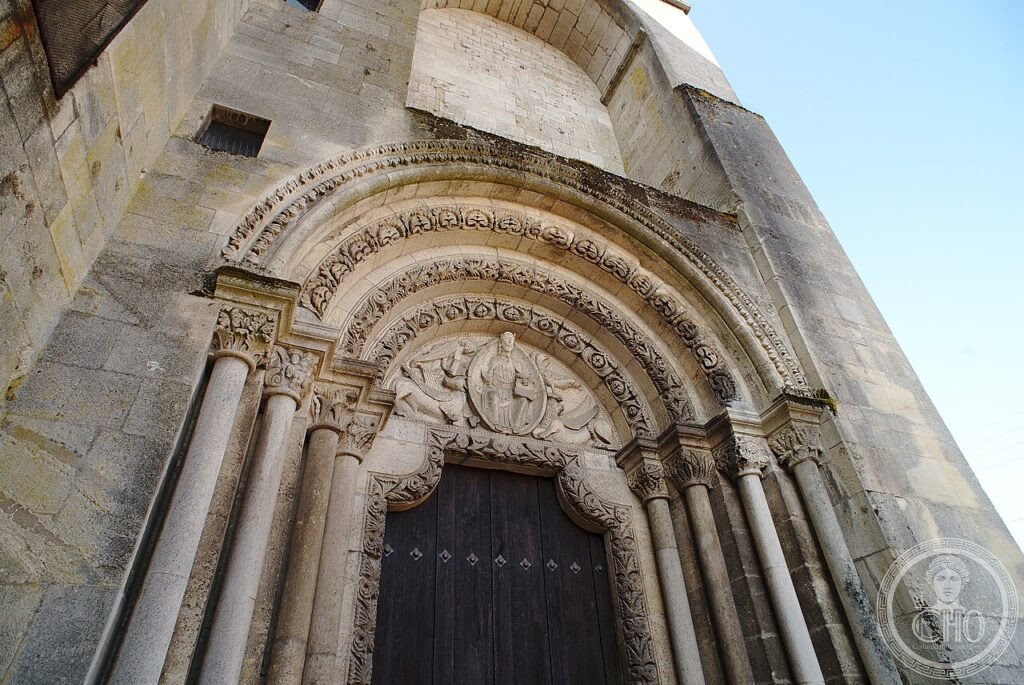
Built from 990 on a Rhenish Romanesque plan, among the oldest in Lorraine, the cathedral of Verdun stands in a commanding position above the valley of the Meuse — a position that turned it, during the battle of 1916, into a target for German artillery and, at the same time, into an observation post and barracks for the French troops.
At a glance
Verdun Cathedral (Cathédrale Notre-Dame), dedicated to the Virgin Mary, was built from 990 following the Romanesque-Rhenish plan, making it the oldest cathedral in Lorraine and one of the oldest in Europe. Its elevated position overlooking the Meuse valley, an asset in peacetime for its visibility and prestige, became a direct liability during the First World War: throughout the 1916 Battle of Verdun, one of the war’s longest and most devastating engagements, the cathedral’s prominent hilltop position made it a target for German artillery, and bombardment caused the roof to collapse — leaving a metre of rubble on the ground — and partially destroyed the towers and cloister. Despite this damage, the building continued to serve a functional military role throughout the battle, used by French forces as an observation post over the Meuse valley and, at various points, as garrison quarters for soldiers. Post-war restoration, carried out by architects A. Ventre and M. Delangle from 1919 to 1935, rebuilt the destroyed sections and, in clearing wartime rubble, unexpectedly rediscovered the cathedral’s 12th-century crypt, whose thirteen carved pillars now depict scenes both from the city’s religious history and from the 1916 battle itself.
Key facts
- Foundation: from 990, Romanesque-Rhenish plan — the oldest cathedral in Lorraine and one of the oldest in Europe
- 1916 Battle of Verdun: the cathedral’s elevated hilltop position made it a target for German artillery; bombardment collapsed the roof (leaving a metre of rubble) and partially destroyed the towers and cloister
- Wartime military use: despite the damage, the cathedral continued functioning as an observation post over the Meuse valley and, at times, as garrison quarters for French troops throughout the battle
- Post-war restoration: 1919-1935, architects A. Ventre and M. Delangle; destroyed sections rebuilt and 18th-century-concealed elements uncovered
- 12th-century crypt: rediscovered during post-war rubble clearance; its 13 carved pillars depict both the city’s religious history and scenes from the 1916 Battle of Verdun
History
Verdun’s cathedral, among the oldest surviving religious buildings in Lorraine, occupied its hilltop site for over 900 years before the specific circumstances of 1916 turned that prominent, historically prestigious position into a direct military liability: the Battle of Verdun, fought from February to December 1916 and remembered as one of the longest and costliest single battles of the First World War, subjected the city to sustained and intense German bombardment throughout, and the cathedral’s height and visibility over the surrounding Meuse valley terrain made it an inevitable target regardless of any explicit intention to destroy a religious monument specifically. The resulting damage — a collapsed roof burying the interior under a metre of rubble, and partial destruction of the towers and cloister — was severe, yet the building’s continued functional use by French forces as an observation post and garrison space throughout the battle demonstrates how thoroughly total industrial warfare of this scale absorbed even damaged religious buildings into direct military infrastructure.
The post-war restoration under architects Ventre and Delangle, running from 1919 to 1935, exemplifies the broader pattern of careful, historically minded reconstruction undertaken across northeastern France in the decades following the First World War’s devastating impact on the region’s built heritage, and the specific rediscovery of the cathedral’s 12th-century crypt during rubble clearance — a genuine archaeological find made possible only by the destruction itself — added a significant medieval element to the building’s documented history that had been lost to view for centuries. The decision to carve scenes from the 1916 battle directly onto the crypt’s medieval-associated pillars, alongside more traditional religious historical imagery, makes the restored crypt itself a deliberate memorial space, physically linking the cathedral’s ancient religious history to the specific 20th-century catastrophe that both damaged and, through that rediscovery, partially revealed it.
What you see
The cathedral’s Romanesque-Rhenish plan, one of the oldest surviving examples of the type in Lorraine, gives the building’s overall massing and structure its defining historic character, restored to its documented pre-war form across the 1919-1935 reconstruction. The rediscovered 12th-century crypt is the essential single destination for visitors, its thirteen carved pillars offering a rare combination of medieval religious iconography and direct 20th-century battle commemoration within the same decorative programme — a genuinely unusual pairing that gives the crypt significance well beyond its architectural age alone. The cathedral’s organ, notable enough to be documented in specialist organ heritage sources, and its programme of concerts and exhibitions, extend the building’s role beyond a purely historical monument into an active cultural venue.
Practical information
- Opening hours: Monday-Saturday, 9:00-12:00 and 14:00-18:00; free admission
- Guided tours: available for groups, approximately €5 per person
- Address: 11 Rue Président Poincaré, 55100 Verdun
Getting there
Verdun is reachable by train from Paris (via Châlons-en-Champagne or Metz, roughly 2.5-3 hours total) and from Metz directly (approximately 1 hour). By car, Verdun sits near the A4 motorway (Paris-Strasbourg). The cathedral stands in the historic centre, overlooking the Meuse. GPS: 49.1595° N, 5.3824° E.
Nearby
- Verdun battlefield sites and memorials — surrounding the city; the Ossuaire de Douaumont, Fort de Vaux, and Fort de Douaumont are among the most significant First World War memorial sites in France
- Citadelle souterraine de Verdun — in the city centre; an underground citadel used as a military headquarters and shelter during the 1916 battle, now open to visitors
- Verdun historic centre — immediately surrounding the cathedral, on the Meuse river
Sources
- Communauté d’Agglomération du Grand Verdun — official heritage information (verdun.fr)
- Tourisme Verdun — official visitor portal (tourisme-verdun.com)
- Visit Grand Est — regional visitor information (visitgrandest.com)
- Wikipedia — “Cathédrale Notre-Dame de Verdun” (fr.wikipedia.org)
Find it on the map
See this place and what’s around it →📷 Become a Cultural Heritage Online photographer
Share your photos of places: they stay published under your name as the author. The more they're seen, the more you get noticed — and soon a contest will reward the most appreciated photos.
Log in or sign up free to add a photoIs this page about you?
This page is read by travellers and heritage enthusiasts who find it on Google. Tell us how you are connected to this place and we will take it from there.