
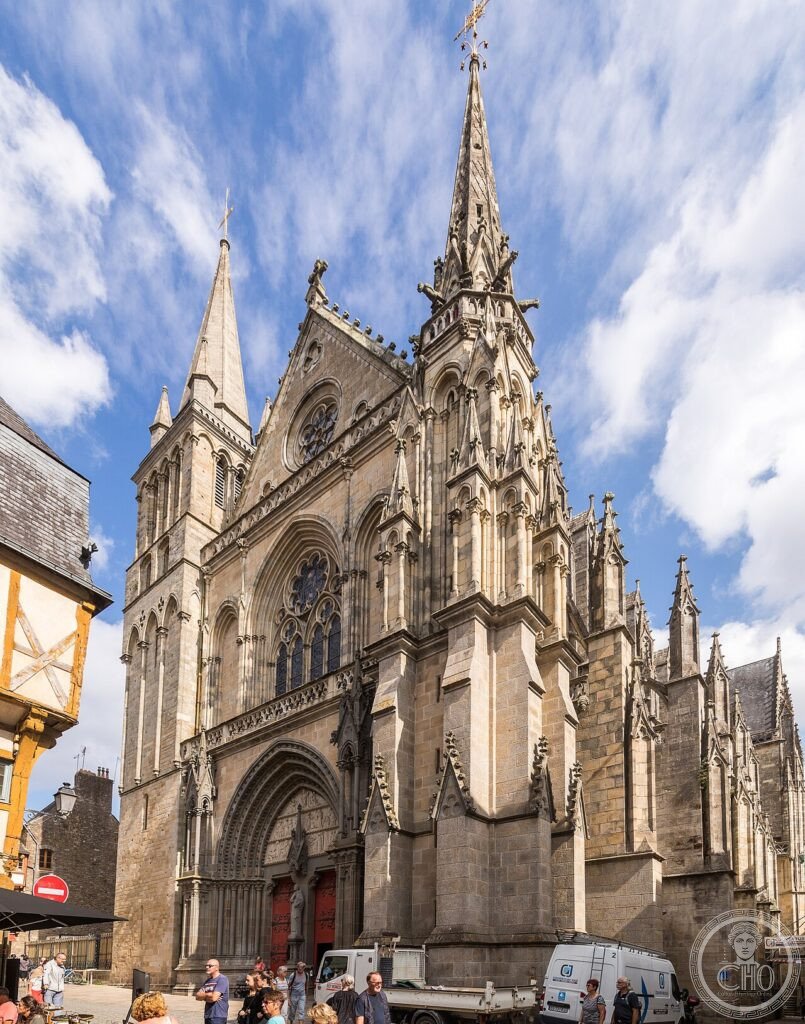
Un predicatore domenicano spagnolo morì qui d’esaurimento nel 1419, dopo un solo anno di missione in Bretagna. La sua tomba attirò folle tali di pellegrini che la vecchia chiesa romanica non riuscì più a contenerli: nacque così, tra il 1454 e il 1520, la cattedrale gotica che si vede oggi.
At a glance
Vannes Cathedral (Cathédrale Saint-Pierre) traces its origins to a first cathedral destroyed in 919 during Norman invasions of Brittany, rebuilt in Romanesque style around 1020 under Bishop Judicaël and his brother Geoffrey I, Duke of Brittany. The Gothic reconstruction visible today, carried out between 1454 and 1520 under Bishop Yves de Pontsal, was driven by a specific and unusual cause: the death in Vannes in 1419 of the Dominican preacher Saint Vincent Ferrier, sent to Brittany by Duke Jean V to revive religious faith, who died of exhaustion after just one year of mission and was buried in the cathedral’s choir. His tomb quickly drew pilgrim crowds large enough to overwhelm the existing Romanesque church, prompting the extensive Gothic rebuilding that followed — funded in part by dedicating one-third of the offerings made at the tomb itself to the reconstruction, an arrangement agreed between Bishop Amaury de La Motte and the cathedral chapter as early as 1419.
Key facts
- Origins: earlier cathedral destroyed 919 by Norman invaders; rebuilt Romanesque c. 1020 under Bishop Judicaël and Duke Geoffrey I of Brittany
- Saint Vincent Ferrier: Dominican preacher from Valencia, sent to Brittany in 1418 by Duke Jean V; died in Vannes 5 April 1419 after just one year of mission; buried in the cathedral choir; canonised 1455 by Pope Callixtus III
- Gothic reconstruction: 1454-1520, under Bishop Yves de Pontsal, driven directly by pilgrim pressure at Vincent Ferrier’s tomb; partly funded by a third of tomb offerings, agreed 1419
- Tomb location today: moved several times over the centuries — to the Rotunda of the Holy Sacrament in 1956, then to the north transept, where it has stood since May 2018
- Current restoration: the cathedral is under liturgical closure for restoration works from January 2025 through 2027; entry via Place Saint-Pierre and a temporary passage still gives access to the restored portion of the building
History
Vannes’s medieval religious history follows a pattern familiar across Brittany and northern France: an early cathedral destroyed by Norman raiders in the 10th century, rebuilt in the Romanesque idiom of the following century, and eventually superseded by a larger Gothic structure once the earlier building could no longer meet the demands placed on it. What distinguishes Vannes specifically is the precise, well-documented cause of that later Gothic rebuilding: the sudden and unanticipated pilgrimage pressure generated by the death and burial of Saint Vincent Ferrier, a Dominican preacher originally from Valencia whose reputation for eloquent, urgent preaching had already made him a significant figure across late medieval Europe before Duke Jean V of Brittany specifically recruited him to revive religious observance in the duchy in 1418. Ferrier’s death after barely a year in Brittany, and his rapid canonisation in 1455, transformed his tomb into a major regional pilgrimage destination essentially overnight, generating the kind of sustained visitor pressure that directly explains the scale and timing of the subsequent 1454-1520 Gothic reconstruction — a building project whose funding arrangement, dedicating a fixed portion of pilgrim offerings at the tomb itself to the reconstruction, makes an unusually direct and traceable link between a specific cult of sainthood and a specific architectural campaign.
The tomb’s own subsequent history — relocated within the cathedral several times across the 20th and 21st centuries, most recently to the north transept in May 2018 — reflects continuing, active management of the pilgrimage site rather than a static historical relic, and the cathedral’s current 2025-2027 restoration closure, while limiting full access, still permits visitors to reach the restored portion of the building via a temporary entrance route, indicating the ongoing practical balance diocesan authorities are managing between conservation work and continued pilgrim and visitor access.
What you see
The Gothic nave and choir, rebuilt across the 1454-1520 campaign, present a Breton Gothic architectural character shaped directly by the practical need to accommodate large pilgrim crowds around Vincent Ferrier’s tomb, a consideration that influenced circulation space within the building as much as pure architectural ambition. The tomb itself, in its current north transept location since 2018, remains the building’s devotional centrepiece and the direct physical link to the cathedral’s specific rebuilding history. Given the ongoing 2025-2027 restoration works, visitors should check current access arrangements before planning a visit focused on specific interior features, since parts of the building may be temporarily inaccessible.
Practical information
- Opening hours: generally 8:30-19:00 daily (some sources cite 10:30-18:00); confirm current hours given ongoing restoration
- Restoration notice: liturgically closed January 2025-2027 for restoration works; entry via Place Saint-Pierre through a temporary passage still accesses the restored section
- Admission: free
- Address: Place Saint-Pierre, intra-muros historic centre, 56000 Vannes
Getting there
Vannes has direct rail connections from Paris (via Rennes or Redon, approximately 2.5-3 hours total), Rennes (approximately 1 hour), and Nantes (approximately 1 hour). The cathedral stands within Vannes’s walled historic centre (intra-muros), fully walkable and largely pedestrianised; visitors arriving by car should park at the edge of the intra-muros zone and continue on foot. GPS: 47.6579° N, -2.7568° E.
Nearby
- Vannes intra-muros ramparts and half-timbered houses — surrounding the cathedral; one of the best-preserved walled medieval town centres in Brittany
- Golfe du Morbihan — a short drive from Vannes; a scenic coastal inlet dotted with islands, a major regional natural and touring attraction
- Carnac megaliths — approximately 45 minutes by car; one of the world’s largest concentrations of prehistoric standing stones
Sources
- Cathédrale de Vannes / Paroisse Saint-Pierre — official visitor and history portal (cathedrale-vannes.fr)
- Ville de Vannes — official heritage information (mairie-vannes.fr)
- Bretagne Tourisme — regional visitor information (bretagne-tourisme.com)
- Wikipedia — “Cathédrale Saint-Pierre de Vannes” and “Vincent Ferrer” (fr.wikipedia.org, en.wikipedia.org)
Find it on the map
See this place and what’s around it →📷 Become a Cultural Heritage Online photographer
Share your photos of places: they stay published under your name as the author. The more they're seen, the more you get noticed — and soon a contest will reward the most appreciated photos.
Log in or sign up free to add a photoIs this page about you?
This page is read by travellers and heritage enthusiasts who find it on Google. Tell us how you are connected to this place and we will take it from there.