
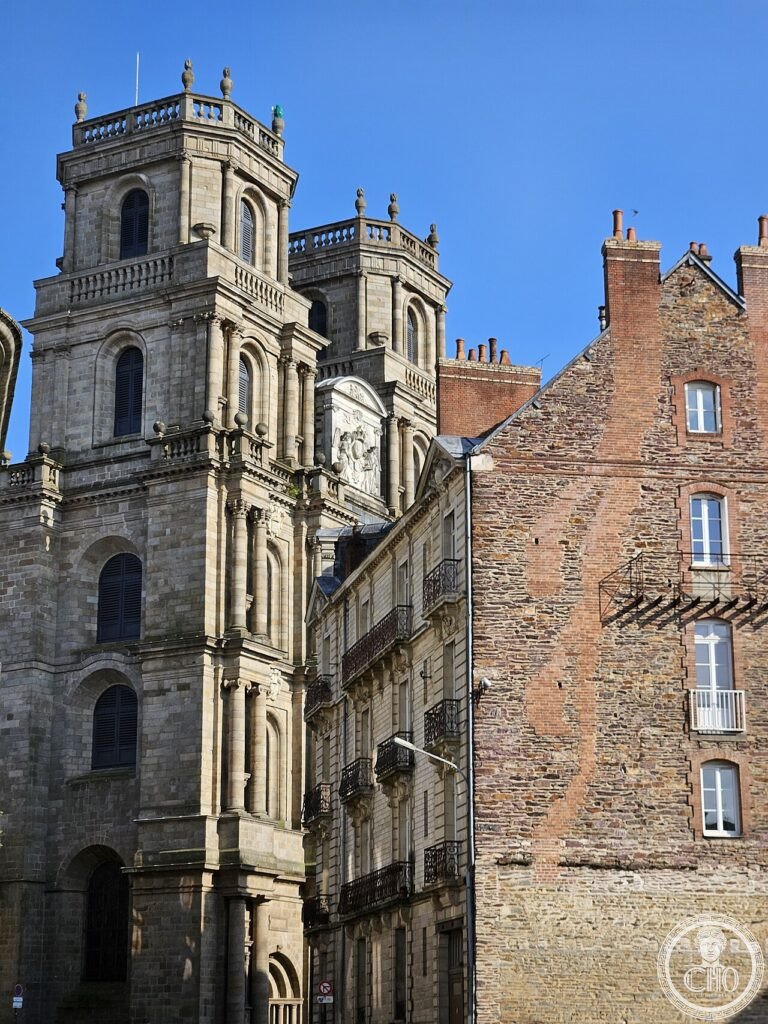
Begun before the Revolution, interrupted by the Revolution itself and finally imposed by Napoleon’s decree in 1811: the cathedral of Rennes is one of the few in France whose completion was, literally, an imperial order.
At a glance
Rennes Cathedral (Cathédrale Saint-Pierre) is unusual among major French cathedrals for the sheer disruption of its construction history: rebuilding began in 1787, was interrupted by the French Revolution, and was only guaranteed completion by an imperial decree of 19 April 1811, in which Napoleon specifically ordered that Rennes’s cathedral be finished. Built to designs by the Nantes architect Mathurin Crucy, who died in 1826 before the work was complete, and carried through to final completion in 1845 under architect Richelot, the cathedral presents an almost entirely Neoclassical interior — a striking departure from the Gothic or Romanesque style more commonly associated with French cathedrals — anchored by a main nave supported on 44 Ionic granite columns finished in stucco to imitate marble.
Key facts
- Reconstruction: begun 1787; interrupted by the French Revolution; guaranteed completion by imperial decree of Napoleon, 19 April 1811; completed 1845
- Architects: Mathurin Crucy of Nantes (designs; died 1826 before completion), work continued and finished by architect Richelot
- Nave: 44 Ionic columns in granite, finished with stucco imitating marble, giving the interior a sober, harmonious Neoclassical character unusual among French cathedrals
- 1869-1873 decorative campaign: architect Langlois redid the vaults, redressed the columns, and designed an extensive polychrome painted decorative scheme, commissioned under Archbishop Godefroy Brossay-Saint-Marc, who brought in leading contemporary artists
- Treasures: a rare 15th-century Antwerp (Flemish) altarpiece, restored after a serious theft in 2007, along with significant goldsmith work
History
Rennes Cathedral’s construction history reflects, more directly than most French cathedrals, the specific political upheavals of late-18th and early-19th-century France: the decision to rebuild the earlier cathedral from 1787 came shortly before the French Revolution disrupted ecclesiastical building projects across the country, and the fact that Rennes’s rebuilding was eventually completed at all owed directly to Napoleon’s personal 1811 decree mandating its finish — a rare instance of a French cathedral’s construction being explicitly guaranteed by imperial political authority rather than proceeding solely under episcopal or diocesan initiative. Architect Mathurin Crucy’s Neoclassical design, continued after his 1826 death by Richelot through to the building’s 1845 completion, gave Rennes an interior aesthetic markedly different from the Gothic revival or historicist styles more commonly favoured for French cathedral projects of the same broad period, instead presenting a sober, classically proportioned nave whose 44 Ionic granite columns owe more to Greco-Roman architectural vocabulary than to medieval French tradition.
The cathedral’s decorative programme was substantially enriched later in the 19th century under Archbishop Godefroy Brossay-Saint-Marc, whose patronage brought leading contemporary artists to the building and included architect Langlois’s 1869-1873 campaign redoing the vaults and designing an extensive polychrome painted scheme across the previously more austere Neoclassical interior — a layering of Second Empire-era decorative ambition onto the earlier Neoclassical structural shell. The cathedral’s 15th-century Flemish altarpiece, among its most significant surviving treasures, suffered a serious theft in 2007 before being recovered and restored, an episode that remains part of the building’s more recent institutional history.
What you see
The nave’s 44 Ionic granite columns, stuccoed to resemble marble, are the building’s defining visual feature, creating a sense of classical order and harmony distinct from the more vertically emphatic, structurally expressive naves of Gothic cathedrals elsewhere in France. The polychrome painted decoration added by Langlois in the 1869-1873 campaign layers a richer, more elaborate visual programme onto this Neoclassical framework, giving the interior a combination of classical restraint and 19th-century decorative ambition. The 15th-century Flemish altarpiece, restored after its 2007 theft, remains among the cathedral’s most significant single artworks, alongside further goldsmith and liturgical treasures displayed within the building.
Practical information
- Opening hours: Monday-Saturday 9:30-18:00, Sunday 14:00-18:00
- Guided tours: Wednesdays in summer, organised by the Rennes tourist office
- Address: Rue de la Monnaie / Rue de la Psalette, 35000 Rennes
Getting there
Rennes has direct TGV rail connections from Paris Gare Montparnasse, taking approximately 1.5 hours. From Rennes station, the cathedral is reachable by bus lines C1, C4, or 11 (Place de Bretagne stop) or the city-centre shuttle (Place des Lices stop), or on foot in approximately 15-20 minutes through the historic centre. GPS: 48.1116° N, -1.6834° E.
Nearby
- Rennes historic centre (Rue Saint-Michel and around) — immediately surrounding the cathedral; extensive half-timbered medieval and early modern streets
- Parlement de Bretagne — a short walk from the cathedral; the former seat of the Breton parliament, an imposing 17th-century building
- Mont-Saint-Michel — approximately 1-1.5 hours by car; the UNESCO-listed tidal island abbey, a common day-trip pairing with Rennes
Sources
- Cathédrale de Rennes — official visitor portal, practical information (cathedrale-rennes.fr)
- Office de Tourisme de Rennes — visitor information (tourisme-rennes.com)
- Ministère de la Culture — heritage listing, Mérimée database (pop.culture.gouv.fr)
- Wikipedia — “Cathédrale Saint-Pierre de Rennes” (fr.wikipedia.org)
Find it on the map
See this place and what’s around it →📷 Become a Cultural Heritage Online photographer
Share your photos of places: they stay published under your name as the author. The more they're seen, the more you get noticed — and soon a contest will reward the most appreciated photos.
Log in or sign up free to add a photoIs this page about you?
This page is read by travellers and heritage enthusiasts who find it on Google. Tell us how you are connected to this place and we will take it from there.