
Alta oltre otto metri, la vetrata della Crocifissione è una delle più antiche di Francia: ai piedi della croce, due teste coronate sono quelle di Alienora d’Aquitania e del marito Enrico II Plantageneto, circondati dai loro figli — il ritratto donatore di una delle donne più potenti del XII secolo europeo.
At a glance
Poitiers Cathedral (Cathédrale Saint-Pierre) was begun around 1162, in the early years of Eleanor of Aquitaine’s marriage to King Henry II of England, and construction continued in phases into the 14th century. As a hall church built in the Plantagenet Gothic style associated with Anjou and Poitou under Angevin rule, the cathedral is distinguished above all by its Crucifixion window — at 3.10 metres wide and 8.35 metres tall, among the oldest stained-glass windows in France, commissioned by Eleanor of Aquitaine herself between roughly 1161 and 1173. The window’s iconography includes an unusually early donor portrait: at its base, two crowned figures represent Eleanor and Henry II, surrounded by their children, making it a rare surviving piece of visual evidence directly connected to one of medieval Europe’s most powerful and politically significant royal marriages.
Key facts
- Construction: begun c. 1162, continuing in phases into the 14th century (1379 marks a late building campaign); Plantagenet (Angevin) Gothic hall-church design
- Crucifixion window: 3.10 m wide by 8.35 m tall, commissioned by Eleanor of Aquitaine between roughly 1161 and 1173; among the oldest surviving stained-glass windows in France
- Donor portrait: Eleanor of Aquitaine and Henry II of England, crowned, shown at the base of the window with their children — the dating window (1161-1173) is fixed by the birth of their fourth son and the 1173 revolt of their sons against Henry II
- Iconographic detail: Christ is shown bearded and pierced by four nails rather than the more common three, with feet not joined by a single nail — features scholars associate with Eastern Christian art traditions, possibly reflecting Eleanor’s own exposure to Byzantine and Holy Land art during the Second Crusade with her first husband, Louis VII of France
- 15th-century Virgin statue: a further significant artwork held in the cathedral, alongside the broader sequence of 13th-century stained glass
History
Eleanor of Aquitaine, one of the most powerful and politically consequential women of 12th-century Europe, held Poitiers as the traditional capital of her own inherited duchy of Aquitaine independently of both her marriages — first to King Louis VII of France, annulled in 1152, and then to Henry II of England, whom she married the same year, bringing Aquitaine into the vast cross-Channel Plantagenet realm. Her commissioning of the Crucifixion window at Poitiers Cathedral, datable to the 1160s-1170s through the identifiable royal children depicted alongside her and Henry, represents a direct, physically surviving act of personal and dynastic patronage from a queen whose political influence, family conflicts (including the 1173 rebellion of her sons against Henry II, after which she was imprisoned by her husband for over a decade), and cultural patronage across both France and England shaped the period profoundly.
The window’s specific iconographic details — a bearded Christ pierced by four nails rather than the more standard Western three-nail depiction — are read by art historians as evidence of Eastern Christian artistic influence, plausibly connected to Eleanor’s own documented travel to the Holy Land during the Second Crusade (1147-1149) alongside her first husband Louis VII, an experience that would have exposed her directly to Byzantine and Levantine Christian art traditions differing in specific iconographic conventions from contemporary Western European practice. The cathedral’s broader construction, continuing in phases from the 1160s into the 14th century, situates the Crucifixion window as one of the building’s earliest surviving decorative elements, predating much of the architectural fabric that would eventually surround it.
What you see
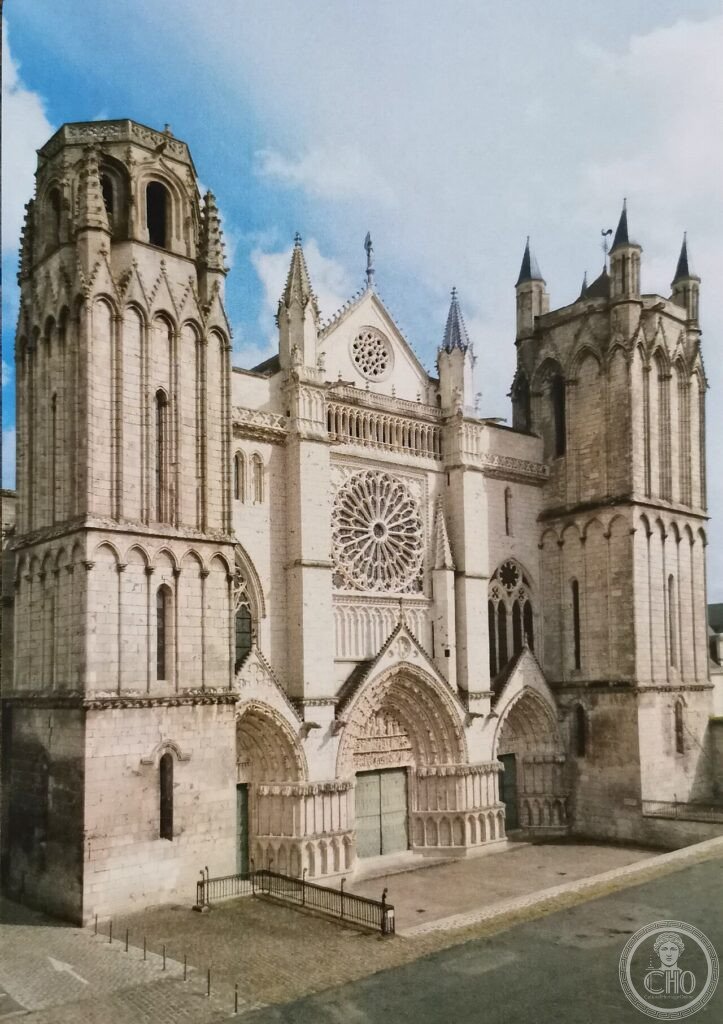
The Crucifixion window, in the choir, is the essential single artwork, its scale and the identifiable royal donor portraits at its base making it worth deliberate, unhurried viewing rather than a passing glance among the cathedral’s wider glass collection. The cathedral’s hall-church design, characteristic of Plantagenet Gothic architecture in Poitou and Anjou, gives the nave and side aisles roughly equal height, creating a broader, more unified interior volume than the more strongly hierarchical nave-and-aisle proportions typical of northern French Gothic cathedrals such as Chartres or Reims. The wider 13th-century stained-glass sequence and the cathedral’s 15th-century Virgin statue add further layers to a building whose construction phases span more than two centuries.
Practical information
- Opening hours: winter 9:00-17:00, summer 9:00-19:30/20:00 depending on season; free admission
- Address: Place de la Cathédrale et du Cardinal Pie, 86000 Poitiers
- Access: bus lines 1, 12, 15, 21; nearest stop “Maison du Tourisme,” 2 minutes’ walk
Getting there
Poitiers has direct TGV rail connections from Paris (approximately 1.5 hours) and Bordeaux (approximately 1.5 hours). From Poitiers train station, the cathedral is reachable by local bus or a walk of roughly 20-25 minutes through the historic centre. By car, Poitiers sits on the A10 motorway (Paris-Bordeaux). GPS: 46.5804° N, 0.3492° E.
Nearby
- Église Notre-Dame-la-Grande — in the historic centre, a short walk from the cathedral; a Romanesque church with an exceptionally elaborate sculpted west facade
- Baptistère Saint-Jean, Poitiers — near the cathedral; one of the oldest surviving Christian buildings in France, with Merovingian-era origins
- Futuroscope — approximately 15 minutes by car; a major theme park, unrelated to the historic centre but a well-known regional draw
Sources
- Visit Poitiers — official tourism portal, cathedral visitor information (visitpoitiers.fr)
- Alienor.org — regional heritage documentation on Eleanor of Aquitaine’s patronage (alienor.org)
- Wikipedia — “Cathédrale Saint-Pierre de Poitiers” and “Eleanor of Aquitaine” (fr.wikipedia.org, en.wikipedia.org)
- Poitiers.net — local heritage portal (poitiers.net)
Find it on the map
See this place and what’s around it →📷 Become a Cultural Heritage Online photographer
Share your photos of places: they stay published under your name as the author. The more they're seen, the more you get noticed — and soon a contest will reward the most appreciated photos.
Log in or sign up free to add a photoIs this page about you?
This page is read by travellers and heritage enthusiasts who find it on Google. Tell us how you are connected to this place and we will take it from there.