
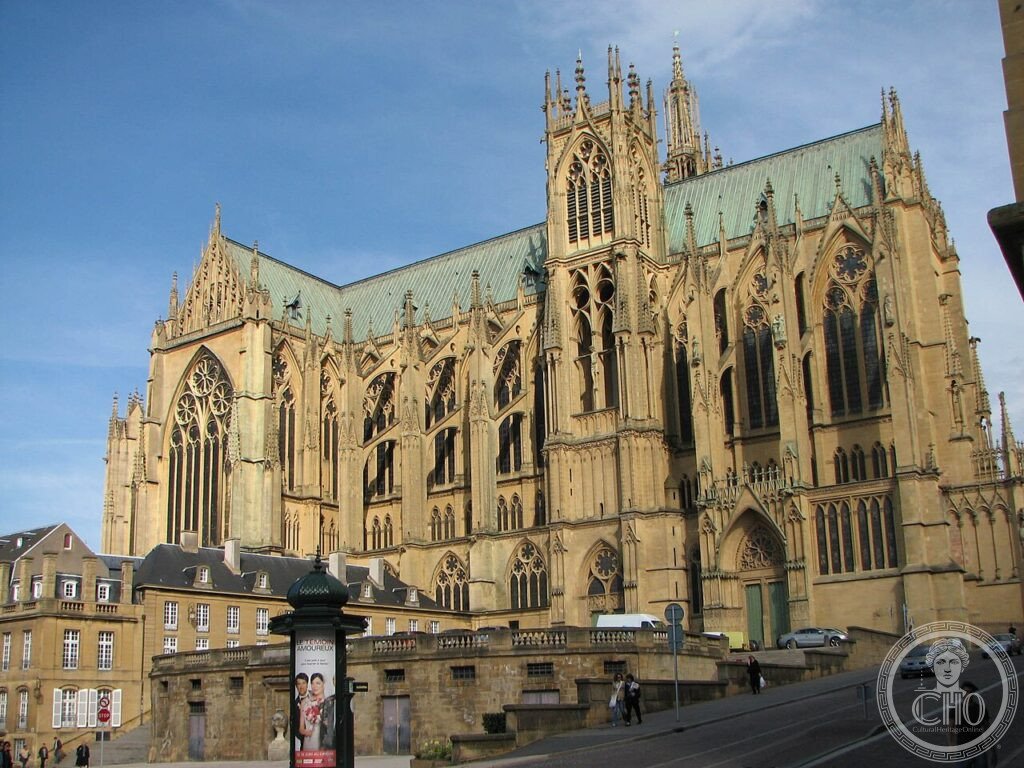
Three centuries of building produced the largest expanse of stained glass among Christian churches: 6,500 square metres, against the 2,600 of Chartres. In 1959 Marc Chagall added his own voice here, after Chartres and Assy, in a window on the Creation in flaming yellow tones.
At a glance
Metz Cathedral (Cathédrale Saint-Étienne) was built across three centuries, from 1220 to 1520, blending Early Gothic, Rayonnant, and Flamboyant Gothic phases into a single structure whose defining feature is its stained glass: at roughly 6,500 square metres, it is one of the most extensively glazed Christian buildings in the world, well over double the glazed surface of Chartres Cathedral’s celebrated 2,600 square metres — a scale that has earned Metz Cathedral its popular nickname, “la Lanterne du Bon Dieu” (the Good Lord’s Lantern). The cathedral’s glass spans from medieval work, including a 1384 west rose window by Hermann de Münster, through to a modern addition: three windows in the north apse designed by Marc Chagall between 1959 and 1969, created after the artist had already worked in stained glass at Chartres and the church of Assy, depicting Old Testament themes in a flame-yellow palette on the theme of Creation.
Key facts
- Construction: 1220-1520, spanning Early Gothic, Rayonnant, and Flamboyant Gothic architectural phases across three centuries of building campaigns
- Stained glass: approximately 6,500 square metres, among the most extensive of any Christian building — more than double Chartres Cathedral’s roughly 2,600 square metres
- West rose window: 1384, by Hermann de Münster, one of the cathedral’s major medieval glass works
- Chagall windows: three windows in the north apse, designed by Marc Chagall 1959-1969, depicting Old Testament scenes centred on the Creation in a flame-yellow palette — created after Chagall’s earlier stained-glass work at Chartres and Assy
- Nickname: “la Lanterne du Bon Dieu” (the Good Lord’s Lantern), a direct popular reference to the building’s exceptional glazed surface and the resulting quality of interior light
History
Metz Cathedral’s three-century construction span, from 1220 to 1520, means the building physically documents the full evolution of French Gothic architecture within a single structure — Early Gothic elements from the earliest 13th-century campaigns give way to the more elaborate tracery of Rayonnant Gothic and finally the intricate, flame-like ornamental forms of Flamboyant Gothic in the building’s latest phases, a progression comparable to what a visitor sees more schematically at cathedrals built over shorter, more unified periods. The cathedral’s exceptional emphasis on glazed surface area over solid wall — the specific architectural choice underlying its 6,500 square metres of stained glass — reflects the structural possibilities Gothic engineering opened up: as rib vaults and flying buttresses took on more of a building’s load-bearing function, walls could be opened up into glass to a degree earlier Romanesque architecture could not support, and Metz’s builders pursued this possibility more aggressively across their long construction campaign than most contemporary cathedrals.
The addition of Marc Chagall’s windows between 1959 and 1969 represents one of the most significant modern interventions in any French Gothic cathedral, undertaken during a broader mid-20th-century movement — also visible at Chartres and at the church of Notre-Dame-de-Toute-Grâce at Assy, where Chagall had also worked — to commission major contemporary artists for church decoration rather than relying exclusively on historical revival styles. Chagall’s own reported statement that stained glass “transmutes physical light into spiritual light” reflects his approach to the medium across these commissions, and the Metz windows’ focus on Old Testament Creation imagery, rendered in his distinctive flame-yellow tonality, sit within the cathedral’s medieval glass without attempting to imitate its style, creating a visible dialogue between 13th-16th-century and 20th-century approaches to the same architectural function within one building.
What you see
The overwhelming scale of glazed surface is the cathedral’s defining visual experience, best appreciated simply by standing in the nave and observing how little solid wall remains between the structural piers — a degree of glass-to-wall ratio unusual even among heavily glazed Gothic cathedrals. The 1384 west rose window by Hermann de Münster anchors the medieval glass sequence, while Chagall’s three north apse windows, executed in his recognisable flame-yellow Creation imagery, offer a direct visual contrast in both palette and figural style to the surrounding medieval work. The building’s three-century construction span is also readable architecturally moving from the earlier, more restrained Gothic phases toward the increasingly elaborate Flamboyant tracery of the later additions.
Practical information
- Opening hours: daily, 8:00-19:00 (April-October), 8:00-18:00 (rest of year); free admission, subject to service schedules
- Guided tours (crypt and treasury): Wednesday, Saturday, Sunday at 14:30, approximately 1.5 hours, from €9, no reservation required
- Address: Place d’Armes, 57000 Metz
Getting there
Metz has direct TGV rail connections from Paris (approximately 1.5 hours) and Strasbourg (approximately 50 minutes); Metz-Ville station is roughly a 9-minute walk from the cathedral. Bus line N83 stops directly at Place d’Armes. By car, Metz sits at the junction of the A4 and A31 motorways; the Parking République and Parking Saint-Jacques are both near the cathedral. GPS: 49.1202° N, 6.1757° E.
Nearby
- Centre Pompidou-Metz — a short walk from the cathedral; a satellite of Paris’s Pompidou Centre with a distinctive undulating wooden-lattice roof
- Place Saint-Louis, Metz — in the historic centre; a medieval arcaded square with houses dating to the 14th-16th centuries
- Verdun — approximately 1 hour by car; First World War battlefield sites and memorials
Sources
- Œuvre de la Cathédrale de Metz — official visitor portal (cathedrale-metz.fr)
- Diocèse de Metz — cathedral history and visitor information (metz.catholique.fr)
- Ville de Metz — “1220-2020: 800 ans de lumière” (metz.fr)
- Wikipedia — “Metz Cathedral” (en.wikipedia.org)
Find it on the map
See this place and what’s around it →📷 Become a Cultural Heritage Online photographer
Share your photos of places: they stay published under your name as the author. The more they're seen, the more you get noticed — and soon a contest will reward the most appreciated photos.
Log in or sign up free to add a photoIs this page about you?
This page is read by travellers and heritage enthusiasts who find it on Google. Tell us how you are connected to this place and we will take it from there.