
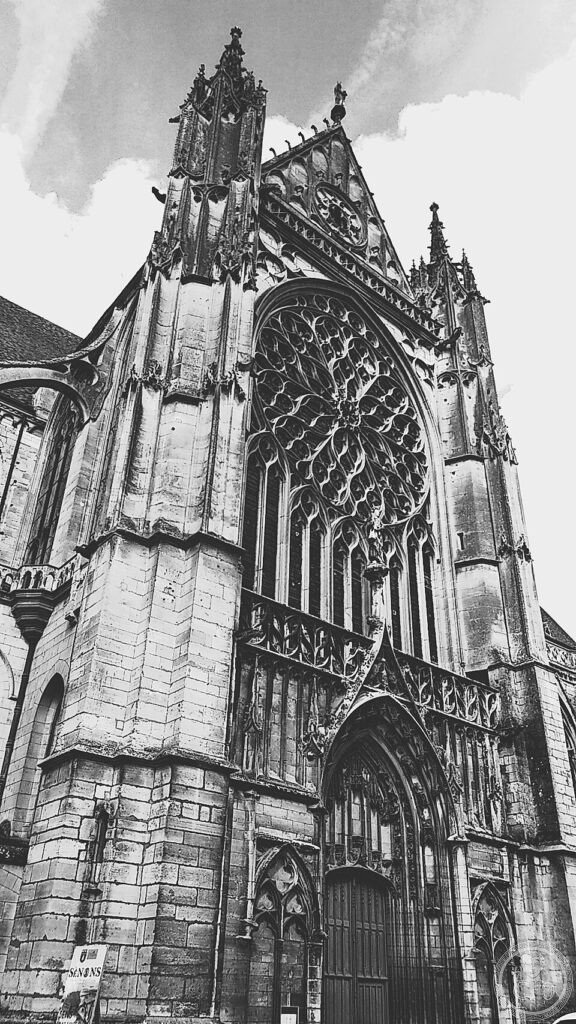
Prima ancora di Chartres o Notre-Dame, fu qui, a Sens, che nacque l’architettura gotica. Nella navata, una vetrata del XIII secolo racconta la storia dell’arcivescovo inglese che visse in esilio proprio accanto a questa cattedrale, prima di tornare a Canterbury per esservi assassinato.
At a glance
The Cathédrale Saint-Étienne de Sens is widely credited as the first fully Gothic cathedral built in the Christian world, with construction beginning around 1130 under Archbishop Henri Sanglier and the nave and choir consecrated in 1164, decades before comparably famous Gothic cathedrals like Chartres or Notre-Dame de Paris reached similar completion. The building’s pioneering rib-vaulted structure and use of pointed arches established a vocabulary that architects across northern France would draw on for the following century. Sens also holds a specific place in English history: Thomas Becket, Archbishop of Canterbury, spent nearly four years in exile here, from 1166 to 1170, in a house near the cathedral, before returning to England where he was murdered — an episode commemorated today in one of the cathedral’s most celebrated stained-glass windows.
Key facts
- Construction: begun c. 1130 under Archbishop Henri Sanglier; nave and choir consecrated 1164; west facade completed by the late 12th century — recognised as the first fully Gothic cathedral in France
- Thomas Becket’s exile: the Archbishop of Canterbury lived near the cathedral from 1166 to 1170, having fled conflict with King Henry II of England over the judicial privileges of the Church; he returned to England and was assassinated at Canterbury in 1170
- Stained glass: among the cathedral’s most significant holdings, rivalling Chartres and Bourges; includes the early-13th-century Thomas Becket window, a Tree of Jesse, the Parable of the Two Sons, and later 16th-century rose windows
- South Tower: accessible by guided tour in summer, offering views over the historic centre of Sens and the Yonne river
- Treasury (Trésor): one of the richest cathedral treasuries in France, including liturgical vestments associated with Thomas Becket
History
Sens held a position of major ecclesiastical authority in medieval France as the seat of an archdiocese whose jurisdiction once extended over a large part of northern France, including, until the 17th century, the diocese of Paris itself — a status reflected in the scale and ambition of the cathedral Archbishop Henri Sanglier undertook to build from around 1130. The building’s rib vaults and pointed arches, combined in a way not previously attempted at this scale, are treated by architectural historians as the true starting point of the Gothic style, predating the famous choir of the royal abbey church of Saint-Denis (from 1140) and the west facade of Chartres, both of which are more commonly associated with Gothic architecture’s popular origins despite Sens’s earlier claim.
Thomas Becket’s presence in Sens between 1166 and 1170 places the cathedral directly within one of medieval Europe’s most consequential church-state conflicts: as Archbishop of Canterbury, Becket clashed with King Henry II of England over the extent of royal authority to try clergy in secular courts, a dispute serious enough that Becket fled England for exile in France, spending several of those years based near the cathedral in Sens before Pope Alexander III eventually brokered a reconciliation that allowed his return — a return that ended, within months, in his murder by four of Henry’s knights in Canterbury Cathedral in December 1170, an event that shocked Christian Europe and led to Becket’s rapid canonisation. The stained-glass window commemorating this episode, created within decades of Becket’s death and canonisation, is among the earliest surviving visual commemorations of the martyred archbishop anywhere.
What you see
The west facade, completed in stages through the late 12th and into later centuries, combines the cathedral’s earliest Gothic structural elements with later additions, including a south tower substantially rebuilt in Flamboyant Gothic style after storm damage; sculptural decoration around the portals depicts biblical and hagiographic scenes typical of major French Gothic cathedral facades. Inside, the nave’s rib-vaulted ceiling and the choir demonstrate the structural innovations that mark Sens’s pioneering status, while the stained glass — spanning from the 13th-century Becket and Jesse Tree windows to 16th-century Renaissance-period rose windows — gives the interior a chronological range of French glasswork spanning three centuries.
Practical information
- Opening hours: daily, 8:00-18:00, free access outside of services
- South Tower guided tours: July-August, Tuesday 14:30, Wednesday 16:30, Friday 14:30, Saturday 9:30 and 16:30, Sunday 15:00; limited places, booking required via the Sens tourist office
- Address: Place de la République, 89100 Sens
Getting there
Sens has a direct rail connection from Paris Gare de Bercy/Gare de Lyon, taking approximately 1 hour, making it a practical day trip from the French capital. By car, Sens sits just off the A6 motorway (Paris-Lyon), roughly 1 hour from southern Paris. The cathedral stands in the heart of the historic centre, on high ground above the Yonne river, and is walkable from the town’s train station in about 10-15 minutes. GPS: 48.1981° N, 3.2840° E.
Nearby
- Palais Synodal, Sens — adjoining the cathedral; a 13th-century archbishop’s assembly hall, one of the finest surviving Gothic civil buildings in France
- Musées de Sens — housed partly in the former archbishop’s palace, with archaeological and decorative art collections
- Auxerre historic centre — approximately 30-40 minutes by car; another major Burgundian cathedral city with its own Gothic cathedral and Romanesque crypt frescoes
Sources
- Ville de Sens — “La première cathédrale gothique” (ville-sens.fr)
- Sens et Sénonais Tourisme — official visitor information (tourisme-sens.com)
- Wikipedia — “Cathédrale Saint-Étienne de Sens” and “Thomas Becket” (fr.wikipedia.org, en.wikipedia.org)
- Diocèse de Sens et Auxerre — parish visitor information (yonne.catholique.fr)
Find it on the map
See this place and what’s around it →📷 Become a Cultural Heritage Online photographer
Share your photos of places: they stay published under your name as the author. The more they're seen, the more you get noticed — and soon a contest will reward the most appreciated photos.
Log in or sign up free to add a photoIs this page about you?
This page is read by travellers and heritage enthusiasts who find it on Google. Tell us how you are connected to this place and we will take it from there.