

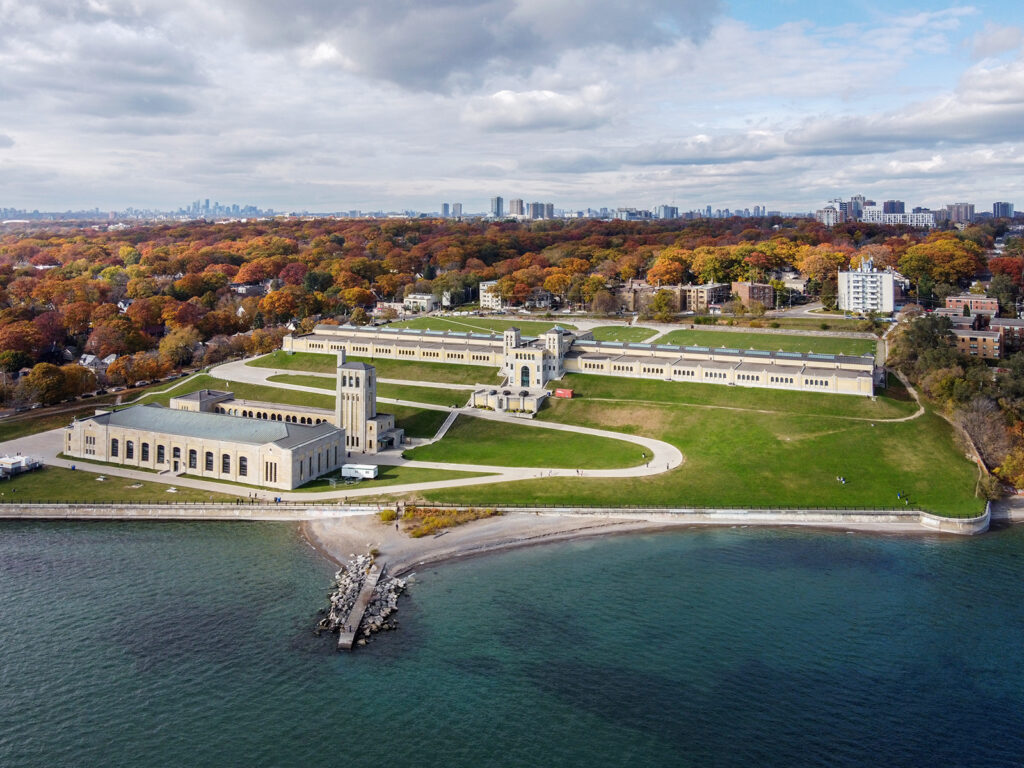
A functioning water treatment facility transformed into an architectural landmark, this Toronto icon merges industrial necessity with classical design on the shore of Lake Ontario.
At a glance
The R. C. Harris Water Treatment Plant stands as both essential infrastructure and celebrated example of civic architecture. Named after Roland Caldwell Harris, Toronto’s longtime commissioner of public works, the plant serves the city’s water supply while commanding attention as a historic building of considerable design merit.
History
The facility was designed by architect Thomas Canfield Pomphrey in collaboration with engineers H.G. Acres and William Gore. It was established to honor Roland Caldwell Harris, whose tenure as public works commissioner shaped Toronto’s municipal infrastructure and vision for the city.
What you see
The plant’s design elevates functional industrial architecture into a visually compelling structure. Its classical aesthetic stands distinctly at the eastern end of Queen Street, where it meets Victoria Park Avenue along Lake Ontario’s shoreline, marking the boundary between Toronto’s Beaches neighbourhood and Scarborough’s Birch Cliff area.
Cultural significance
Beyond its role supplying water to Toronto, the plant has captured the imagination of filmmakers. It served as a filming location for the 1983 comedy Strange Brew, starring Rick Moranis and Dave Thomas, introducing the building to audiences far beyond Toronto.
Key facts
- Location: Toronto, Ontario, Canada
- Coordinates: 43.6732, -79.2788
- Architect: Thomas Canfield Pomphrey
- Engineers: H.G. Acres, William Gore
- Named after: Roland Caldwell Harris, commissioner of public works
Practical information & getting there
The plant occupies a prominent waterfront site at the eastern end of Queen Street and Victoria Park Avenue in Toronto’s east end, easily accessible from downtown. Check ahead for current access policies, as this is an active municipal facility.
Constructed during the 1930s, the plant opened in 1941 and is the largest water treatment plant in Toronto.
Sources & resources
Find it on the map
See this place and what’s around it →📷 Become a Cultural Heritage Online photographer
Share your photos of places: they stay published under your name as the author. The more they're seen, the more you get noticed — and soon a contest will reward the most appreciated photos.
Log in or sign up free to add a photoIs this page about you?
This page is read by travellers and heritage enthusiasts who find it on Google. Tell us how you are connected to this place and we will take it from there.
This entry stays online and free either way — and a free account lets you add to it yourself.