
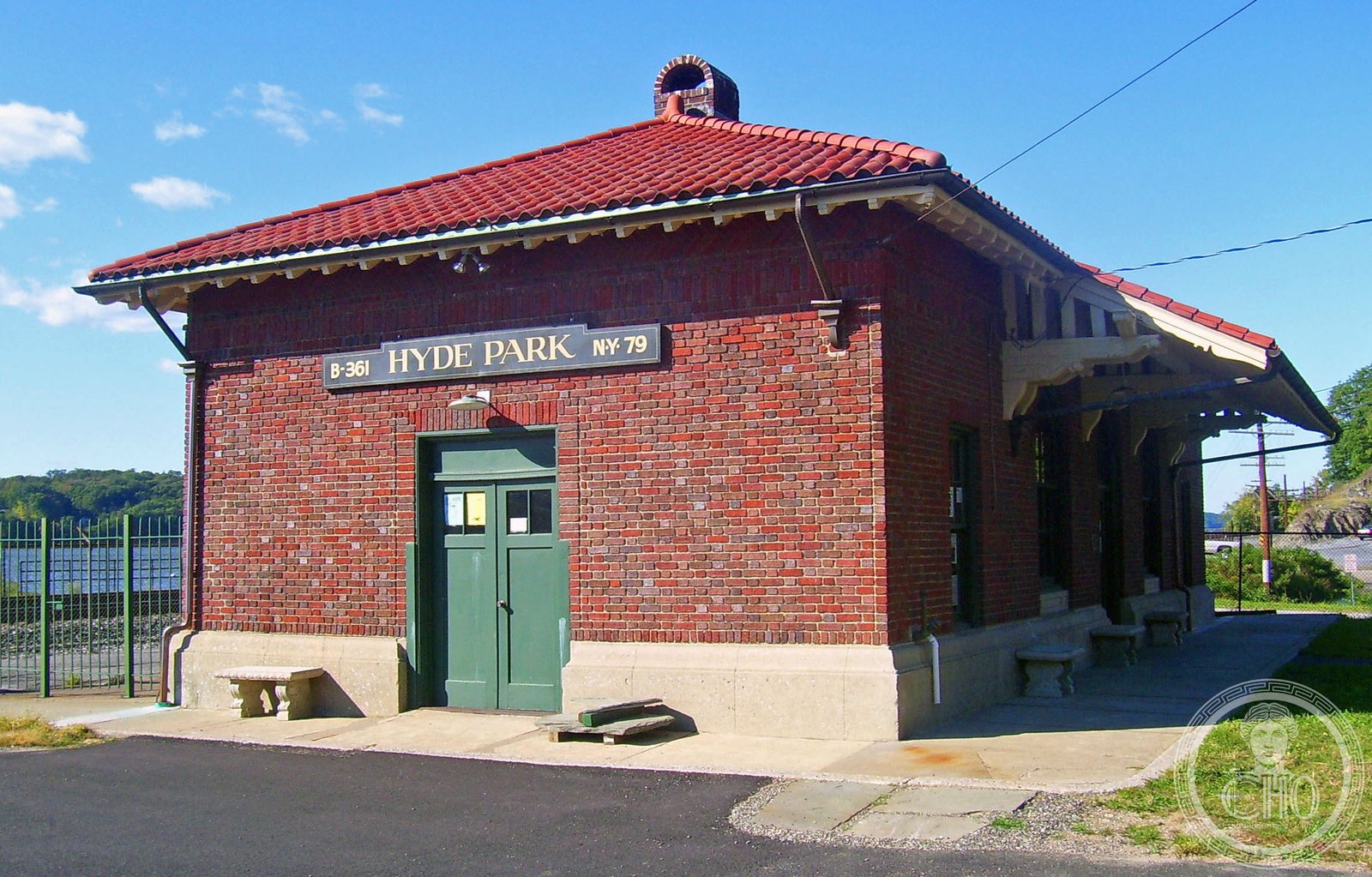
A Mission and Spanish Revival railroad station where presidents and dignitaries once passed, now preserved as a regional rail museum after rescue from demolition.
At a glance
Hyde Park Station stands at the confluence of Crum Elbow Creek and the Hudson River, a handsome early 20th-century station that served the New York Central Railroad’s route between New York City and Albany. Built in 1914 by Warren and Wetmore—architects who also designed Grand Central Terminal—the station reflects the refined tastes of the railroad’s golden age. Today it operates as a regional rail museum run by volunteers.
History
The site first saw rail service in 1851, when the Hudson River Railroad established a modest wooden station. By 1914, the New York Central commissioned Warren and Wetmore to replace it with a permanent structure befitting the area’s prominence. The station gained historical note when President Franklin D. Roosevelt used it during his presidency: in 1939 to greet King George VI and Queen Elizabeth on their state visit, and in 1945 when his body passed through en route to his burial in Hyde Park.
Passenger rail declined sharply after midcentury. Regular service halted in 1953, and the New York Central eventually sold the building to the Town of Hyde Park as the railroad divested assets to survive financial strain. By 1975, vandalism and neglect had brought the station to the brink of demolition.
The Hudson Valley Railroad Society intervened at the last moment, leasing the station for one dollar per year. Over fifteen years, volunteers completed full restoration of the roof, interior, and exterior, transforming it into a working museum. An annual model train show now funds operations.
What you see
The 1914 station combines Mission and Spanish Revival influences—a distinctive pairing executed with restraint and elegance. The completely restored tiled roof is a particular point of pride among preservationists. The building retains its original character while accommodating museum displays.
The Hudson River tracks beyond remain active, used by both CSX freight and Amtrak’s Empire Service, a reminder of the line’s continuing importance in Northeast transportation.
Cultural significance
Hyde Park Station represents a moment when American railroads commanded national prestige and architectural investment. Its presence anchored the community’s connection to the wider world—and to power itself, as presidential visits underscored. The station’s rescue and restoration by volunteers demonstrates how local passion can preserve industrial heritage otherwise lost to economic decline.
Key facts
- Location: Hyde Park, New York, United States
- Coordinates: 41.787°N, 73.946°W
- Built: 1914
- Architects: Warren and Wetmore
- Style: Mission and Spanish Revival
- Current status: Regional rail museum operated by Hudson Valley Railroad Society
- Original wooden station: Established 1851 by Hudson River Railroad
Practical information & getting there
The station is located in Hyde Park along the active Hudson River railroad corridor. The Hudson Valley Railroad Society manages the building as a museum and hosts an annual model train show to support operations. You can reach Hyde Park by car or via Amtrak’s Empire Service trains, which still pass the station daily. For current visiting hours and details, contact the Hudson Valley Railroad Society directly.
Sources & resources
Find it on the map
See this place and what’s around it →📷 Become a Cultural Heritage Online photographer
Share your photos of places: they stay published under your name as the author. The more they're seen, the more you get noticed — and soon a contest will reward the most appreciated photos.
Log in or sign up free to add a photoIs this page about you?
This page is read by travellers and heritage enthusiasts who find it on Google. Tell us how you are connected to this place and we will take it from there.