
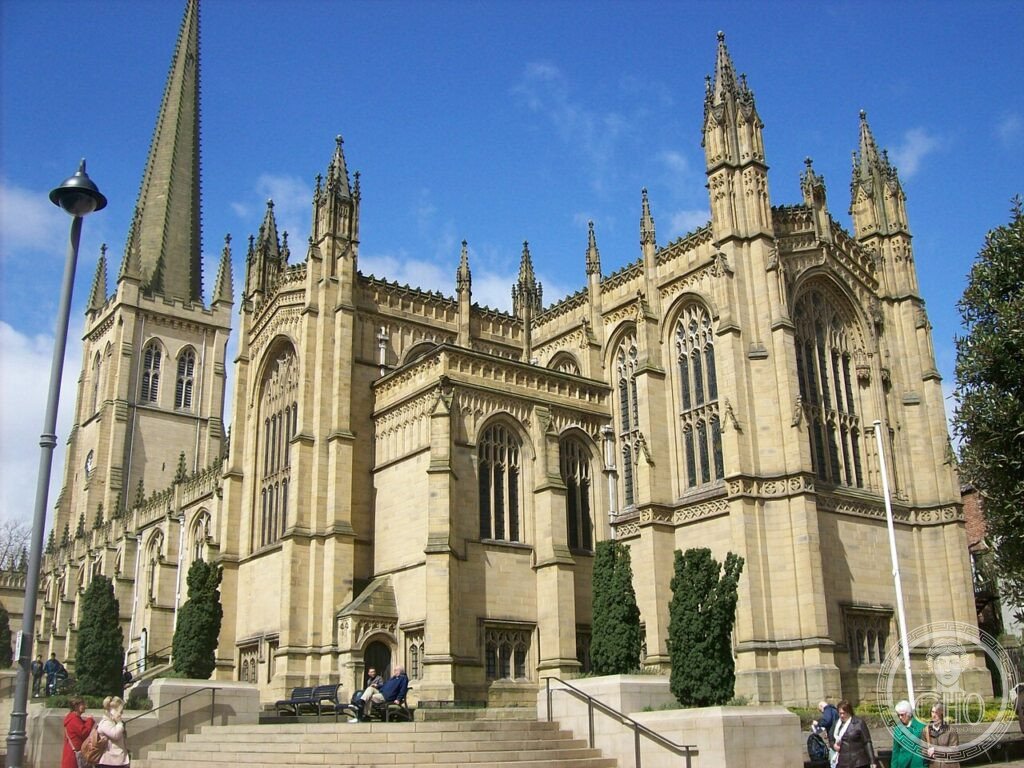
A parish church already old by the time of the Domesday Book, Wakefield Cathedral carries a 247-foot Perpendicular Gothic spire that has watched over the city since the 15th century, and peregrine falcons that have nested on it since 2015.
At a glance
Wakefield Cathedral, dedicated to All Saints, sits on a site with Anglo-Saxon origins and appears in the Domesday Book of 1086, making it one of the older recorded church sites in West Yorkshire. In 1090, William II granted the church and surrounding lands to Lewes Priory, and a Norman church was raised shortly after. The building was substantially reconstructed in 1329 and again in 1469, giving it the late-medieval, Perpendicular Gothic character it retains today, most visible in its 247-foot spire, the tallest in Yorkshire. The church became a cathedral in 1888 with the creation of the Diocese of Wakefield and today shares co-equal cathedral status with Bradford and Ripon within the Diocese of Leeds.
Key facts
- Recorded: in the Domesday Book, 1086; church and lands granted to Lewes Priory by William II in 1090
- Major reconstructions: 1329 and 1469, giving the building its late-medieval Perpendicular Gothic form
- Spire: 247 feet (75 metres) tall, the highest spire in Yorkshire
- Victorian restoration: 1858–1874, by George Gilbert Scott and his son John Oldrid Scott
- East end additions: chancel, transept, and St Mark’s Chapel, built from 1904 by John Loughborough Pearson and completed by his son Frank L. Pearson
- Cathedral status: since 1888, Diocese of Wakefield; now within the Diocese of Leeds alongside Bradford and Ripon cathedrals
- Listing: Grade I listed building, designated 14 July 1953
History
The site’s documented history begins in the Anglo-Saxon period, and a church here is recorded in the Domesday Book of 1086. William II’s grant of the church and Wakefield’s lands to Lewes Priory in 1090 brought it under monastic oversight, and a Norman stone church followed soon after. The building was substantially rebuilt twice in the later Middle Ages, in 1329 and again in 1469, the second campaign giving the church the Perpendicular Gothic form, tall proportions, and slender spire that still define it.
Little further structural change came until the Victorian era, when George Gilbert Scott and his son John Oldrid Scott carried out a major restoration between 1858 and 1874, repairing and reworking the medieval fabric according to 19th-century tastes. The church’s promotion to cathedral status arrived in 1888, when a new Diocese of Wakefield was created to serve the growing industrial population of the West Yorkshire coalfield and textile towns.
Cathedral status brought a need for greater liturgical space, and from 1904 the east end was extended with a new chancel, transept, and St Mark’s Chapel, designed by John Loughborough Pearson and, after his death, completed by his son Frank L. Pearson. The diocese itself was later absorbed into the Diocese of Leeds, formed in 2014 from the former dioceses of Wakefield, Bradford, and Ripon and Leeds, but Wakefield retained its cathedral status as one of three co-equal cathedrals in the new diocese.
What you see
The exterior is dominated by the 247-foot spire, built of ashlar sandstone in the early 15th-century Perpendicular style and tall enough to be visible across much of Wakefield and the surrounding countryside — still the highest spire anywhere in Yorkshire. Pearson’s early 20th-century east end additions sit alongside the medieval nave and tower in a sympathetic Gothic idiom, extending the building without breaking its late-medieval silhouette.
Inside, look for the 17th-century rood screen dividing nave from chancel, and the 15th-century choir stalls, whose misericords — small carved ledges on the underside of hinged seats — preserve some of the building’s oldest surviving woodwork. Stained glass by Charles Eamer Kempe, a leading Victorian and Edwardian glass designer, adds rich colour to several windows. Since 2015, a pair of peregrine falcons has nested on the tower, raising 24 chicks across seven breeding seasons and drawing bird-watchers alongside pilgrims and visitors.
Practical information
- Opening hours: Monday to Friday and Sunday, approximately 8am to 4pm; Saturday 9:30am to 4pm
- Admission: free entry; donations welcomed
- Time needed: 30–45 minutes for the nave, choir, and chapels
Getting there
Wakefield Cathedral stands in the heart of Wakefield city centre, within easy walking distance of both Wakefield Westgate and Wakefield Kirkgate railway stations, which connect to Leeds, Sheffield, and London. By road, the city sits just off the M1 motorway. GPS: 53.6830° N, 1.4968° W.
Nearby
- Sandal Castle — a medieval motte-and-bailey castle on the southern edge of Wakefield, site of the Battle of Wakefield in 1460
- Nostell Priory — a Palladian country house and National Trust property about 6 miles from Wakefield, built on the site of a medieval Augustinian priory
- Pontefract Castle — a ruined royal castle roughly 8 miles from Wakefield, historically significant as a site of imprisonment for Richard II
Sources
Find it on the map
See this place and what’s around it →📷 Become a Cultural Heritage Online photographer
Share your photos of places: they stay published under your name as the author. The more they're seen, the more you get noticed — and soon a contest will reward the most appreciated photos.
Log in or sign up free to add a photoIs this page about you?
This page is read by travellers and heritage enthusiasts who find it on Google. Tell us how you are connected to this place and we will take it from there.