
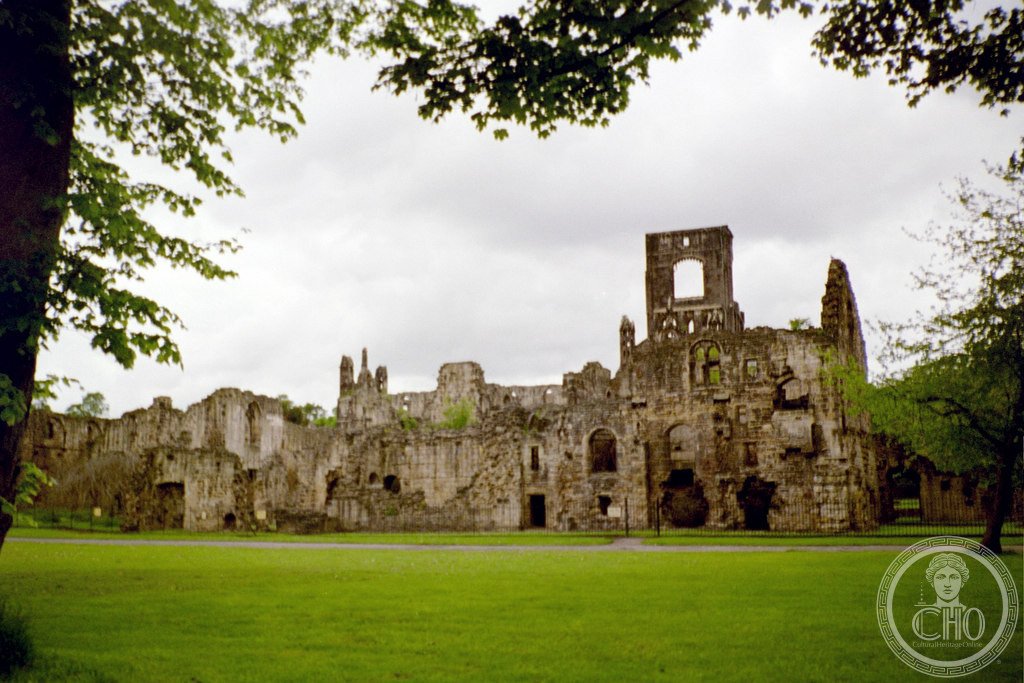
Inside a public park on the edge of Leeds, the ruins of the Cistercian abbey of Kirkstall remain among the most complete in England: walls, cloister and bell tower that for two centuries drew Romantic painters such as Turner, and today are free to enter.
At a glance
Kirkstall Abbey stands beside the River Aire on the western edge of Leeds, its extensive ruins set within a 23.5-hectare public park. Founded in 1152 as a daughter house of Fountains Abbey, after an earlier, unsuccessful settlement attempt at Barnoldswick, the Cistercian community here built one of the most architecturally complete monastic churches to survive in England, combining round-headed Romanesque forms with the earliest pointed Gothic arches. Suppressed in 1539, the abbey was bought by Leeds City Council in 1889 and opened permanently to the public in 1895; it remains free to enter, managed today by Leeds Museums and Galleries, with the Grade I listed gatehouse now housing the Abbey House Museum.
Key facts
- Founded: 1152, as a Cistercian daughter house of Fountains Abbey, after monks first settled unsuccessfully at Barnoldswick in 1147
- Architecture: combines austere round-headed Romanesque work with some of the earliest pointed Gothic arches in the region — a short chancel, transepts with chapels, and largely unornamented windows typical of early Cistercian design
- Surrendered: 22 November 1539, during the dissolution of the monasteries
- Ownership: bought by Leeds City Council in 1889 and opened to the public in 1895; managed today by Leeds Museums and Galleries
- Setting: set within a 23.5-hectare public park beside the River Aire, free to enter
- Artistic legacy: the picturesque ruins attracted Romantic-era painters, notably J.M.W. Turner
- Gatehouse: the Grade I listed abbey gatehouse now houses the Abbey House Museum, a separate paid attraction
History
Kirkstall’s Cistercian community began in May 1147, when Abbot Alexander led twelve monks from Fountains Abbey to found a new house at Barnoldswick, in the Ribble valley. The site proved unsuitable for monastic farming, and within a few years the community relocated to a stretch of the Aire valley at Kirkstall, where building work on a permanent abbey began around 1152. Freed from the difficulties of its first site, the community built a church and monastic complex on a scale and to a level of architectural completeness that would make Kirkstall one of the best-preserved Cistercian sites in the country, its round-arched Romanesque nave meeting some of the earliest pointed Gothic work built in the region.
The abbey functioned as a working Cistercian house for close to four centuries, supporting itself chiefly through sheep farming and wool production across its Yorkshire estates, before it was surrendered to the crown on 22 November 1539 as part of Henry VIII’s dissolution of the monasteries. Like many suppressed abbeys, Kirkstall was subsequently used as a source of building stone and left to decay, its roofless walls becoming a favourite subject for artists of the Romantic period, among them J.M.W. Turner, who painted and sketched the ruins on more than one occasion.
In 1889, Leeds City Council acquired the abbey, and in 1895 opened the site permanently to the public as a park, a status it has retained ever since. The Grade I listed gatehouse was converted into the Abbey House Museum, while the abbey ruins themselves passed into the care of what is now Leeds Museums and Galleries, which continues to manage conservation, events, and visitor access on a free, donation-supported basis.
What you see
The abbey church is the most substantial survival, its walls standing to a considerable height along much of the nave and crossing, allowing visitors to trace the plan of a short chancel, transepts with subsidiary chapels, and a central tower base in a single walk. The architecture shows the transition Cistercian builders were working through in the mid-12th century: round-headed Romanesque arcades and unornamented, deeply splayed window openings sit alongside early pointed Gothic arches, a combination that makes Kirkstall a useful reference point for the shift between the two styles in northern England.
Beyond the church, the cloister ranges retain substantial sections of the chapter house, warming house, and refectory, giving a strong sense of the abbey’s full monastic footprint rather than just its church. The surrounding parkland, laid out after the council’s 1889 purchase, frames the ruins in mature trees and open lawns along the Aire, the same picturesque combination of river, ruin, and greenery that drew Turner and other painters to the site two centuries ago.
Practical information
- Opening hours: abbey grounds open daily, dawn to dusk
- Entry: free; run on a “Give What You Can” basis with a suggested £5 donation via a contactless point at the entrance
- Abbey House Museum: in the gatehouse, separate paid admission, with its own opening hours
- Time needed: 45-60 minutes for the abbey ruins; longer with the museum and park
- Extras: free audio tour and guidebook available; the park regularly hosts outdoor cinema, theatre, and festivals
Getting there
Kirkstall Abbey lies about 3 miles northwest of Leeds city centre, just off the A65 in the Kirkstall area of the city. The nearest railway station is Leeds railway station, from where local buses run directly to the abbey; Kirkstall Forge station, on a suburban line, is also within walking distance. On-site parking is available in the abbey park. GPS: 53.8206° N, -1.6067° E.
Nearby
- Abbey House Museum — in the abbey’s own Grade I listed gatehouse, with recreated Victorian streets and galleries
- Leeds city centre — about 3 miles away, with Leeds Art Gallery, Leeds City Museum, and the Victorian arcades
- Fountains Abbey — the mother house from which Kirkstall’s founding monks came, further north near Ripon
Sources
- Leeds Museums and Galleries — “Kirkstall Abbey” visitor pages (museumsandgalleries.leeds.gov.uk)
- Historic England — National Heritage List for England, list entries 1256668 and 1018149
- Wikipedia — “Kirkstall Abbey” (en.wikipedia.org)
Find it on the map
See this place and what’s around it →📷 Become a Cultural Heritage Online photographer
Share your photos of places: they stay published under your name as the author. The more they're seen, the more you get noticed — and soon a contest will reward the most appreciated photos.
Log in or sign up free to add a photoIs this page about you?
This page is read by travellers and heritage enthusiasts who find it on Google. Tell us how you are connected to this place and we will take it from there.