
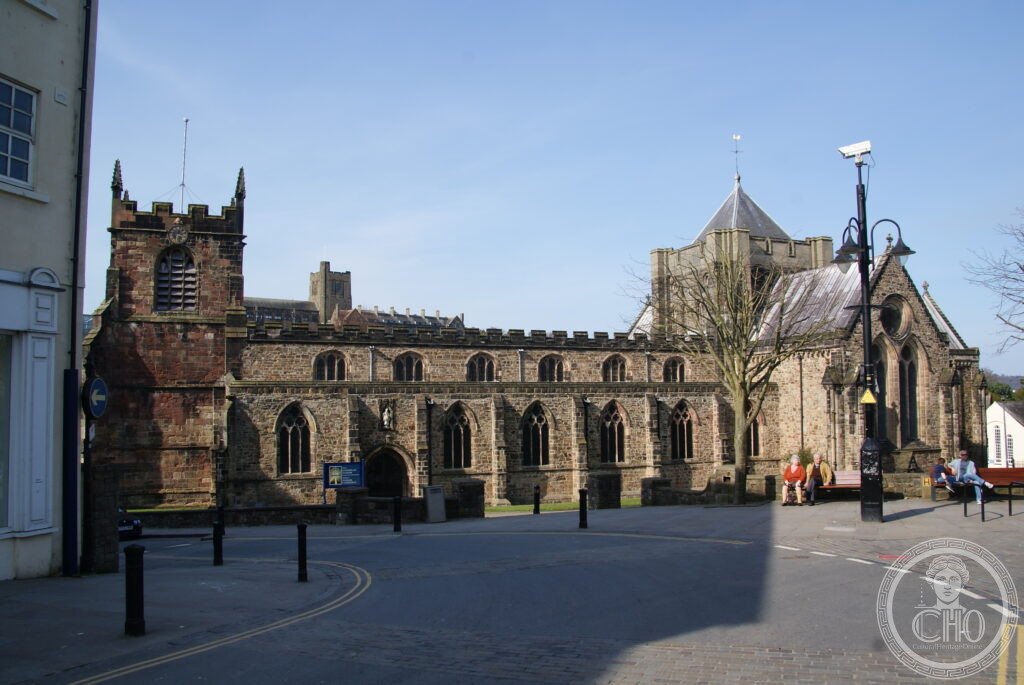
Built deliberately low so as not to be seen from the sea, the cathedral of Saint Deiniol holds fourteen centuries of unbroken worship at the heart of North Wales.
At a glance
Bangor Cathedral occupies a site that has hosted continuous Christian worship since around 530, when Saint Deiniol founded a monastic community here on land granted by Maelgwn Gwynedd, king of Gwynedd — making it, by tradition, the oldest cathedral foundation in Britain still in use. Deiniol is said to have been consecrated bishop by Saint David, tying Bangor’s origins directly to the other great Welsh cathedral of the age. The early monastery was sacked in 634 and again in 1073, and nothing of the original buildings survives; the oldest fabric now standing dates from the episcopate of Bishop David (1120–1139), built with the support of Gruffudd ap Cynan, king of Gwynedd, who was buried near the high altar. The cathedral suffered further destruction under King John’s forces in 1211 and during Edward I’s campaigns in 1282, and its present appearance owes much to a major Victorian restoration by George Gilbert Scott beginning in 1868.
Key facts
- Founded around 530 by Saint Deiniol as a monastic community, traditionally the oldest cathedral site in continuous use in Britain.
- The oldest surviving fabric dates to the episcopate of Bishop David (1120–1139), built with royal patronage from Gruffudd ap Cynan, king of Gwynedd.
- The site was deliberately kept low-lying, reportedly to avoid attracting the attention of Viking raiders approaching from the sea.
- Architect George Gilbert Scott led a major restoration from 1868, though his planned central tower and spire were never completed due to structural concerns.
- The cathedral holds the Mostyn Christ, a late-15th-century oak carving of Christ, among its most significant medieval artworks.
- A Biblical Garden on the cathedral grounds cultivates every plant species mentioned in scripture.
- The organ was rebuilt by noted organ builder William Hill in 1873.
History
Bangor’s Christian history begins around 530, when Saint Deiniol established a monastery on land granted by Maelgwn Gwynedd, king of Gwynedd. Tradition holds that Deiniol was consecrated the first Bishop of Bangor by Saint David himself, linking the two great early Welsh sees from their earliest days. The monastery was sacked in 634 and again by Viking raiders in 1073; no trace of these original buildings remains today.
The earliest surviving parts of the present cathedral date to the episcopate of Bishop David, between 1120 and 1139, when construction proceeded with financial support from Gruffudd ap Cynan, king of Gwynedd, who was later buried near the high altar in recognition of his patronage. The building endured further violence in the following centuries: forces loyal to King John damaged it in 1211, and Edward I’s invasion of Wales brought fresh destruction in 1282.
By the 19th century the cathedral was in poor structural condition, and architect George Gilbert Scott was engaged from 1868 to carry out an extensive restoration, funded in part by an £11,000 campaign in 1879 covering the nave and tower. Scott’s original design called for a tall central tower topped by a spire, but engineers judged the medieval foundations unable to bear the load, and the tower was completed at a lower, sturdier height. The result is the building seen today: a working cathedral of the Church in Wales, its Norman and medieval core still legible beneath centuries of restoration.
What you see
Bangor Cathedral reads, on approach, as a long, low building rather than a soaring one — a direct legacy of its early medieval siting, chosen to keep the community out of view from Viking ships in the Menai Strait. The nave and crossing tower, largely the product of George Gilbert Scott’s Victorian restoration, sit above earlier Norman and Gothic fabric that survives in fragments through the aisles and chancel, evidence of the repeated cycles of destruction and rebuilding that mark the cathedral’s history.
Inside, the late-15th-century Mostyn Christ, a carved oak figure, stands as one of the few major medieval artworks in Wales to survive the Reformation’s iconoclasm largely intact. The cathedral’s Biblical Garden, planted with species mentioned throughout scripture, extends the building’s devotional purpose into its grounds, while the 1873 William Hill organ continues to anchor the choral tradition of a foundation that traces its worship back roughly fourteen centuries.
Practical information
- Opening hours: Monday to Thursday, 10:00–18:00; Friday and Saturday, 10:00–15:00; open for services on Sunday (hours can vary — check ahead).
- Admission: free entry.
- Time needed: 30–45 minutes.
- Address: Cathedral Office, Diocesan Centre, Cathedral Close, Bangor, LL57 1RL, Wales.
Getting there
Bangor is served directly by Bangor railway station, on the North Wales Coast Line, with regular trains from Chester, Holyhead, and Cardiff via Crewe; the cathedral is a short walk from the station through the city centre. The nearest airports are Liverpool John Lennon and Manchester, both roughly 70–80 miles away. By road, Bangor sits just off the A55 expressway along the North Wales coast. GPS coordinates: 53.226509, -4.127475.
Nearby
- Penrhyn Castle — a 19th-century neo-Norman country house built for a slate-quarrying fortune, about 2 miles east of Bangor, now in the care of the National Trust.
- Menai Suspension Bridge — Thomas Telford’s early 19th-century suspension bridge linking the mainland to Anglesey, a few miles from Bangor.
- Beaumaris Castle — the unfinished but formidable Edward I fortress on Anglesey, part of the UNESCO-listed Castles and Town Walls of King Edward in Gwynedd.
Sources
- Wikipedia, “Bangor Cathedral”
- Britannica, “Bangor Cathedral”
Find it on the map
See this place and what’s around it →📷 Become a Cultural Heritage Online photographer
Share your photos of places: they stay published under your name as the author. The more they're seen, the more you get noticed — and soon a contest will reward the most appreciated photos.
Log in or sign up free to add a photoIs this page about you?
This page is read by travellers and heritage enthusiasts who find it on Google. Tell us how you are connected to this place and we will take it from there.