
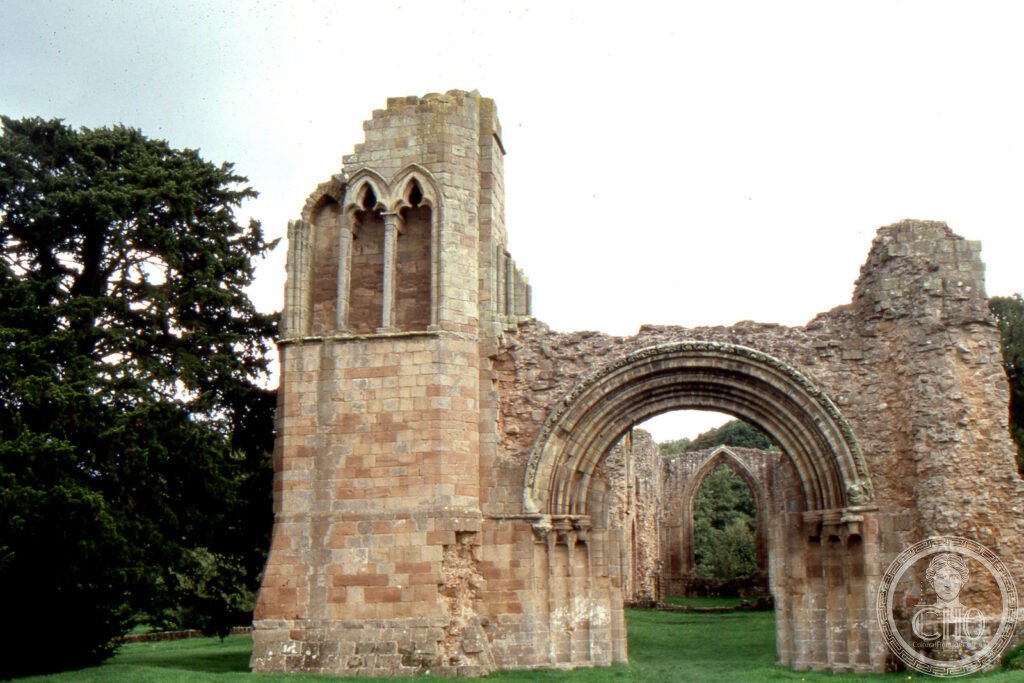
On a low ridge in rural Shropshire, the roofless nave of Lilleshall Abbey still stands to gallery height, its carved portal and cloister outlines surviving a royal dissolution, a Civil War siege and coal subsidence beneath its own foundations.
At a glance
Lilleshall Abbey stands in open farmland near Newport, Shropshire, the ruined church and cloister of a house of Augustinian canons founded between 1145 and 1148. Richard de Belmeis, Archdeacon of Middlesex, and his brother Philip, lord of the nearby manor of Tong, endowed the community, which followed the austere Arrouaisian observance imported from northern France and dedicated its church to St Mary. Building continued through the 12th and 13th centuries, producing a cruciform church over 60 metres long with a stone-vaulted roof and a richly carved processional entrance. The canons surrendered the abbey voluntarily in October 1538. English Heritage has managed the site, now a free, unstaffed ruin, since 1950.
Key facts
- Founded: 1145–1148, by Richard de Belmeis, Archdeacon of Middlesex, and his brother Philip de Belmeis, lord of Tong, for canons of the Augustinian order
- Observance: Arrouaisian, a strict reformed branch of the Augustinian rule imported from the abbey of Arrouaise in northern France
- Dedication: the Church of St Mary of Lilleshall, recorded on the abbey’s own 13th-century seal
- Architecture: a cruciform church over 60 metres long with a stone-vaulted roof, built across the 12th and 13th centuries; the round-arched west portal and a lavishly carved processional doorway with sculpted tympanum survive
- Dissolution: surrendered voluntarily on 16 October 1538 under Henry VIII, having narrowly escaped the 1536 suppression of lesser monasteries because its recorded income exceeded the £200 threshold
- After the Reformation: bought by James Leveson in 1539 and held by the Leveson family, later Dukes of Sutherland, as a private estate into the 20th century
- Damage: the crossing tower and transepts were destroyed during a Parliamentarian siege in 1643, and the standing walls were further weakened by coal-mining subsidence in the 19th and 20th centuries
History
The abbey’s founders, Richard de Belmeis, Archdeacon of Middlesex, and his brother Philip de Belmeis, lord of the manor of Tong, established the community between 1145 and 1148, during the civil war of King Stephen’s reign known as the Anarchy. They placed it under the Arrouaisian observance, a stricter variant of the Augustinian rule that had originated at the abbey of Arrouaise in northern France and spread to only a handful of English houses in the twelfth century. The canons dedicated their church to St Mary, a dedication recorded on the abbey’s own thirteenth-century seal, and building work on the cruciform church and surrounding cloister ranges continued in phases through the twelfth and thirteenth centuries, eventually producing a stone-vaulted nave running to more than 60 metres.
By the 1530s Lilleshall was a modest but solvent house. When Thomas Cromwell’s commissioners began suppressing the smaller monasteries in 1536, Lilleshall’s recorded annual income placed it just above the £200 threshold that determined which houses closed first, buying its canons two more years before they voluntarily surrendered the abbey to the Crown on 16 October 1538. The Crown sold the property in 1539 to James Leveson, a Wolverhampton wool merchant, and the Leveson family — later ennobled as Dukes of Sutherland — retained Lilleshall as part of their estate for the next four centuries, quarrying stone from the abandoned claustral buildings for local farm work while leaving the church shell largely as a picturesque ruin.
The site suffered further damage during the English Civil War, when a Parliamentarian siege in 1643 destroyed the abbey’s crossing tower and transepts, and again in the nineteenth and twentieth centuries, when coal extraction beneath the surrounding parish caused subsidence that cracked and tilted sections of the surviving walls. The Leveson successors eventually placed the ruin into state guardianship, and English Heritage has managed Lilleshall Abbey as a free, unstaffed public monument since 1950.
What you see
From the approach path, the west front presents a broad round-arched portal beneath a scatter of lancet window openings, the stonework weathered but its mouldings still legible. Set into the south side of the nave, the abbey’s best-preserved carved feature is a processional doorway that once led canons from the cloister into the church for the day’s services: its tympanum carries a band of low-relief decoration, a survival that most of the region’s other Augustinian houses lost to later quarrying or collapse. Visitors can climb a narrow, dark spiral stair from the nave to gallery level, where the scale of the vanished stone vault becomes legible against the sky and the full length of the cruciform plan opens out below.
East and south of the church, low wall footings trace the domestic ranges that once closed the cloister on three sides — chapter house, dormitory undercroft and refectory among them — though centuries of stone-robbing for local farm buildings have reduced most of them to ground-level outlines rather than standing rooms. The contrast between the relatively intact church and the largely vanished domestic quarter is itself informative: it shows how selectively post-Dissolution owners salvaged usable building stone, taking the smaller-scale claustral masonry while leaving the taller, structurally riskier church walls to stand or fall on their own.
Practical information
- Opening hours: daily, 10am–6pm April to end of September; 10am–4pm October to end of March
- Tickets: free entry; the site is unstaffed
- Time needed: about 30–45 minutes
- Access: entry via a kissing gate; uneven ground and low walls throughout; the spiral stair from the nave to gallery level is narrow and dark and unsuitable for mobility aids or pushchairs
Getting there
Lilleshall Abbey lies on Abbey Road outside Lilleshall village, about 6 miles north of Telford and 3 miles south of Newport, Shropshire. Telford Central is the nearest railway station, with local bus services (routes 5, 5A and 5E) continuing toward Lilleshall; the 481 service between Telford and Stafford also passes within a mile of the site. By car, the abbey is reached via the A518 between Telford and Newport, with a small car park at the site open from April to mid-October and an overflow car park at the gateway entrance, about 250 metres from the ruin, used the rest of the year. GPS: 52.7238° N, -2.3906° W.
Nearby
- White Ladies Priory — a short drive away; the ruined church of a 12th-century Augustinian priory, notable as one of the hiding places used by the future Charles II during his 1651 escape after the Battle of Worcester
- Boscobel House — adjoining White Ladies Priory; the Tudor hunting lodge where the fugitive king reputedly hid in an oak tree, now also in English Heritage’s care
- Lilleshall Monument — a 21-metre stone obelisk on Lilleshall Hill, in the same village as the abbey, raised in 1833 to commemorate George Leveson-Gower, 1st Duke of Sutherland, whose family had owned the abbey ruins since 1539
Sources
- English Heritage, official visitor page, Lilleshall Abbey
- Historic England, National Heritage List for England, entry 1015286, Lilleshall Abbey
- Wikipedia, “Lilleshall Abbey”
- Wikipedia, “Lilleshall Monument”
Find it on the map
See this place and what’s around it →📷 Become a Cultural Heritage Online photographer
Share your photos of places: they stay published under your name as the author. The more they're seen, the more you get noticed — and soon a contest will reward the most appreciated photos.
Log in or sign up free to add a photo