
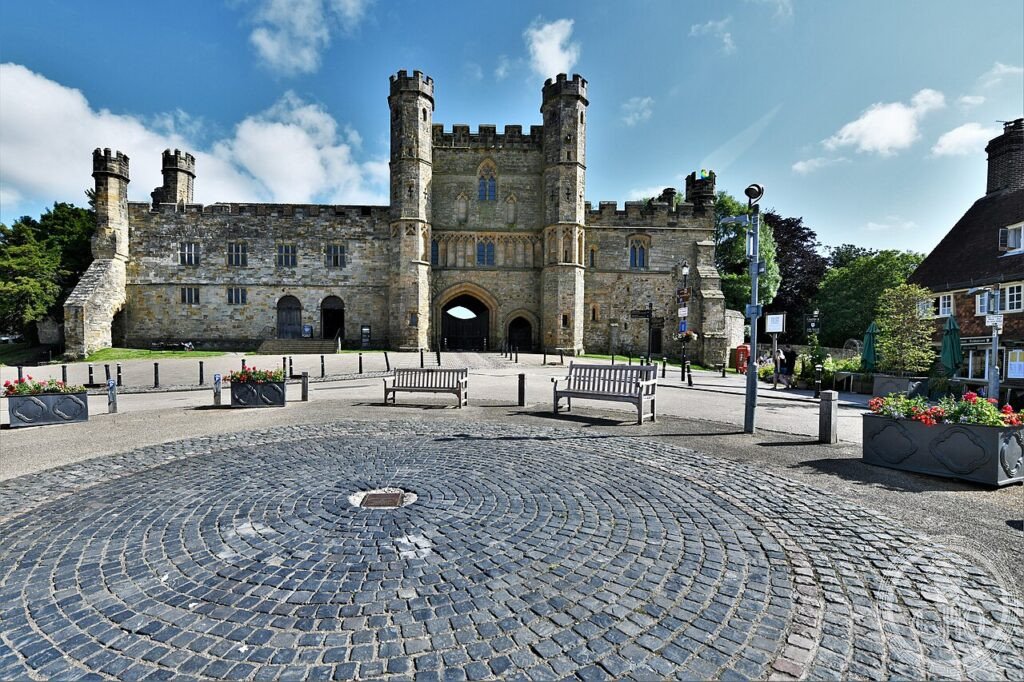
On the ridge where Harold fell in 1066, William the Conqueror raised a monastery not to mark his victory but to atone for it, at the pope’s command.
At a glance
Battle Abbey rises above the East Sussex town that took its name from the battle fought on this ground on 14 October 1066. William the Conqueror founded the Benedictine house in 1070 on the instruction of Pope Alexander II, who required the Normans to atone for the lives lost in the invasion of England. The high altar of the abbey church is said to have stood on the spot where King Harold II fell. The church was finished around 1094 and consecrated in the reign of William’s son, William II. Henry VIII dissolved the community in 1538; English Heritage now cares for the surviving ruins, the fourteenth-century gatehouse, and the battlefield as a single site.
Key facts
- Founded in 1070 by William the Conqueror, on the ground where he defeated Harold II on 14 October 1066
- Built on the order of Pope Alexander II, as penance for the dead of the Norman invasion
- The high altar reputedly marked the spot where King Harold was killed
- The abbey church was completed around 1094 and consecrated under William II
- The Great Gatehouse, built in 1338 by Abbot Alan of Ketling, is a Grade I listed structure
- Dissolved in 1538 under Henry VIII; granted to Sir Anthony Browne, who demolished the abbey church
- A Scheduled Monument, managed by English Heritage since 1976
History
William of Normandy is said to have vowed, before the battle, to build a monastery if he won the day. Victory alone did not settle the matter: Pope Alexander II, who had backed the invasion, required the Conqueror and his men to do penance for the English dead, and a purpose-built abbey was the chosen act of atonement. Construction of Battle Abbey began in 1070 under royal patronage, with the church itself completed by about 1094 and consecrated during the reign of William Rufus, William the Conqueror’s son. English Heritage’s own account of the site places the high altar of that church on the spot traditionally identified as where King Harold II fell, a claim the abbey’s founders themselves promoted rather than a later embellishment; a marker on the ground preserves the tradition today, alongside a monument raised by Normandy residents in 1903.
The abbey functioned as a working Benedictine house for more than four centuries before Henry VIII’s dissolution of the monasteries reached it in May 1538, when seventeen monks were in residence. The king granted the property to Sir Anthony Browne, a courtier who demolished the abbey church and parts of the cloister to convert the site into a private residence, adding a new range east of the medieval gatehouse in the process. The gatehouse itself survived largely intact; a 2016 tree-ring analysis of its timbers identified building phases from the early and later fifteenth century, evidence that the structure now standing was extended and reworked across generations rather than raised in a single campaign. The Great Gatehouse proper, with its pointed carriage arch and flanking turrets, dates to 1338 and is credited to Abbot Alan of Ketling. English Heritage has managed the abbey ruins and the surrounding battlefield since 1976, and the whole site carries Scheduled Monument protection first designated in 1928.
What you see
The Great Gatehouse dominates the approach from Battle High Street: a stone gateway of 1338 with a pointed carriage archway beside a smaller pedestrian arch, two storeys of ornamental blind arcading above, a castellated parapet, and four octagonal turrets marking the corners. To its west stands an older, twelfth-century two-storey range that served as the porter’s lodge; to its east, a wing added in the sixteenth century, probably under Sir Anthony Browne, occupies the site of the former almonry and did service as the manor court room into the eighteenth century. Visitors can climb to the gatehouse roof for a wide view over the town and the battlefield beyond, and an exhibition inside sets out the abbey’s history and the rival accounts of the 1066 battle.
Below the gatehouse, the abbey precinct holds the fragmentary remains of the claustral buildings that survived Browne’s demolition, best read with the site’s audio tour, which threads through what is left of the monastic ranges. Beyond the ruins, the battlefield itself opens out as a walking trail across the slope the Normans called Senlac Hill, the ground against which the abbey’s own foundation story is measured: a monastery built, on its founders’ own account, directly over the site of the day’s greatest loss of life.
Practical information
- Open daily, 10am to 5pm (last entry 4pm)
- The visitor centre is closed for refurbishment until July 2026; the gatehouse exhibition and battlefield remain open
- Booking online in advance can bring up to 25% off gate prices
- Visitors arriving by public transport or bicycle receive a 20% discount with proof of travel
- Allow 2 to 3 hours to see the gatehouse exhibition, abbey ruins, and battlefield trail
- A café operates near the gatehouse; a children’s playground themed on the site’s medieval history is on the grounds
Getting there
Battle Abbey stands in the centre of Battle, East Sussex, a short walk from Battle railway station, which runs direct trains to London Charing Cross (roughly 90 minutes) and to Hastings (about 15 minutes). By car, the abbey lies close to the A21, around 9 miles north of Hastings and about two hours from central London. GPS coordinates: 50.9151, 0.4861.
Nearby
- Hastings Castle — the Norman castle overlooking the Channel that gave the 1066 battle its name, about 7 miles south
- Bodiam Castle — a moated fourteenth-century fortress, roughly 7 miles north
- Pevensey Castle — a Roman fort reused as the Norman landing-point defence in 1066, about 9 miles southwest
Sources
- English Heritage, “1066 Battle of Hastings, Abbey and Battlefield” — english-heritage.org.uk
- Wikipedia, “Battle Abbey”
- Historic England, List Entry 1278698, “The Gatehouse, Battle Abbey, Battle” — historicengland.org.uk
Find it on the map
See this place and what’s around it →📷 Become a Cultural Heritage Online photographer
Share your photos of places: they stay published under your name as the author. The more they're seen, the more you get noticed — and soon a contest will reward the most appreciated photos.
Log in or sign up free to add a photoIs this page about you?
This page is read by travellers and heritage enthusiasts who find it on Google. Tell us how you are connected to this place and we will take it from there.