
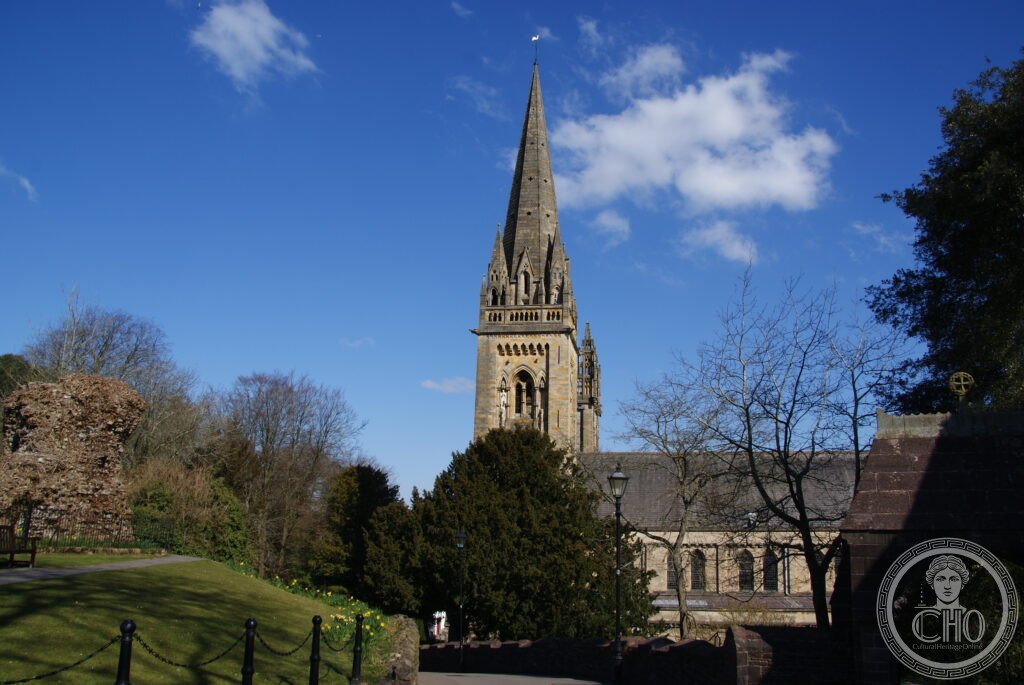
Sventrata da una mina paracadutata nel 1941, la cattedrale gallese più antica di Cardiff rinacque con un arco di cemento e una scultura di Jacob Epstein che affronta a viso aperto la navata medievale.
At a glance
Llandaff Cathedral stands on the banks of the River Taff in Llandaff, now a suburb of Cardiff, on a site with a Christian tradition stretching back to the early medieval period. The Norman bishop Urban, appointed in 1107, began construction of the present cathedral around 1120, transferring the relics of the Welsh saint Dubricius to the new building; the structure was substantially complete by the death of Bishop Nicholas ap Gwrgant in 1183. The cathedral has been rebuilt and restored repeatedly since — after storm damage in 1703, during a major Victorian restoration by John Prichard in the 19th century, and most dramatically after a German parachute mine destroyed much of the nave roof during the Cardiff Blitz on 2 January 1941. The post-war reconstruction, completed under architect George Pace by 1960, introduced one of the cathedral’s most striking features: Jacob Epstein’s sculpture Christ in Majesty, raised on a bare concrete arch above the nave.
Key facts
- Construction of the present cathedral began around 1120 under Norman bishop Urban, on a site associated with Welsh saints Dubricius and Teilo.
- Substantially completed by 1183, the year of Bishop Nicholas ap Gwrgant’s death.
- A German parachute mine destroyed the nave roof, south aisle, and chapter house on 2 January 1941, during the Cardiff Blitz.
- The cathedral reopened after reconstruction in 1958, with architect George Pace overseeing the post-war works.
- Sculptor Jacob Epstein created Christ in Majesty, a modernist figure mounted on a concrete arch above the nave — a deliberate contrast with the medieval fabric around it.
- Victorian architect John Prichard carried out a major restoration between 1841 and 1869 after centuries of neglect and partial ruin.
- The cathedral installed an entirely new pipe organ between 2010 and 2013, built by Nicholson & Co — the first wholly new organ for a British cathedral since Coventry’s in the 1960s.
History
Welsh tradition places the founding of a church at Llandaff in the sub-Roman period, associated with the saints Dubricius and Teilo, though the surviving building history begins with the Normans. Bishop Urban, appointed in 1107, began building the present cathedral around 1120 and had the relics of Saint Dubricius brought from Bardsey Island to the new church. Work continued under his successors, and the structure was largely finished by the time Bishop Nicholas ap Gwrgant died in 1183.
The following centuries were unkind to the building: it suffered severe damage during Owain Glyndŵr’s rebellion around 1400, and the Great Storm of 1703 brought down the southwest tower. An 18th-century attempt at restoration by John Wood the Elder, working in an incongruous Italian classical style, was left incomplete. It took a thorough Victorian restoration, led by architect John Prichard between 1841 and 1869, to return the cathedral to something like a coherent medieval form.
The most severe blow came on 2 January 1941, when a German parachute mine intended for Cardiff docks fell short and detonated close to the cathedral, blowing the roof off the nave, south aisle, and chapter house. Reconstruction did not begin in earnest until after the war; architect George Pace led the works through the 1950s, and the cathedral reopened in 1958. Pace’s design deliberately left the scars of history visible while introducing a bold modern element: a concrete parabolic arch spanning the nave, built to carry Jacob Epstein’s aluminium sculpture Christ in Majesty, unveiled in 1957.
What you see
The cathedral’s exterior mixes worked Dundry stone brought from Somerset in the Norman and medieval phases with local blue lias stone used in post-Reformation rebuilding, giving the walls a visibly layered history. Two towers rise unevenly at the west end: the northwest tower, rebuilt in fine Perpendicular style by Jasper Tudor in the 15th century, and a shorter southwest tower repaired after storm damage in the 18th century. Inside, the Norman arcades and medieval choir survive alongside clearly modern interventions from the 1950s reconstruction.
The building’s defining moment comes at the crossing, where George Pace’s raw concrete parabolic arch strides across the nave, carrying Jacob Epstein’s Christ in Majesty — a monumental aluminium figure of Christ enthroned, deliberately unpolished and confrontational rather than serene. Positioned directly above the congregation, it turns the scar of wartime destruction into the cathedral’s most recognisable image, a modernist intervention inside a building whose oldest fabric predates it by eight centuries.
Practical information
- Opening hours: Monday to Saturday, 08:00–17:30; Sunday, 08:00–16:00 (subject to services and events).
- Admission: free entry.
- Time needed: 30–45 minutes.
- Address: Llandaff Cathedral, Prebendal House, Llandaff, Cardiff, CF5 2LA.
Getting there
Llandaff is a suburb of Cardiff, about ten minutes by train from Cardiff Central to Fairwater station, followed by a 10–15 minute walk to the cathedral; bus routes 25, 63, and 66 from Westgate Street in central Cardiff also serve the area. Cardiff Airport lies around 12 miles to the southwest. Free parking is available around the cathedral green, with additional free parking (first two hours) off Llandaff High Street. GPS coordinates: 51.495748, -3.217855.
Nearby
- Cardiff Castle — Roman fort and Victorian Gothic revival castle in Cardiff city centre, about 3 miles from Llandaff.
- Bishop’s Palace, Llandaff — the ruined medieval residence of the Bishops of Llandaff, standing near the cathedral close.
Sources
- Wikipedia, “Llandaff Cathedral”
- Llandaff Cathedral, official visitor information (llandaffcathedral.org.uk)
Find it on the map
See this place and what’s around it →📷 Become a Cultural Heritage Online photographer
Share your photos of places: they stay published under your name as the author. The more they're seen, the more you get noticed — and soon a contest will reward the most appreciated photos.
Log in or sign up free to add a photoIs this page about you?
This page is read by travellers and heritage enthusiasts who find it on Google. Tell us how you are connected to this place and we will take it from there.