
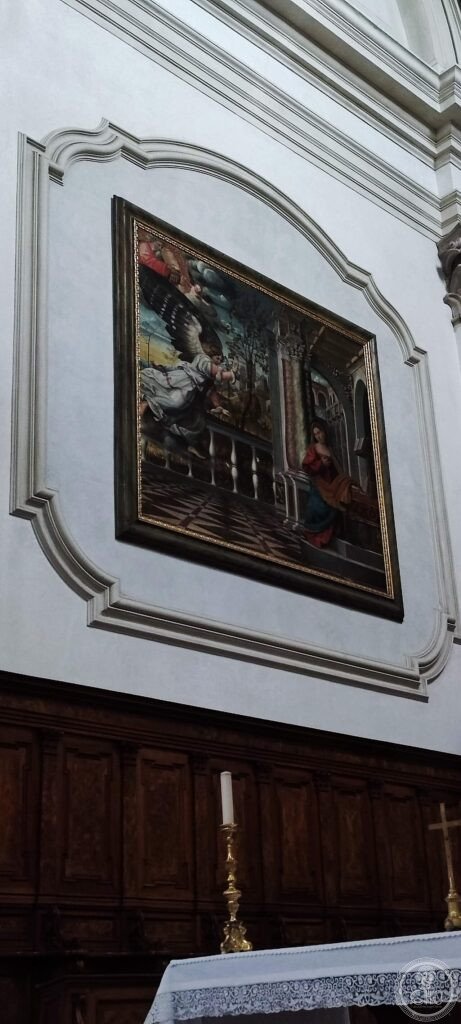
On the Meschio, in the walled heart of Serravalle, the parish church of Santa Maria Nova has kept since the sixteenth century an altarpiece that the town commissioned from Titian, and which the architect Domenico Schiavi enclosed in the present church in 1779.
At a glance
The Duomo di Serravalle, dedicated to Santa Maria Nova, stands in the Serravalle district of Vittorio Veneto, on the bank of the Meschio river facing Piazza Flaminio. Despite the name “Duomo,” it is the parish church of Serravalle rather than the diocese’s actual cathedral, whose seat, Santa Maria Assunta, sits across town in the Ceneda district. What Serravalle’s church holds instead is one of the region’s most important Renaissance commissions: an altarpiece painted for its high altar by Titian, contracted in 1542 and delivered by the early 1550s. The building seen today, with a gabled facade and a single rectangular nave with rounded corners, was completed in 1779 under the Tolmezzo architect Domenico Schiavi, replacing an earlier church that may date to the early 14th century — the period of the surviving bell tower standing beside it.
Key facts
- Dedication: Santa Maria Nova; parish church (“parrocchiale”) of Serravalle, diocese of Vittorio Veneto — not the diocesan cathedral, which is Santa Maria Assunta in the Ceneda district
- Rebuilt: completed in 1779 by architect Domenico Schiavi (1718-1795) of Tolmezzo, on the site of an earlier sacred building possibly dating to the early 1300s
- High altarpiece: Madonna in Gloria with Saints Andrew and Peter, commissioned from Titian in 1542, delivered in the early 1550s after payment disputes; oil on panel, 456 × 270 cm
- Bell tower: 14th-century Romanesque core on the Meschio riverbank, reworked over the centuries, with a mullioned bell chamber and an octagonal spire above a balustraded terrace
- Other artworks: paintings by Francesco da Milano (15th-16th c.), the Sacra Famiglia by Pietro Pajetta, 19th-century frescoes by Giovan Battista Canal and Felice Schiavoni
- Marble altars: the Confraternita dei Battuti altar (1645) by Francesco Cavrioli, the Santissimo Sacramento altar designed by architect Giuseppe Segusini with sculptures by Marco Casagrande, and baptistery reliefs by Paolo Possamai
- Organ and bells: the organ was built in 1822 by Agostino and Antonio Callido and is still used for concerts; the tower holds a peal of 5 bells cast in 1920 by the De Poli foundry of Vittorio Veneto
History
A sacred building is recorded on this site possibly as early as the start of the 14th century, the period historians attribute to the surviving bell tower once attached to the older church. During the Renaissance the church was enriched with work by leading local painters, some of which is still visible in the present building’s altars, before the whole structure was rebuilt to its current form in 1779 under the direction of architect Domenico Schiavi of Tolmezzo, giving Serravalle’s parish church its gabled facade and single nave with rounded corners.
The building’s most celebrated possession predates that 18th-century rebuild by more than two centuries. In the spring of 1542, the Serravalle council commissioned an altarpiece for the high altar; it first approached the local painter Francesco da Milano before turning instead to Titian, partly, contemporary sources suggest, for the prestige the choice conferred on the commissioners themselves. Titian was paid 250 ducats over time for the resulting Madonna in Gloria with Saints Andrew and Peter, likely finished around 1547-48, though the panel was not actually delivered to Serravalle until the early 1550s amid disputes over payment. The painting deteriorated over the following centuries and suffered a problematic restoration in 1865; two further conservation campaigns between 1991 and 2000 recovered much of its original color.
The 18th and 19th centuries added the church’s other major furnishings: the Santissimo Sacramento altar, designed by the Belluno architect Giuseppe Segusini with sculptural work by Marco Casagrande (who also worked on the Duomo of nearby Conegliano), the baptistery’s marble reliefs by Paolo Possamai, and, in 1822, the Callido organ still heard in concerts today. The tower’s five bells were recast by the De Poli foundry of Vittorio Veneto in 1920.
What you see
The facade is a plain gable (“a capanna”), broken only by a small oculus standing in for a rose window and by the tympanum-crowned entrance portal; the unadorned exterior envelope encloses a rectangular plan with smoothed, rounded corners. Inside, the single nave runs between three minor altars on each side, all reworked over the centuries in marble by successive local sculptors and architects, before arriving at the high altar and Titian’s altarpiece — a Sacra Conversazione of the Madonna and Child in glory flanked by Saints Andrew and Peter, with an apostolic fishing scene visible in the background.
Outside, the bell tower stands forward of the facade directly on the Meschio’s bank, its 14th-century Romanesque masonry visibly patched by later restorations; a square shaft rises to a bell chamber lit by mullioned two-light openings, then to a balustraded terrace from which an octagonal spire lifts above the rooftops. Between the Duomo and the tower, a small piazzetta opens toward the hill of the Santuario di Sant’Augusta, while along the church’s southern flank Via Casoni — formerly Via Tiera — runs beneath a covered portico lined with historic palazzi.
Practical information
- Hours: no posted museum-style opening hours; the church functions as an active parish and is generally accessible around Mass times
- Tickets: free admission
- Time needed: 20-30 minutes; visits outside Mass times are best arranged through the Comune di Vittorio Veneto tourism office
Getting there
Vittorio Veneto is served by its own railway station on the Conegliano-Ponte nelle Alpi line, about 2 km from Serravalle’s historic centre; Conegliano, on the Venice-Udine main line, is the nearest major rail junction, roughly 20 km away. The closest airport is Venice Treviso (Antonio Canova), about 35 km south; Venice Marco Polo is about 60 km away. By car, the A27 motorway (Venice-Belluno) has exits at Vittorio Veneto Sud and Vittorio Veneto Nord, both a short drive from Piazza Flaminio, where the Duomo faces the Meschio river. GPS: 45.9998° N, 12.2908° E.
Nearby
- Santuario di Sant’Augusta — reached on foot via the monumental staircase built in 1931-32 behind the Duomo; a pilgrimage shrine holding the relics, found in 1450, of the martyr venerated as Serravalle’s patron saint
- Castrum di Serravalle — surviving stretches of the medieval fortified walls and towers that once ringed the old town, linking the Sant’Augusta rock above to the demolished Porta del Terraglio behind the Duomo
- Via Casoni and the Palazzi di Serravalle — a porticoed street immediately beside the church, formerly called Via Tiera, lined with historic palazzi of the old walled town
Sources
- Comune di Vittorio Veneto — official tourism office, “Duomo di Serravalle” visitor sheet (turismovittorioveneto.it)
- Diocesi di Vittorio Veneto — official diocesan website (diocesivittorioveneto.it)
- Wikipedia — “Duomo di Serravalle” and “Pala di Serravalle” (it.wikipedia.org)
- Fondo Ambiente Italiano (FAI) — “I Luoghi del Cuore,” Duomo di Serravalle listing (fondoambiente.it)
Find it on the map
See this place and what’s around it →📷 Become a Cultural Heritage Online photographer
Share your photos of places: they stay published under your name as the author. The more they're seen, the more you get noticed — and soon a contest will reward the most appreciated photos.
Log in or sign up free to add a photoIs this page about you?
This page is read by travellers and heritage enthusiasts who find it on Google. Tell us how you are connected to this place and we will take it from there.