
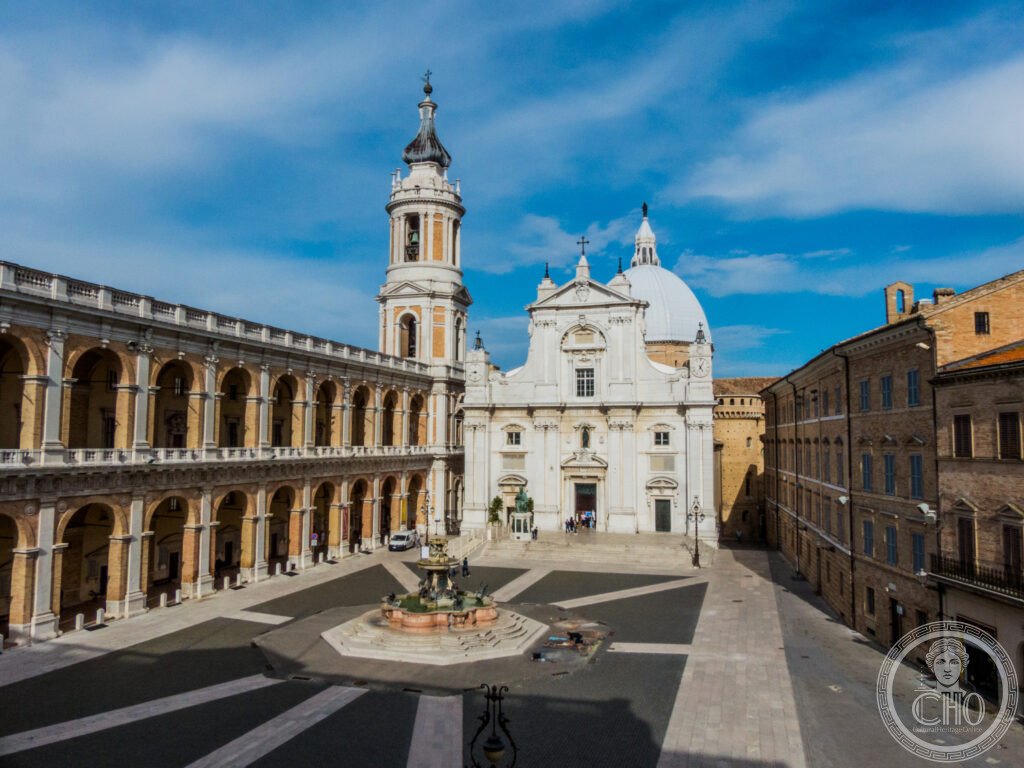
Dentro una basilica rinascimentale costruita apposta per custodirla, tre pareti di pietra non locale — secondo la tradizione la casa di Nazareth dove visse Maria — sono racchiuse in un rivestimento marmoreo disegnato da Bramante. Da secoli è una delle mete di pellegrinaggio più importanti della cristianità.
At a glance
The Basilica della Santa Casa in Loreto, in the Marche region, was built between 1469 and 1587 specifically to enclose and protect the Santa Casa (Holy House) — three stone walls that devotional tradition holds to be part of the house in Nazareth where the Virgin Mary was born, lived, and received the Annunciation. According to the tradition recorded from the late 13th century onward, the house was carried from Nazareth to the Marche coast, and finally to its present hilltop site, in the night between 9 and 10 December 1294 — a translation popular devotion long attributed to angels, though a widely accepted critical-historical hypothesis instead credits the transport to a Crusader-era Christian family named Angeli, whose name may have fed the angelic legend. Archaeological and material analysis lends some support to a genuine Levantine origin for the stones: the Santa Casa’s masonry does not match local Marche building material and instead corresponds to construction techniques and stone typical of Palestine at the time of Christ, and its three surviving walls fit precisely against the still-existing fourth wall and grotto in Nazareth. Whatever the precise historical mechanism, Loreto’s sanctuary has drawn pilgrims for over seven centuries and remains one of the most visited Marian shrines in Italy.
Key facts
- Translation tradition: the Santa Casa is held by tradition to have arrived at Loreto on the night of 9-10 December 1294, after an earlier stop near Recanati’s port; popular legend credits angels, while a widely accepted historical hypothesis points to Crusader-era transport by a Christian family
- Basilica: built 1469-1587 to enclose the Santa Casa; its dome, by Giuliano da Maiano and Giuliano da Sangallo, spans 22 metres and was explicitly inspired by Brunelleschi’s dome of Florence Cathedral
- Marble screen (rivestimento marmoreo): commissioned by Pope Julius II and designed by Donato Bramante in 1507, one of the major sculptural ensembles of the Italian Renaissance, wrapping the Santa Casa’s exterior in relief-carved marble
- Material evidence: the Santa Casa’s stone does not match local Marche building material and instead corresponds to construction typical of Palestine in the 1st century; its three walls align precisely with the surviving grotto and fourth wall still venerated in Nazareth
- Function today: a Pontifical Sanctuary (Santuario Pontificio) under direct Holy See jurisdiction; site of the Vatican-run Loreto Airport originally built to serve Marian air pilgrimages, and patronal shrine of aviators (Our Lady of Loreto was declared patroness of aviation in 1920)
History
Devotion to the Santa Casa developed rapidly after its documented appearance on the Marche coast in the late 13th century, and by the 15th century the site had become significant enough a pilgrimage destination that successive popes committed major resources to building an appropriately monumental basilica around the relic itself; construction proceeded from 1469 through 1587, drawing on a sequence of Renaissance architects and artists across more than a century. The marble screen enclosing the Santa Casa’s exterior, commissioned by Julius II and designed by Bramante from 1507, ranks among the most significant sculptural programmes of the Roman High Renaissance, its relief panels depicting scenes from the life of the Virgin carved by a workshop that included several of the era’s leading sculptors working from Bramante’s design after his death.
The critical-historical explanation of the Santa Casa’s transport — Crusader-era removal by a Christian family, rather than angelic flight — gained wider scholarly acceptance particularly from the 20th century onward, as archival research uncovered documentary traces consistent with a family named Angeli (or de Angelis) having been involved in transporting relics from the Holy Land following the fall of the last Crusader strongholds in the late 13th century, a period when the collapse of Christian control in the Levant prompted the removal of numerous relics and sacred objects to Europe. This historical account does not, in the Church’s own current framing, negate the site’s devotional significance or the material evidence connecting the stones to a genuine Nazareth origin; rather, it offers a historically grounded mechanism for how a structure with authentic Palestinian building characteristics came to stand on an Italian hillside, replacing the purely miraculous account without necessarily displacing the underlying claim of the house’s authenticity. Loreto’s status as a major pilgrimage site continued to grow across the following centuries, formalised in the 20th century by its designation as patronal shrine for aviators and by direct Holy See governance as a Pontifical Sanctuary.
What you see
The basilica’s dome, at 22 metres in diameter among the largest Renaissance domes in Italy, rises directly above the Santa Casa itself, which stands as an independent structure inside the church rather than forming part of the basilica’s own load-bearing walls — visitors walk around the exterior of the Casa, enclosed in Bramante’s carved marble screen, before entering its plain, un-marbled interior through a low doorway. Inside the Santa Casa, worn stone walls and a small altar contrast deliberately with the elaborate marble exterior, preserving what tradition holds to be the room’s original, unadorned fabric rather than extending the Renaissance decorative programme into the sacred space itself. The marble screen’s relief panels, largely executed after Bramante’s 1514 death by sculptors working from his designs, depict episodes from the life of the Virgin, including scenes of the Nativity and the Santa Casa’s own translation to Loreto.
Practical information
- Basilica hours: open daily from around 6:15 to 19:30 for individual prayer and visits; no entrance ticket required
- Masses: weekdays approximately 7:00 (inside the Santa Casa), 7:30, 8:30, 10:00, 11:00, 17:00, 18:30; Sundays/feast days additional times through 21:00; the Angelus is recited daily at noon, broadcast on Italian television
- Location: Piazza della Madonna, Loreto (province of Ancona)
Getting there
Loreto has its own railway station (Loreto) on the Adriatic coastal line, connecting to Ancona in around 15-20 minutes and to Bologna or points further north with a change; from the station, the historic hilltop centre is reached by local bus or a steep uphill walk. Ancona-Falconara “Raffaello Sanzio” Airport, roughly 20-30 minutes away, is the nearest air gateway. By car, Loreto sits just off the A14 Adriatic motorway. GPS: 43.4410° N, 13.6108° E.
Nearby
- Recanati — a short drive away; birthplace of the poet Giacomo Leopardi, with his family home and a museum dedicated to his work
- Ancona historic centre — around 20-30 minutes away; a Roman and medieval port city with a Romanesque cathedral, Duomo di San Ciriaco, on the Guasco hill
- Riviera del Conero — a short distance south of Ancona; a protected coastal park of limestone cliffs and beaches along the Adriatic
Sources
- Santuario Pontificio della Santa Casa di Loreto — official visitor and history portal (santuarioloreto.va)
- Wikipedia — “Basilica della Santa Casa” (en.wikipedia.org)
- Italia.it — official Italian tourism board, Marche/Loreto (italia.it)
- Enciclopedia Treccani — entries on Loreto and Bramante
Find it on the map
See this place and what’s around it →📷 Become a Cultural Heritage Online photographer
Share your photos of places: they stay published under your name as the author. The more they're seen, the more you get noticed — and soon a contest will reward the most appreciated photos.
Log in or sign up free to add a photoIs this page about you?
This page is read by travellers and heritage enthusiasts who find it on Google. Tell us how you are connected to this place and we will take it from there.