
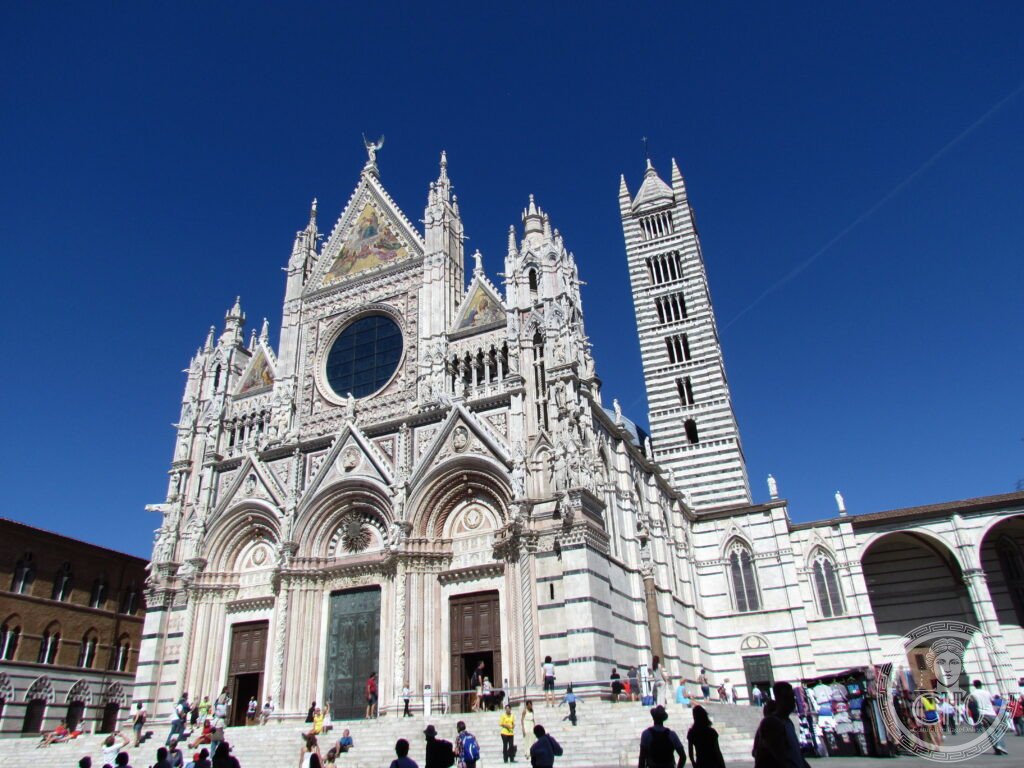
Bande di marmo bianco e verde scuro corrono lungo tutta la cattedrale senese, dalla facciata di Giovanni Pisano fino al pavimento a intarsio che l’Opera del Duomo tiene coperto quasi tutto l’anno per proteggerlo — e che si scopre solo per poche settimane, di solito a settembre.
At a glance
Siena Cathedral, dedicated to the Assumption of the Virgin (Santa Maria Assunta), was consecrated in 1179 and largely built between 1196 and the mid-14th century, on a hilltop site tradition holds occupied by an earlier 9th-century church. Its black-and-white banded marble, echoed on the campanile, is one of the clearest visual signatures of Sienese Gothic architecture, and its lower facade — carved by Giovanni Pisano, appointed capomaestro in 1284 — carries one of the richest sculptural programmes of any Italian cathedral facade. Inside, the cathedral holds two features of exceptional rarity: Nicola Pisano’s marble pulpit (1265-1268), one of the pivotal works of 13th-century Italian sculpture, and a floor of 56 inlaid marble panels (the pavimento), largely kept covered for conservation and uncovered to the public only for a few weeks most years, typically in late summer.
Key facts
- Consecrated: 1179, in the presence of the Sienese-born Pope Alexander III; main construction 1196 to the mid-14th century
- Facade: lower register (Romanesque-Gothic, sculpted with prophets, sibyls, and philosophers) by Giovanni Pisano, capomaestro 1284-1297; upper mosaic register completed in the 19th century
- Pulpit: by Nicola Pisano (Giovanni’s father), 1265-1268, carved in marble with dense narrative relief panels of the life of Christ — a landmark work bridging Gothic and classical influence in Italian sculpture
- Pavimento (floor): 56 inlaid marble panels by numerous artists across two centuries, including Domenico Beccafumi and Matteo di Giovanni, depicting biblical, allegorical, and historical scenes; uncovered fully only 6-10 weeks a year, typically including September
- Libreria Piccolomini: built from 1492 to house Pope Pius II’s book collection; frescoed by Pinturicchio and workshop, 1503-1508, with scenes from Pius II’s life beneath a grotesque-style vault
- The “Duomo Nuovo”: the unfinished remains of an ambitious 1330s-1340s attempt to enlarge the cathedral into one of the largest churches in Christendom, abandoned after structural problems and the 1348 Black Death; the would-be nave now forms an open-air panorama terrace
History
The cathedral’s 1179 consecration, attended by the Sienese pope Alexander III shortly after the papacy’s reconciliation with Emperor Frederick Barbarossa, marked an early milestone in a building campaign that unfolded over the following two centuries as Siena’s civic and commercial power grew. Giovanni Pisano’s appointment as capomaestro in 1284 brought the lower facade its defining sculptural programme; further work extended and completed the upper register only much later, with 19th-century mosaic decoration replacing or supplementing the medieval scheme. Siena’s ambitions reached their peak in the 1330s and 1340s, when the city, then at the height of its economic and political power, began the “Duomo Nuovo,” an enlargement intended to make the cathedral one of the largest in the Christian world by turning the existing building into merely a transept of a far larger nave.
This project halted amid structural difficulties with the new foundations and was then decisively abandoned after the Black Death of 1348 devastated Siena’s population and, with it, both the civic wealth and the workforce the project depended on — a demographic and economic shock from which the city’s medieval expansion never fully recovered. The unfinished walls and arches of the Duomo Nuovo survive today as one of the most evocative “great unbuilt” fragments of Italian Gothic architecture, now used as a public viewing terrace over the city. Inside the completed cathedral, work continued in different forms for centuries afterward: Pope Pius II, a Sienese native, commissioned the Piccolomini Library in 1492 to house his personal book collection, and Pinturicchio’s subsequent fresco cycle there, completed in 1508, remains one of the best-preserved Renaissance fresco programmes in Italy specifically because the library’s more limited, controlled public exposure has spared it much of the wear affecting more heavily used spaces of the cathedral.
What you see
The facade’s lower register, by Giovanni Pisano, crowds prophets, sibyls, and classical philosophers into a dense Gothic sculptural programme unusual for its combination of biblical and pagan figures within a single Christian building’s facade — several of the original marble statues are now held in the Museo dell’Opera del Duomo, replaced on-site by copies to protect the originals from weathering. Inside, the black-and-white banded piers continue the exterior’s striping into a vast, dim nave, at the centre of which Nicola Pisano’s pulpit stands on carved marble columns, its narrative panels depicting the Nativity, Adoration of the Magi, Massacre of the Innocents, Crucifixion, and Last Judgment in a dense, deeply undercut relief style that marked a turning point in Italian sculpture.
The pavimento beneath visitors’ feet, when uncovered, reveals 56 individual marble panels executed across roughly two centuries by dozens of different artists and workshops, ranging from graffito-technique outline drawings to fully modelled inlay compositions depicting subjects from the Sibyls to the story of Absalom and the expulsion of Herod. The Piccolomini Library, reached from the nave, presents an entirely different visual register: Pinturicchio’s brightly coloured fresco cycle narrating Pius II’s life fills the walls beneath a densely patterned grotesque-style vault, framing the library’s collection of illuminated choir books.
Practical information
- Opening hours: generally 10:30-18:00, with seasonal and liturgical variations; check operaduomo.siena.it before visiting
- Tickets: the OPA SI PASS combined ticket covers the Cathedral, Piccolomini Library, Baptistery, Crypt, Museo dell’Opera, the Porta del Cielo (facade rooftop walkway), and the Duomo Nuovo panorama terrace; valid for three consecutive days from first use
- Pavimento uncovering: the full inlaid floor is visible only during a limited annual window, typically several weeks including September; check current-year dates before planning a visit around it
- Time needed: around 2 hours to see the full OPA SI PASS itinerary
Getting there
Siena’s historic centre is closed to private traffic; visitors arriving by car should use the Siena Ovest exit from the Florence-Siena autostrada toward the Parcheggio Duomo, or Siena Sud toward Parcheggio Il Campo, both a short walk from the cathedral. By train, Siena station connects to Florence in approximately 1.5 hours (with a change) and sits at the edge of the historic centre, requiring a walk or local bus up to Piazza del Duomo. GPS: 43.3178° N, 11.3291° E.
Nearby
- Piazza del Campo — a short walk from the Duomo; Siena’s shell-shaped main square and the course of the Palio horse race
- Battistero di San Giovanni — beneath the cathedral’s apse, part of the OPA SI PASS itinerary; a baptismal font with bronze reliefs by Donatello, Ghiberti, and Jacopo della Quercia
- Basilica di San Domenico — across the city on its own hill; holds the preserved head of Saint Catherine of Siena
Sources
- Opera del Duomo di Siena — official visitor and history portal (operaduomo.siena.it)
- Ministero della Cultura — entry on Cattedrale di Siena e Libreria Piccolomini (cultura.gov.it)
- Wikipedia — “Siena Cathedral” (en.wikipedia.org)
- Visit Tuscany — regional visitor information (visittuscany.com)
Find it on the map
See this place and what’s around it →📷 Become a Cultural Heritage Online photographer
Share your photos of places: they stay published under your name as the author. The more they're seen, the more you get noticed — and soon a contest will reward the most appreciated photos.
Log in or sign up free to add a photoIs this page about you?
This page is read by travellers and heritage enthusiasts who find it on Google. Tell us how you are connected to this place and we will take it from there.