
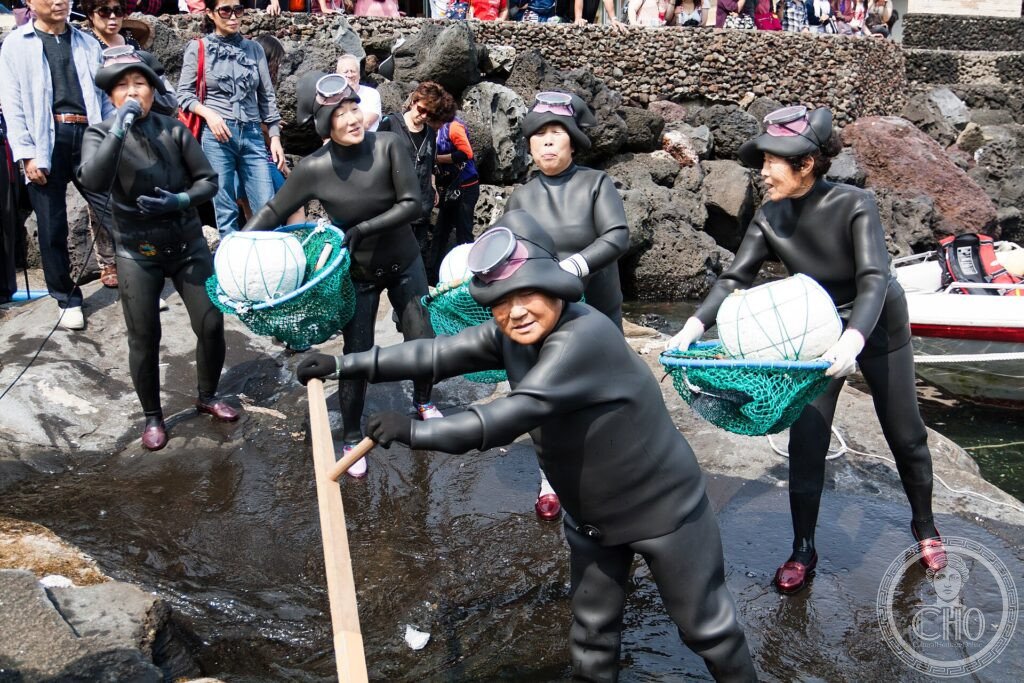
For generations, the haenyeo of Jeju have sustained their families through deep-sea diving, harvesting mollusks, seaweed, and other marine life without mechanical aids. Their practice embodies independence, resilience, and a distinctive semi-matriarchal way of life.
At a glance
Haenyeo are female divers whose livelihood depends on breath-held diving into Jeju’s cold waters. Working independently or in small groups, they navigate the seafloor by feel and memory, reading currents and seasons to locate their catch. Their trade has sustained Jeju’s economy and shaped its social fabric for centuries, with women often serving as primary breadwinners for their households.
Origins & history
The roots of haenyeo diving stretch deep into Jeju’s past, though exact origins remain unclear. What is certain is that this practice has become inseparable from Jeju identity, creating a distinctive semi-matriarchal family structure where women hold economic and social authority. The tradition persists today despite modernization and changing economic conditions.
The practice
A haenyeo diver descends in a simple wetsuit, mask, and weights, carrying a net or basket. She holds her breath—sometimes for more than two minutes—while working the rocky seafloor, feeling for abalone, sea cucumber, and edible seaweed with practiced hands. The sound of her distinctive rhythmic breathing as she surfaces, repeated across hours of diving, marks the soundscape of Jeju’s coastal villages.
Divers work seasonally, their calendar dictated by water temperature and marine cycles. Younger women dive deeper and longer; older haenyeo work shallower waters but often possess superior knowledge of seafloor geography and resource locations. Community bonds are forged through shared labor, with divers gathering before dawn and returning at dusk.
Cultural significance
The haenyeo embody an independent spirit and determination that defines Jeju culture. By controlling their own labor and income, these women have maintained economic autonomy unusual in East Asian societies. The practice represents not extraction but stewardship—a sustainable relationship with marine resources refined over generations.
Their recognition as UNESCO Intangible Cultural Heritage acknowledges both the practice’s survival value and its role in preserving Jeju’s distinct identity in an increasingly homogenized world.
Key facts
- Anchor community: Jeju City, South Korea (33.50785, 126.52062)
- Countries: South Korea
- UNESCO Intangible Cultural Heritage: 2016 (reference 01068)
- Livelihood: harvesting mollusks, seaweed, and other sea life by breath-held diving
Where to experience it
Jeju City remains the heartland of haenyeo culture. While the number of active divers has declined, the practice continues along Jeju’s coasts. Visitors can encounter divers at work during daylight hours, particularly in summer months when water conditions are favorable and tourism peaks.
Sources & resources
- Haenyeo — Wikipedia
- Culture of Jeju haenyeo women divers — UNESCO Intangible Cultural Heritage
- Cultural Heritage Online
Find it on the map
See this place and what’s around it →📷 Become a Cultural Heritage Online photographer
Share your photos of places: they stay published under your name as the author. The more they're seen, the more you get noticed — and soon a contest will reward the most appreciated photos.
Log in or sign up free to add a photo