
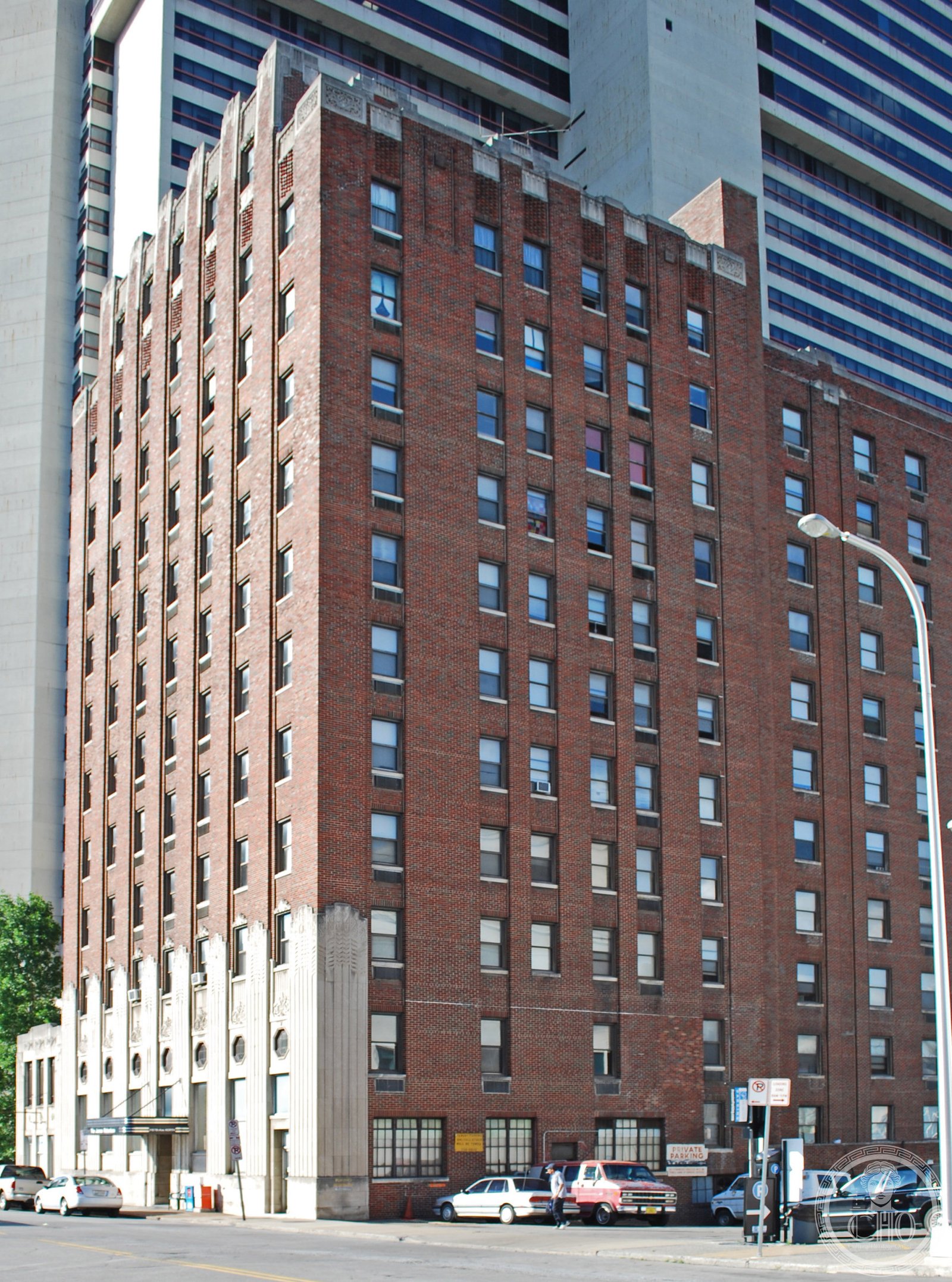
A 1929 Art Deco hotel at 118 North 7th Avenue in downtown Nashville — designed by Marr & Holman, the city’s most prolific early 20th-century architectural firm, listed on the National Register of Historic Places in 1984, and now serving as the James Robertson Apartments.
At a glance
The James Robertson Hotel stands at 118 North 7th Avenue at Commerce Street in the heart of downtown Nashville, Tennessee. Completed in 1929 and designed by the Nashville firm Marr & Holman, the building represents one of the city’s most important surviving examples of the Art Deco commercial style that defined American urban development in the late 1920s. Listed on the National Register of Historic Places on October 10, 1984 (reference 84000092) as part of the Multiple Property Submission for Marr and Holman Buildings in Downtown Nashville, the building has since been converted to residential use as the James Robertson Apartments, occupying its 0.5-acre site within Nashville’s downtown historic district.
Key facts
- Built: 1929
- Style: Art Deco
- Architects: Marr & Holman, Nashville
- Site: 0.5 acres at North 7th Avenue and Commerce Street, downtown Nashville
- NRHP: October 10, 1984 (ref. 84000092); part of “Marr and Holman Buildings in Downtown Nashville TR” multiple property submission
- Current use: James Robertson Apartments (residential conversion)
- Address: 118 North 7th Avenue, Nashville, Tennessee 37219
- GPS: 36.16028, −86.78167
History
The James Robertson Hotel was completed in 1929, during the final years of the 1920s building boom that transformed downtown Nashville from a Victorian commercial district into a city of Art Deco towers and hotels. The building takes its name from James Robertson, the frontier leader who co-founded Nashville’s predecessor settlement of Fort Nashborough in 1779 — a naming convention that placed the hotel in the tradition of Nashville’s practice of honoring its founders in its most prominent commercial buildings. The architects, Marr & Holman, were the dominant architectural firm in Nashville during the Art Deco period: their commissions included a series of hotels, office buildings, and public structures across downtown Nashville that collectively constitute the most coherent surviving Art Deco district in Tennessee.
The building’s NRHP designation in 1984 came as part of a Multiple Property Submission that recognized the collective significance of Marr & Holman’s downtown Nashville work — an early and important example of the preservation community’s recognition that Art Deco commercial architecture deserved the same protection as earlier building types. The conversion to apartments under the James Robertson Apartments name represents the trajectory of many of Nashville’s historic hotel buildings: the decline of the mid-century downtown hotel market, followed by the residential conversion that 21st-century downtown revitalization has made economically viable. The building’s position within Nashville’s expanded downtown residential market — driven by the city’s rapid growth since the 2000s — has ensured its maintenance and ongoing presence in the downtown streetscape.
What you see
The James Robertson Hotel’s Art Deco character is expressed through the vocabulary that Marr & Holman developed across their Nashville commissions: the vertical surface articulation, the geometric ornament at the cornice and at street level, and the massing strategy that produces a tower silhouette well-adapted to the narrow Nashville street grid. The building reads as a contained urban block — its facades organized by the alternating rhythm of window bays and pilasters characteristic of the best Art Deco hotel design — rather than as a free-standing tower, which gives it a civic quality appropriate to its position within Nashville’s downtown historic district.
The building’s conversion to residential use has preserved its exterior character while substantially altering its interior. The lobby — originally the ceremonial entry to a commercial hotel — has been adapted to the requirements of an apartment building. The North 7th Avenue facade, which remains the building’s primary public face, preserves the Art Deco surface treatment that earned the building’s NRHP designation: the geometric ornament in the masonry, the cornice treatment at the top of the tower, and the articulation of the base at street level that gives the building its urban presence. The Marr & Holman Buildings Multiple Property designation specifically recognizes this exterior character as the building’s primary historic value.
Practical information
- The James Robertson Apartments is an active residential building; interior public access is not available.
- The exterior is best viewed from North 7th Avenue between Commerce Street and Union Street.
- The NRHP designation plaque is at the main entrance on North 7th Avenue.
- The building is within walking distance of Nashville’s major tourist destinations in the Broadway entertainment district.
Getting there
The James Robertson Hotel is at 118 North 7th Avenue in downtown Nashville, Tennessee. Nashville International Airport (BNA) is approximately 8 miles east of downtown via Interstate 40. The WeGo Public Transit system serves downtown Nashville with multiple bus routes; the Music City Star commuter rail runs to the Riverfront Station approximately 10 blocks east. By car, Interstate 40 and Interstate 65 intersect in the southern portion of downtown Nashville; the Broadway and Church Street exits provide direct access to the 7th Avenue corridor. The building is a 5-minute walk from the Tennessee State Capitol (1859) and a 10-minute walk from the Broadway honky-tonk district along Lower Broadway.
Nearby
- Tennessee State Capitol (1859) — approximately 3 blocks northwest on Charlotte Avenue; the Greek Revival capitol building completed by William Strickland, who died before its completion and is interred within its walls; open for public tours on weekdays; the grounds afford a panoramic view of downtown Nashville
- Country Music Hall of Fame and Museum — approximately 6 blocks southeast at 222 5th Avenue South; the largest popular music museum in the world, with 350,000 artifacts documenting the history of country music; the building’s architecture, by Tuck Hinton, draws explicitly on the geometry of piano keys and musical notation
- Ryman Auditorium (1892) — approximately 5 blocks south at 116 5th Avenue North; the former Union Gospel Tabernacle, built by riverboat captain Thomas G. Ryman as a revival meeting hall; the original home of the Grand Ole Opry (1943–1974); the Victorian Gothic building is one of the most acoustically perfect performance spaces in the world and hosts concerts year-round
Sources
- Wikipedia: “James Robertson Hotel” (Nashville, Tennessee)
- National Register of Historic Places: James Robertson Hotel, ref. 84000092, National Park Service (1984); Multiple Property Submission: “Marr and Holman Buildings in Downtown Nashville TR”
- Wikimedia Commons: RobertsonHotelNashville.jpg, CC BY-SA 3.0, Andrew Jameson
Find it on the map
See this place and what’s around it →Record researched and written by Luigi De Marchi for Cultural Heritage Online, 2026.
📷 Become a Cultural Heritage Online photographer
Share your photos of places: they stay published under your name as the author. The more they're seen, the more you get noticed — and soon a contest will reward the most appreciated photos.
Log in or sign up free to add a photoIs this page about you?
This page is read by travellers and heritage enthusiasts who find it on Google. Tell us how you are connected to this place and we will take it from there.