
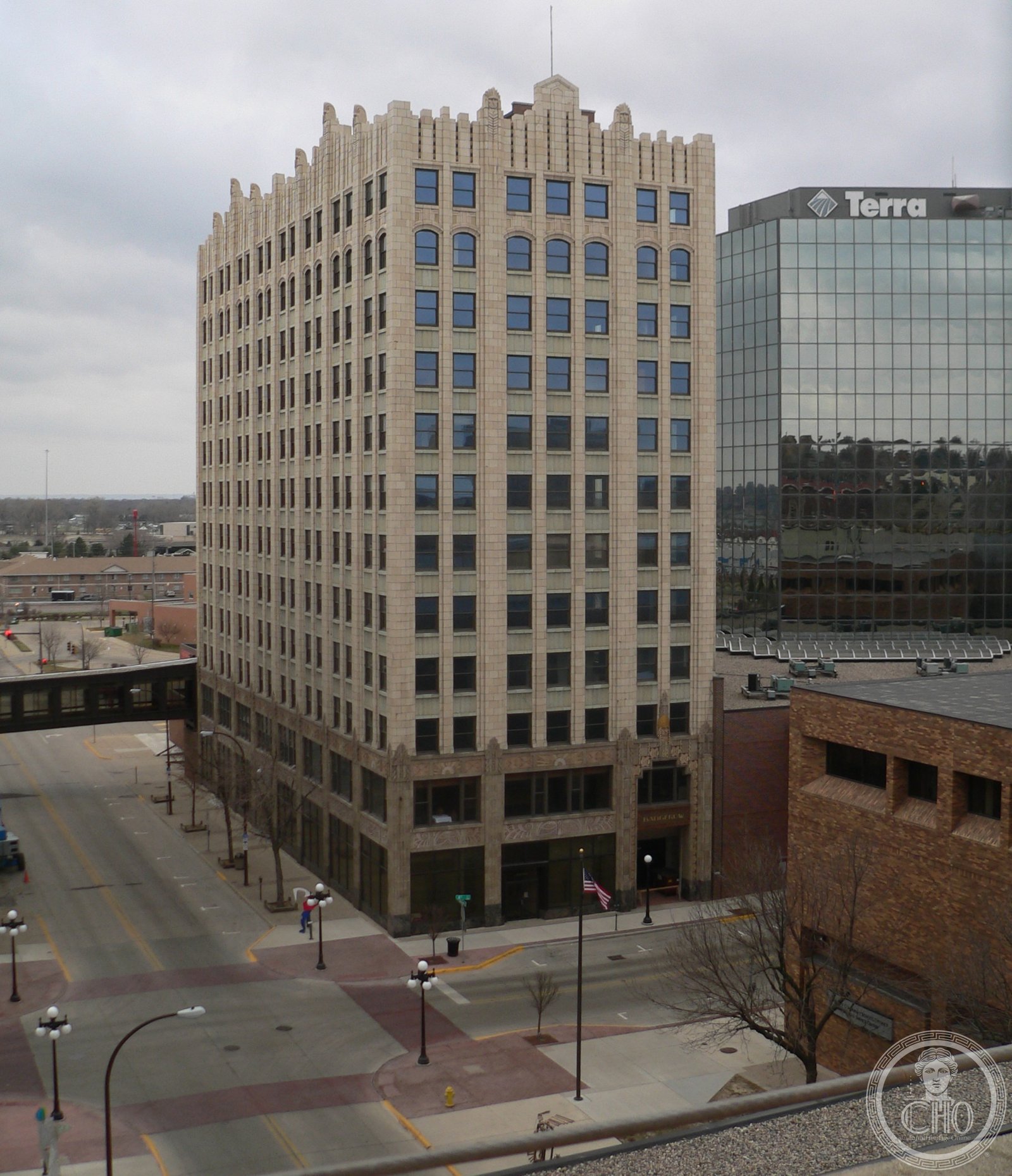
A twelve-story Art Deco office tower at 622 4th Street in downtown Sioux City — designed by K.E. Westerlind and completed in 1933 with a distinctive terra cotta facade featuring vertical piers, bronze ornamentation, and a recurring Native American head motif; the tallest building in Sioux City for many years; one of five buildings that represented the 1930s in Iowa’s 50 Most Significant Buildings of the 20th Century.
At a glance
The Badgerow Building stands at 622 4th Street in downtown Sioux City, Iowa. Designed by the Sioux City architectural firm of K.E. Westerlind and completed in 1933, the twelve-story Art Deco office tower rises 169 feet — enough to make it the tallest building in Sioux City for many years after its completion. Listed on the National Register of Historic Places in 1982, the Badgerow Building was named one of the 50 Most Significant Iowa Buildings of the 20th Century by the Iowa Chapter of the American Institute of Architects — one of only five buildings on the list representing the 1930s, a recognition of the building’s significance both as an example of Art Deco office design and as a marker of Sioux City’s ambition and resilience during the Depression years.
Key facts
- Built: 1933
- Style: Art Deco
- Architect: K.E. Westerlind, Sioux City
- Height: 169 feet (52 m), 12 stories
- Facade material: Terra cotta
- Ornament: Vertical piers, bronze ornamentation, geometric window highlights, recurring Native American head motif
- Interior: Lobby with black Belgian marble and pink Tennessee marble walls; terrazzo floors
- NRHP listed: March 24, 1982 (ref. 82002646)
- Distinction: One of 50 Most Significant Iowa Buildings of the 20th Century (Iowa AIA); one of five 1930s buildings on the list
- Address: 622 4th Street, Sioux City, Iowa 51101
- GPS: 42.49386, −96.40225
History
Sioux City, Iowa reached the peak of its commercial development in the first three decades of the 20th century, sustained by its position as a livestock and agricultural processing center for the Northern Plains. The Badgerow Building — completed in 1933 at the depth of the Depression — represents the continuation of this building ambition even in the most difficult economic conditions of the era. The choice of terra cotta with bronze ornamentation and a distinctive decorative program incorporating a Native American head motif was not merely decorative: it placed the building in a regional tradition of incorporating Plains Indian imagery into the built environment of a city that had grown up on the Missouri River at the edge of the Northern Plains, and it gave the Badgerow Building a distinct identity among the Art Deco towers being constructed across the country in the early 1930s.
The building served as Sioux City’s tallest structure for years after its completion — a status that carried particular weight in a Prairie city where vertical ambition was measured against the flat horizon of the surrounding agricultural landscape. Its recognition by the Iowa AIA as one of the five buildings representing the 1930s among the 50 Most Significant Iowa Buildings of the 20th Century reflects the dual significance of the Badgerow: as an architectural achievement of the Art Deco period and as a civic monument to Depression-era Sioux City’s economic confidence.
What you see
The Badgerow Building’s terra cotta facade is organized around the vertical pier system that is one of the defining formal strategies of Art Deco office architecture in the early 1930s. The vertical piers — rising from the base to the building’s crown — create a strong upward rhythm that counteracts the Depression-era tendency toward horizontal emphasis in commercial architecture, while the bronze ornamentation and the geometric window highlights establish the Art Deco identity at the key visual nodes of the facade: entrance surround, floor transitions, and crown. The recurring Native American head motif — integrated into the terracotta ornamental panels at multiple levels of the facade — is the most distinctive element of the building’s exterior, a regional ornamental choice that distinguishes the Badgerow from generic Art Deco office towers and connects it to the specific cultural geography of the Missouri River plains.
The lobby interior carries the same quality of material investment as the exterior: black Belgian marble and pink Tennessee marble on the walls, terrazzo floors — a combination that communicates institutional solidity and commercial ambition in the specific material vocabulary that the most serious Art Deco office buildings of the period aspired to. The contrast between the black Belgian marble and the pink Tennessee marble produces a polychromatic effect that was characteristic of the most sophisticated Art Deco interiors of the Depression era.
Practical information
- The Badgerow Building is an active commercial office building; the lobby is accessible during business hours.
- The exterior is visible from 4th Street and the surrounding downtown Sioux City streetscape.
- The NRHP listing plaque is at the main entrance.
Getting there
The Badgerow Building is at 622 4th Street in downtown Sioux City, Iowa. Sioux Gateway Airport/Colonel Bud Day Field (SUX) is approximately 6 miles south of downtown via US Highway 75. By car, Interstate 29 parallels the Missouri River through Sioux City; the Singing Hills Boulevard/Floyd Boulevard and Iowa Highway 12 exits provide access to downtown. Sioux City is at the confluence of Iowa, Nebraska, and South Dakota, making it the gateway to a region whose Art Deco civic and commercial architecture — the Sioux City Municipal Auditorium (1938), the Warrior Hotel (1930), the Federal Building and Courthouse (1932) — is concentrated in a downtown walkable from the Badgerow Building.
Nearby
- Sioux City Municipal Auditorium (1938) — approximately 3 blocks southeast on Douglas Street; the WPA-era Art Deco municipal auditorium that has hosted civic events and concerts for nearly 90 years; one of the defining examples of New Deal public architecture in Iowa
- Sergeant Floyd Monument — approximately 1.5 miles north on Lewis Boulevard; the 1900 obelisk marking the burial site of Sergeant Charles Floyd, the only member of the Lewis and Clark Expedition to die during the journey; a National Historic Landmark
- Sioux City Art Center — at 225 Nebraska Street; the municipal art museum with collections of American art, regional works, and traveling exhibitions; housed in a 1938 PWA-era building expanded by a 2001 addition
Sources
- Wikipedia: “Badgerow Building”
- NRHP listing, March 24, 1982, ref. 82002646, National Register of Historic Places
- Iowa Chapter, American Institute of Architects: “A Century of Iowa Architecture: 50 Most Significant Iowa Buildings of the 20th Century,” Iowa Public Television, 2010
- Wikimedia Commons: Badgerow_Bldg_from_NE_3.JPG, CC0, Ammodramus
Find it on the map
See this place and what’s around it →Record researched and written by Luigi De Marchi for Cultural Heritage Online, 2026.
📷 Become a Cultural Heritage Online photographer
Share your photos of places: they stay published under your name as the author. The more they're seen, the more you get noticed — and soon a contest will reward the most appreciated photos.
Log in or sign up free to add a photoIs this page about you?
This page is read by travellers and heritage enthusiasts who find it on Google. Tell us how you are connected to this place and we will take it from there.