
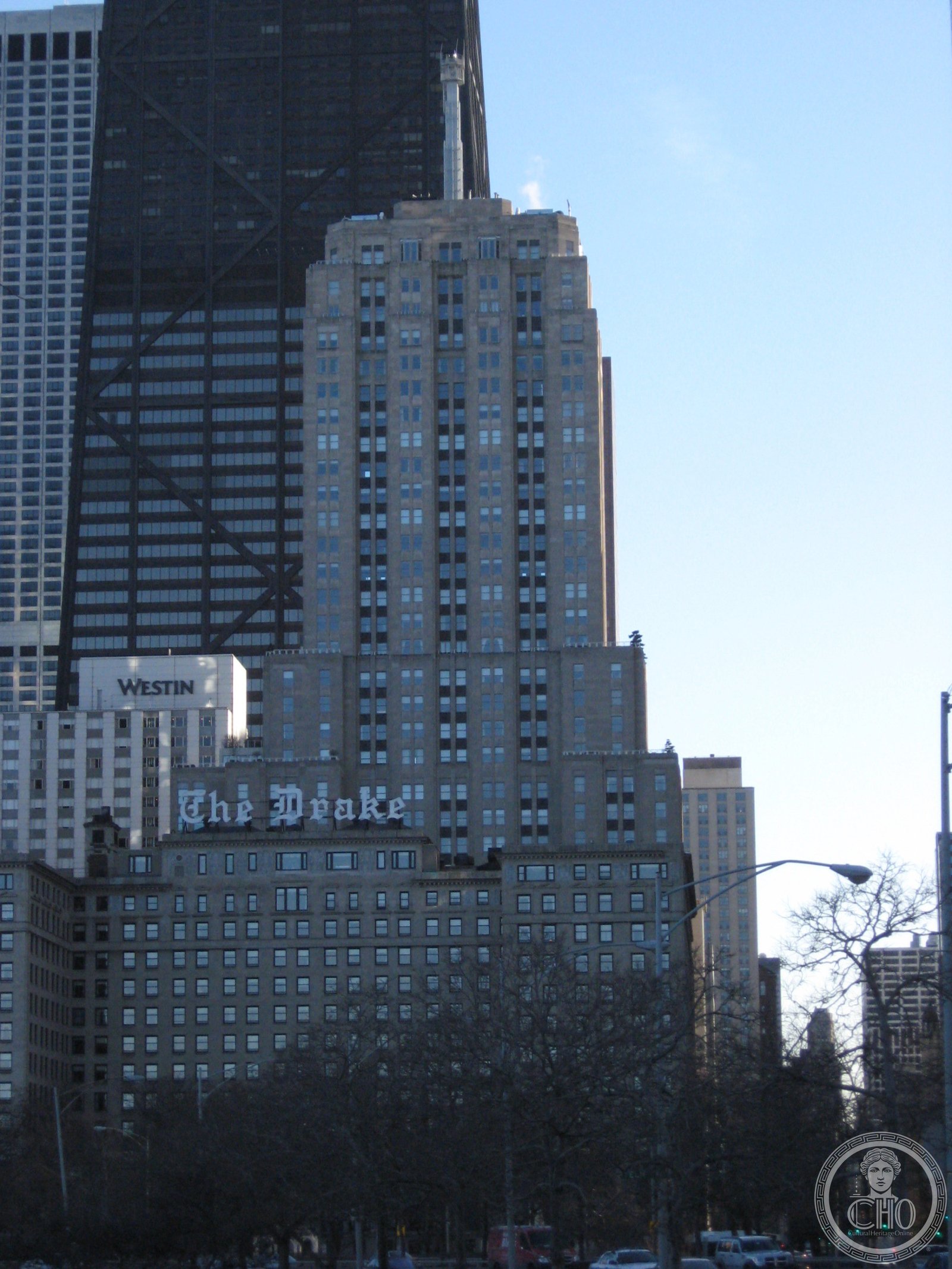
A 37-story Art Deco skyscraper at 919 North Michigan Avenue designed by Holabird & Root and completed in 1929 for Colgate-Palmolive-Peet — illuminated at the summit by the Lindbergh Beacon, a two-billion-candlepower rotating searchlight that guided aircraft to Midway Airport from 1930 until 1981 and made the building one of the most recognizable night landmarks on the American skyline — and housing Playboy magazine’s headquarters from 1965 to 1989.
At a glance
The Palmolive Building stands at 919 North Michigan Avenue in the Magnificent Mile district of Chicago, Illinois. Completed in 1929 to the designs of Holabird & Root — the Chicago firm whose partners William Holabird and Martin Roche had defined Chicago commercial architecture in the 1890s, and whose successor firm maintained that tradition into the Art Deco era — the 37-story building was built as the headquarters of Colgate-Palmolive-Peet Company and is a landmark of the Art Deco phase of the Chicago commercial tradition. Its most famous single feature is the Lindbergh Beacon, installed at the building’s summit in 1930 and named for Charles Lindbergh, who attended the dedication ceremony: a two-billion-candlepower rotating searchlight intended to guide aircraft to Midway Airport that operated continuously for 51 years until neighboring residents of the John Hancock Center successfully petitioned to have it turned off in 1981. The building was designated a National Historic Landmark and listed on the NRHP in 2003, and was converted to luxury residential condominiums beginning in 2001.
Key facts
- Built: 1929
- Style: Art Deco
- Architects: Holabird & Root, Chicago
- Stories: 37
- Original tenant: Colgate-Palmolive-Peet Company headquarters
- Lindbergh Beacon: Two-billion-candlepower rotating searchlight installed 1930, named for Charles Lindbergh; guided aircraft to Midway Airport; operated 1930–1981
- Playboy HQ: Hugh Hefner moved Playboy magazine headquarters here 1965–1989 (building was renamed “Playboy Building”)
- NRHP listed: August 21, 2003
- Current use: Luxury residential condominiums (converted 2001)
- Address: 919 North Michigan Avenue, Chicago, Illinois 60611
- GPS: 41.89980, −87.62390
History
The Palmolive Building was completed at a moment when North Michigan Avenue was transforming from a residential and mixed-use street into one of the most commercially ambitious boulevards in the United States. The Michigan Avenue Bridge had opened in 1920, extending the avenue north over the Chicago River, and developers immediately recognized that the wide, tree-lined corridor connecting the Loop to the Gold Coast represented the most valuable commercial real estate in a rapidly growing city. Holabird & Root designed the Palmolive Building as the northern terminus of this new commercial corridor, a setback Art Deco tower whose silhouette against the Lake Michigan sky would establish the character of the Magnificent Mile before the phrase existed. Colgate-Palmolive-Peet — the soap-and-personal-care giant formed by the 1928 merger of Colgate, Palmolive, and Peet Brothers — commissioned the building as its U.S. headquarters, choosing Chicago over New York as the base of its national operations.
The Lindbergh Beacon, installed in 1930 at the summit of the 37-story tower, became immediately famous: a two-billion-candlepower light visible 40 miles away that rotated to guide aircraft approaching from the west toward Midway Airport. Charles Lindbergh — then the most famous person in the world, three years after his 1927 transatlantic flight — attended the dedication ceremony and christened the beacon with his name. For 51 years the Lindbergh Beacon operated continuously, becoming one of the most recognizable features of the Chicago night skyline. In 1965, Hugh Hefner moved Playboy magazine’s headquarters into the building, and the tower was renamed the Playboy Building; illuminated “PLAYBOY” lettering appeared on the roofline. Hefner departed in 1989. The Lindbergh Beacon was shut down in 1981 after wealthy residents of the newly constructed John Hancock Center objected to the light sweeping through their windows. The building was converted to luxury condominiums in 2001 under its original Palmolive name, and was listed on the National Register in 2003.
What you see
The Palmolive Building is Holabird & Root’s most polished Art Deco skyscraper — the building that confirmed the firm’s mastery of the setback formula that had emerged from the 1916 New York Zoning Resolution and that defined American commercial architecture in the late 1920s. The tower rises from a broad base on Michigan Avenue in controlled setbacks that create the stepped silhouette of 1920s Art Deco skyscraper design, with the ornamental program concentrated at the entrance, the setback shoulders, and the crown. The building’s exterior is clad in a pale stone that reads against the sky with the crispness characteristic of Holabird & Root’s handling of the Art Deco vocabulary — surfaces cleaner and more vertical than the Chicago commercial tradition of brick and terra cotta that the firm’s founders had established in the 1890s.
The lobby interior — polished black marble with gold ornamental metalwork — survives as one of Chicago’s finest Art Deco commercial interiors, now serving the luxury residential conversion that has occupied the building since 2001. The summit, where the Lindbergh Beacon once rotated, is now the mechanical penthouse of the residential building — the beacon itself was removed when it stopped operating in 1981 — but the building’s crown reads from below with the same stepped mass that made the Lindbergh Beacon’s platform the most visible point on the Chicago skyline for five decades.
Practical information
- Residential building; the lobby is not publicly accessible, but the exterior is visible from North Michigan Avenue.
- Located in the Magnificent Mile commercial corridor between the Chicago River and Oak Street Beach; the building is at the north end of the main shopping and hotel district.
- The Chicago Architecture Center offers architectural boat tours that pass near the building; walking tours of the Magnificent Mile include discussion of the Palmolive Building’s role in defining the corridor.
Getting there
The Palmolive Building is at 919 North Michigan Avenue in the Near North Side neighborhood of Chicago, Illinois. O’Hare International Airport (ORD) is approximately 18 miles northwest; Midway Airport (MDW) is approximately 12 miles southwest. The Chicago Transit Authority Red Line stops at Grand/State (approximately 8 blocks south) and Chicago/State (approximately 3 blocks south); the CTA 151 and 147 bus routes run along Michigan Avenue and stop directly in front of the building. By car, Lake Shore Drive runs along the lakefront east of Michigan Avenue and provides access from the north and south.
Nearby
- John Hancock Center (1969) — immediately north at 875 North Michigan Avenue; the 100-story Skidmore, Owings & Merrill tower whose residents successfully ended the Lindbergh Beacon’s operation in 1981, and the building that defined the northern anchor of the Magnificent Mile
- Fourth Presbyterian Church of Chicago (1914) — across from the Palmolive Building at 126 East Chestnut Street; the Gothic Revival church that has maintained a remarkable urban presence at the heart of Chicago’s most commercially intensive street since its founding
- Water Tower and Pumping Station (1869) — four blocks south at 806 North Michigan Avenue; the landmark Gothic Revival towers that survived the 1871 Great Chicago Fire and gave the Magnificent Mile district its popular name “Water Tower Place”
Sources
- Wikipedia: “Palmolive Building (Chicago)”
- National Register of Historic Places, listing August 21, 2003
- Sinkevitch, Alice (ed.): AIA Guide to Chicago (2nd ed., 2004) — on Holabird & Root and the Magnificent Mile development context
- Wikimedia Commons: Palmolive_Building.jpg, CC BY-SA 4.0, Zol87
Find it on the map
See this place and what’s around it →Record researched and written by Luigi De Marchi for Cultural Heritage Online, 2026.
📷 Become a Cultural Heritage Online photographer
Share your photos of places: they stay published under your name as the author. The more they're seen, the more you get noticed — and soon a contest will reward the most appreciated photos.
Log in or sign up free to add a photoIs this page about you?
This page is read by travellers and heritage enthusiasts who find it on Google. Tell us how you are connected to this place and we will take it from there.