
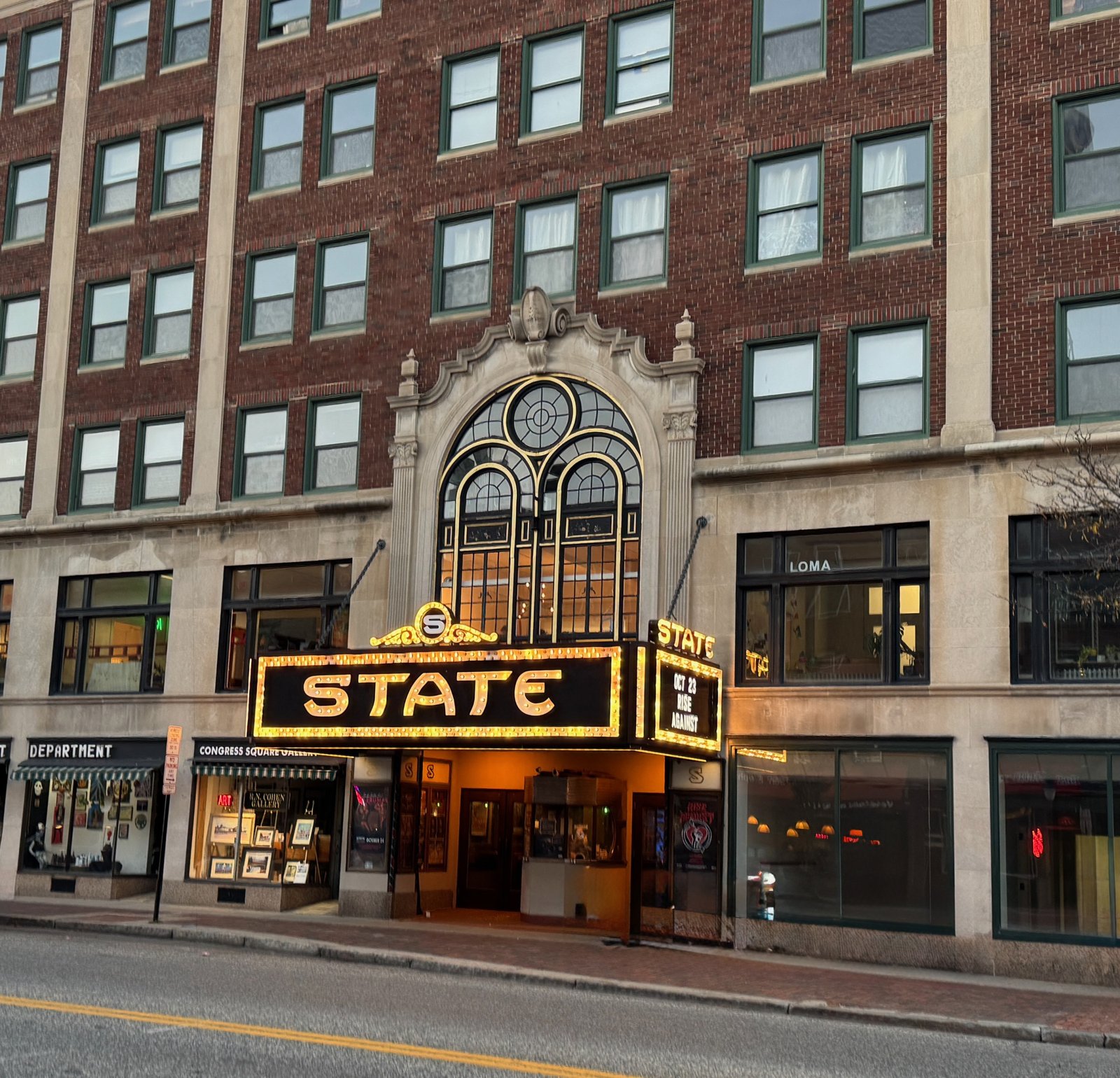
State Theatre
A 1929 Moorish and Art Deco picture palace that opened to Gloria Swanson, descended into an adult cinema, and rose again as Maine’s premier concert venue.
At a glance
The State Theatre at 609 Congress Street in downtown Portland, Maine opened on 8 November 1929 with a design by architect Herbert W. Rhodes that blended Moorish and Art Deco ornament into a picture palace of genuine grandeur. Original appointments included wrought iron stairs, bronze doors, tapestry rugs, Spanish balconies, and a Wurlitzer organ; three projectors and a magniscope equipped the booth for first-run presentations. After more than six decades of use—as a first-run cinema, a variety theater, and eventually an adult movie house—the building closed in 1990 and stood empty through two unsuccessful restoration efforts before a 2010 renovation by The Bowery Presents returned it to active use as a 1,870-seat performing arts venue. It remains Portland’s most significant surviving picture palace and one of only two examples of the Moorish Revival style applied to Maine entertainment architecture.
Key facts
- Opened: November 8, 1929
- Architect: Herbert W. Rhodes
- Style: Moorish Revival and Art Deco
- Original capacity: 2,300 seats
- Current capacity: 1,870 seats
- Address: 609 Congress Street, Portland, ME 04101
- Current use: Live performance venue (The Bowery Presents, 2010)
History
Herbert W. Rhodes delivered the State Theatre to Portland in the same year that the Great Depression began, timing that gave the building a particular resonance: as the economy contracted, a picture palace offering escape from daily life was exactly what a New England port city needed. The premiere screening featured Gloria Swanson in The Trespasser, presented to 2,200 invited patrons in a room that the Portland press described in superlatives. The technical specification—three projectors and a magniscope for enhanced image quality—signaled that this was a first-run theater of the highest class, competitive with the best houses in larger American cities.
The State Theatre operated as a first-run cinema for over thirty years before television competition pushed it toward theatrical and dance programming. By the 1980s, the building had declined to use as an adult cinema, a trajectory common to grand urban theaters whose neighborhoods changed around them. The theater closed in 1990. Restoration attempts in 1993 and 2000 raised money but could not produce a workable business model, leaving the State Theatre’s future uncertain through the early 2000s.
The partnership of The Bowery Presents and investor Alex Crothers succeeded where earlier efforts had not, investing $1.5 million in renovations that respected the building’s architectural character while making it functional for contemporary live performance. The theater reopened in October 2010 and has since hosted major touring acts across rock, pop, jazz, and world music, restoring the State Theatre to its place as Portland’s most distinguished entertainment venue.
What you see
The Congress Street facade deploys the Moorish Revival vocabulary that Rhodes had chosen for the theater: arched openings, surface ornament drawn from Islamic architectural geometry, and the sort of exotic theatrical framing that picture palaces of the 1920s used to signal that entering the building was itself a departure from ordinary life. The Art Deco inflection, visible in the streamlining of the ornamental elements and the commercial signage zone at street level, gives the design its period specificity; this is Moorish Revival as filtered through the commercial design culture of 1929, not a strict historical pastiche.
The interior was fitted with the luxury details that distinguished a class-A picture palace from its competitors: wrought iron stairs and railings, bronze doors at the principal entrances, tapestry rugs in the lobby and circulation spaces, Spanish balconies at the upper level, and a Wurlitzer organ for the musical accompaniment that silentfilms still required in 1929. The 2010 renovation retained the architectural envelope and the principal decorative surfaces while reconfiguring the seating for concert use at 1,870 capacity.
Practical information
- Current use: Active concert venue; check State Theatre Portland website for events
- Tickets: Available online; general admission or reserved seating depending on the event
- Exterior: Freely viewable from Congress Street
- Box office: Opens before ticketed events
- Time needed: 10 minutes for exterior; full evening for a concert
Getting there
The State Theatre is at 609 Congress Street in downtown Portland, Maine, the city’s principal commercial and cultural artery. Portland International Jetport is three miles south; the Downtown Portland Transportation Center on Thompson’s Point is a 20-minute walk or short Uber/Lyft from the theater. The Congress Street Arts District, which includes the Portland Museum of Art, the Portland Public Library, and several other performing arts venues, surrounds the theater within a few blocks.
Nearby
- Portland Museum of Art (1983) — I.M. Pei’s brick Postmodern building at Congress Square, three blocks west; the museum complex includes the 1801 McLellan House
- Merrill Auditorium (1912) — Portland’s Beaux-Arts city hall and concert hall, two blocks east on Congress Street
- Victoria Mansion (1860) — the finest Italianate villa in North America, five minutes’ walk south on Danforth Street
- Old Port Historic District — Portland’s Victorian commercial waterfront, ten minutes’ walk downhill from the theater
Sources
- Wikipedia, “State Theatre (Portland, Maine)” — primary narrative source
- Wikimedia Commons, State_Theatre,_Portland,_Maine.jpg (Seasider53, CC BY 4.0)
Find it on the map
See this place and what’s around it →📷 Diventa un fotografo di Cultural Heritage Online
Condividi le tue foto dei luoghi: restano pubblicate con la tua firma come autore. Più vengono viste, più ti fai conoscere — e presto un concorso premierà le foto più apprezzate.
Accedi o registrati gratis per aggiungere una fotoDo you manage this place?
This page is read by travellers and heritage enthusiasts who find it on Google. Keep it accurate — and make it work for you. Free for non-profit heritage institutions.