
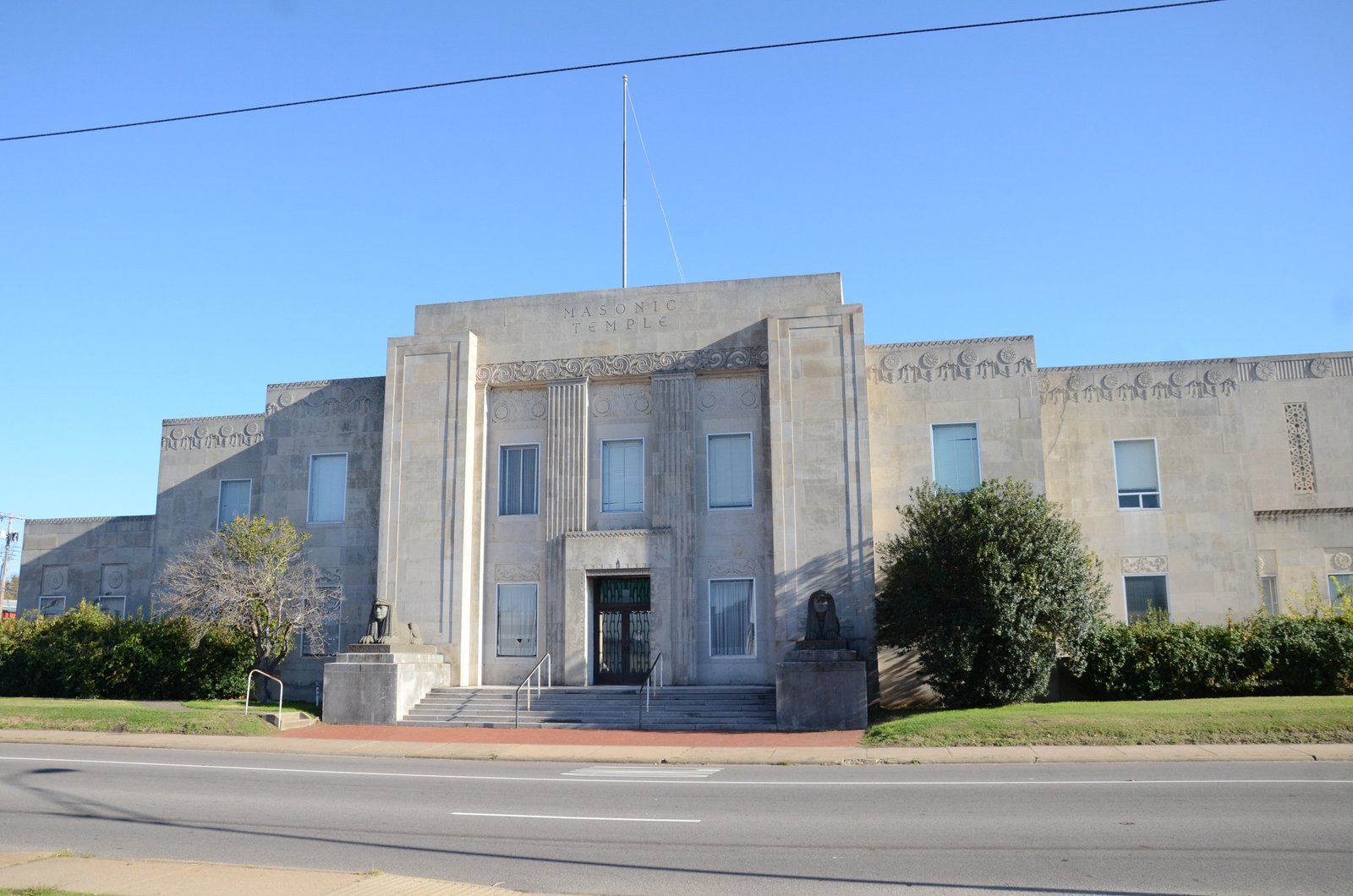
A 1929 Art Deco stone temple whose Egyptian Revival interior once screened Malco pictures and now amplifies live concerts as Temple Live.
At a glance
The Fort Smith Masonic Temple at 200 North 11th Street is a 53,000-square-foot stone building completed in 1929 to designs by George R. Mann, the architect of the Arkansas State Capitol. Its Art Deco facade, stepped back from a projecting central section in a composition of carved stone, fluted pilasters, and recessed bays, shares a sensibility with the Egyptian Revival decoration that Mann concentrated in the interior. Listed on the National Register of Historic Places in 1992, the temple has had a remarkable second and third life: an 800-seat movie theater operated by Malco Theaters from 1930, and since 2017 a 1,100-capacity concert venue called Temple Live, with expansion to Wichita and Cleveland.
Key facts
- Completed: 1929
- Architect: George R. Mann (designer of the Arkansas State Capitol)
- Style: Art Deco-influenced Egyptian Revival
- Size: 53,000 square feet, stone construction
- Address: 200 North 11th Street, Fort Smith, AR 72901
- NRHP: ref. 92001624, added 20 November 1992
- Current use: Temple Live concert venue (since 2017), capacity 1,100
History
George R. Mann had already given Arkansas its Beaux-Arts State Capitol when he turned to the Masonic commission in Fort Smith. The resulting building, completed in 1929, deployed his knowledge of monumental stone construction in a more eclectic vocabulary: Art Deco massing and surface treatment on the exterior, Egyptian Revival decoration in the interior, a pairing that reflects the Masonic fraternity’s longstanding identification with the ancient world and the contemporary moment in equal measure. The temple housed multiple Masonic bodies—Scottish Rite, York Rite, Eastern Star, and DeMolay chapters—through the first decades of its life.
On 3 November 1930, the building’s 800-seat auditorium began its second career as a movie theater under Malco Theaters, with Rain or Shine as the inaugural program. A marquee was added to the B Street side to advertise showings, and for decades the Masonic Temple was also one of Fort Smith’s principal picture palaces. The juxtaposition of Masonic ceremony and mainstream entertainment in the same stone shell is characteristic of how American fraternal buildings adapted to changing economic conditions through the mid-twentieth century.
In 2017, the building was reimagined once more as Temple Live, a concert venue exploiting the acoustic volume and dramatic atmosphere of the Egyptian Revival interior. The concept proved scalable: Temple Live expanded to Wichita, Kansas and Cleveland, Ohio by 2019, making the Fort Smith original the flagship of a small regional concert brand rooted in repurposed Masonic architecture.
What you see
Mann organized the North 11th Street facade around a projecting central block from which flanking bays step progressively back, a composition that gives the building the stepped silhouette of an Art Deco tower compressed into a horizontal mass. The central section carries the weight of the ornamental program: a projecting entrance frame, slightly projecting pilaster-like elements that provide vertical structure to the facade, and two fluted pilasters flanking the main portal, their capitals carrying the decorative carved stonework that ties the exterior to the Egyptian Revival mood of the interior. A band of carving runs at the top of the facade, just below the flat roofline, binding the composition at its cornice.
The interior is where Mann’s Egyptian Revival intentions become fully legible. The auditorium, originally fitted for Masonic ceremony and later for cinema, has the tall ceilinged, atmospherically decorated quality that the Egyptian Revival demanded: a room designed to suggest the antechamber of a temple rather than a mundane assembly hall. As Temple Live, the space benefits from precisely that theatrical charge—the acoustic volume, the visual drama, and the sense that something of consequence happens here.
Practical information
- Current use: Temple Live concert venue; check templivefortsmith.com for event calendar
- Tickets: Available online; capacity 1,100; standing and seated configurations
- Exterior: Freely viewable from North 11th Street and B Street
- Time needed: 20 minutes for exterior; full evening for a concert
- Dress: Casual for concerts
Getting there
Fort Smith sits at the Oklahoma border in western Arkansas, approximately two and a half hours west of Little Rock via I-40. The Masonic Temple is at 200 North 11th Street in the downtown core, four blocks north of the Arkansas River. Fort Smith Regional Airport is two miles south of downtown; Amtrak’s Heartland Flyer stopped service to Fort Smith in 2022, leaving car or bus as the practical long-distance option. Street and surface lot parking is available on 11th Street and adjacent blocks.
Nearby
- Fort Smith National Historic Site — the old federal courthouse, jail, and gallows where Judge Isaac Parker presided; four blocks south on Rogers Avenue
- Arkansas and Missouri Railroad Depot (1910) — Neoclassical passenger station two blocks east, now a museum
- Fort Smith Museum of History — on Rogers Avenue, covering the city’s military and frontier heritage
- Fort Smith Convention Center — one block north, hosts touring exhibitions and regional events
Sources
- Wikipedia, “Fort Smith Masonic Temple” — primary narrative source
- National Register of Historic Places, ref. 92001624 (20 November 1992)
- Wikimedia Commons, Fort_Smith_Masonic_Temple,_Front_View.JPG (Shane Vaughn, CC BY-SA 3.0)
Find it on the map
See this place and what’s around it →Record researched and written by Luigi De Marchi for Cultural Heritage Online, 2026.
📷 Become a Cultural Heritage Online photographer
Share your photos of places: they stay published under your name as the author. The more they're seen, the more you get noticed — and soon a contest will reward the most appreciated photos.
Log in or sign up free to add a photoIs this page about you?
This page is read by travellers and heritage enthusiasts who find it on Google. Tell us how you are connected to this place and we will take it from there.