
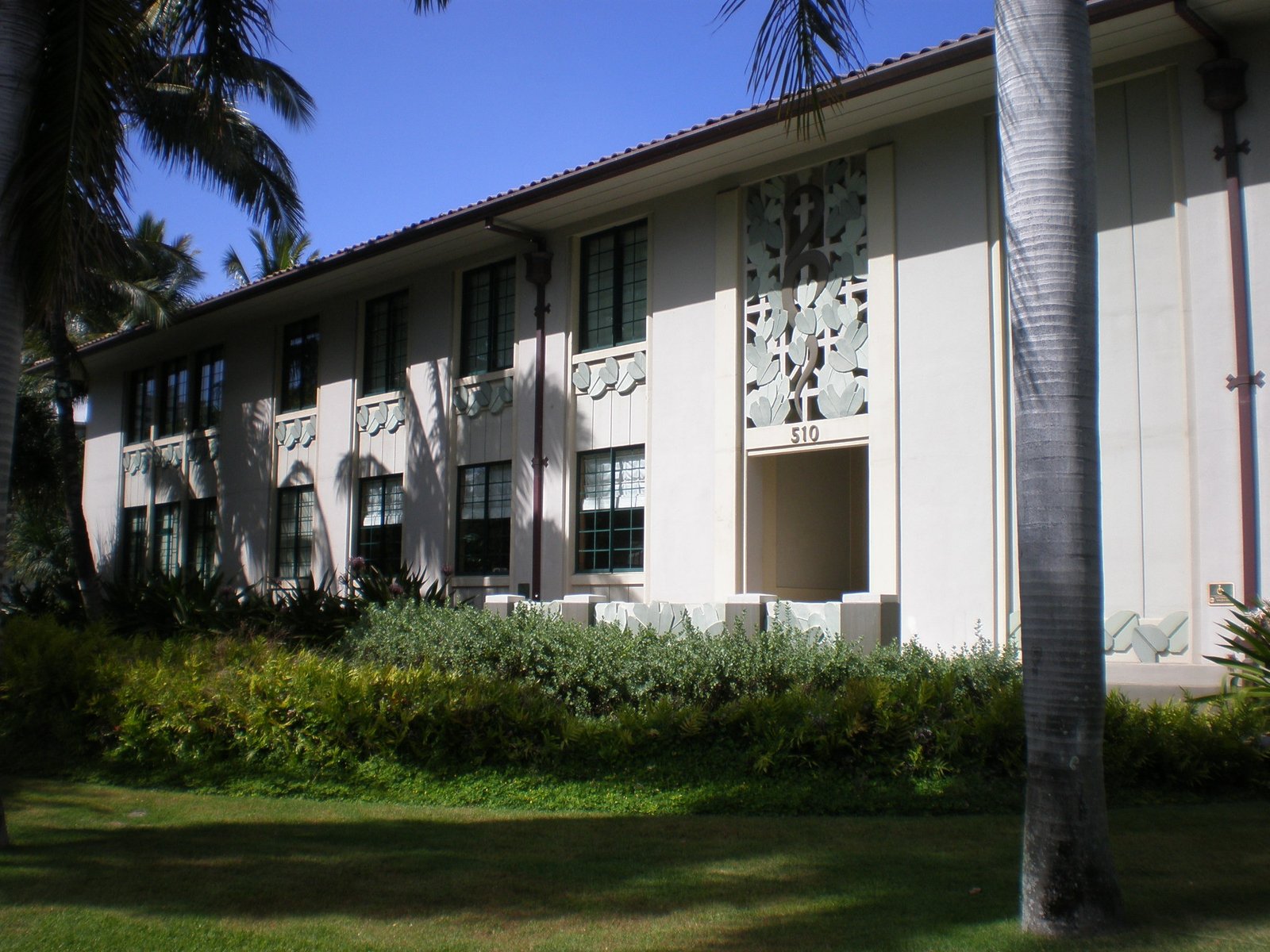
A 1941 Art Deco memorial in the Hawaiian idiom, where ‘ape leaf railings and torch ginger carvings translate the island’s flora into a language of civic tribute.
At a glance
The Mabel Smyth Memorial Building at 501 Punchbowl Street in Honolulu is a two-story concrete structure of 1941 that represents a rare synthesis of mainland Art Deco discipline and native Hawaiian ornamental motifs. Designed by architect Charles W. Dickey in 1937 and completed four years later, the building was funded by a $100,000 community campaign in memory of Mabel Leilani Smyth, who died in 1937 after eight years as superintendent of Hawaii’s territorial public nursing service. Its L-shaped plan, tiled hip roof, and carved botanical details—‘ape leaf, caduceus, and torch ginger—make it one of the most distinctive examples of Hawaiian-inflected Art Deco in the islands. Listed on the National Register of Historic Places in 1994, the building now serves as a conference center within the Queen’s Medical Center campus.
Key facts
- Designed: 1937 by Charles W. Dickey; built 1941
- Style: Art Deco, Hawaiian Style
- Address: 501 Punchbowl Street, Honolulu, HI 96813
- NRHP: ref. 93001558, added 3 February 1994
- Also: Hawaii State Historic Preservation Division Historic Site
- Current use: Queen’s Medical Center Conference Center
- Construction cost: approximately $100,000 (community fundraising)
History
Mabel Leilani Smyth spent eight years as superintendent of the Territorial Public Nursing Service of Hawaii before her death in 1937. Colleagues, patients, and civic leaders launched a fundraising campaign that gathered approximately $100,000 to commission a building in her memory—a sum that expressed the depth of regard her work had earned in the island community. Charles W. Dickey, one of Hawaii’s most accomplished architects of the period, received the commission in 1937 and delivered designs that balanced the Art Deco conventions of the era with Hawaiian ornamental sensibility.
Construction was completed and the building dedicated on 4 January 1941, with a ceremony that included Hawaiian chants and music—an acknowledgment that the memorial was not simply a building of its time but a Hawaiian cultural object. On opening, the structure housed headquarters for professional nursing and medical organizations, including nurses’ associations, the Board of Registration of Nurses, medical societies, a medical library, and an air-conditioned auditorium. It functioned as the professional home of Hawaii’s healthcare establishment during the territorial period and into statehood.
A renovation in 2000 substantially altered the interior while leaving the exterior Art Deco Hawaiian envelope intact. National Register of Historic Places listing followed in 1994; the building also holds status as a Hawaii State Historic Preservation Division Historic Site, a dual recognition that underscores its significance at both federal and state levels. Today it operates as a conference center within the Queen’s Medical Center, the hospital grounds whose institutional mission connects directly to the nursing legacy Mabel Smyth served.
What you see
Charles W. Dickey was already known for a regional approach to Hawaii’s built environment when he designed the Smyth Building, and the result shows his understanding of how to work within an Art Deco vocabulary without ignoring place. The building’s two-story concrete form occupies an L-shaped plan beneath a tiled hip roof—a Hawaiian building type that Dickey had employed across decades of island practice. The flat-topped Art Deco discipline and the regional roof form coexist without tension, each lending authority to the other.
The ornamental program is where the Hawaiian inflection is most legible. ‘Ape leaf, the large-lobed foliage of the taro-family plant that has deep significance in Hawaiian culture, appears in the stairway railing and entrance panel, paired with a caduceus that places the building in its medical context. The second-floor doors carry carved torch ginger designs, the flame-red flower of the Hawaiian uplands rendered in the crisp relief vocabulary of Art Deco. The combination—institutional American Moderne dressed in specifically Hawaiian botanical imagery—is unusual outside the islands and makes the Smyth Building a genuinely local document.
Practical information
- Access: Located on the Queen’s Medical Center campus; exterior viewable from Punchbowl Street
- Interior: Conference center use; not open for independent tours
- Photography: Exterior from public sidewalk freely permitted
- Parking: Queen’s Medical Center parking structures are nearby
- Time needed: 15–20 minutes for exterior and grounds
Getting there
The Mabel Smyth Memorial Building stands at 501 Punchbowl Street in central Honolulu, within the Queen’s Medical Center campus. From the Daniel K. Inouye International Airport, take the H-1 freeway east to the Punchbowl Street exit and drive south approximately one mile to the hospital complex. TheBus routes 1 and 2 serve the Punchbowl Street corridor. The building is about a 15-minute walk from downtown Honolulu’s historic Chinatown district and Iolani Palace.
Nearby
- National Memorial Cemetery of the Pacific (Punchbowl) — the crater cemetery honoring American war dead, 10 minutes’ walk uphill from the building
- Iolani Palace (1882) — the only royal palace on American soil, fifteen minutes’ walk northeast
- Hawaii State Art Museum — in a 1928 Spanish Mission Revival building two blocks from the palace
- Honolulu Chinatown Historic District — the oldest Chinatown in the United States, ten minutes’ walk east on Punchbowl
Sources
- Wikipedia, “Mabel Smyth Memorial Building” — primary narrative source
- National Register of Historic Places, ref. 93001558 (3 February 1994)
- Hawaii State Historic Preservation Division, Historic Site designation
- Wikimedia Commons, Honolulu-Mabel-Smyth-Auditorium.JPG (Joel Bradshaw, Public Domain)
Find it on the map
See this place and what’s around it →Record researched and written by Luigi De Marchi for Cultural Heritage Online, 2026.
📷 Become a Cultural Heritage Online photographer
Share your photos of places: they stay published under your name as the author. The more they're seen, the more you get noticed — and soon a contest will reward the most appreciated photos.
Log in or sign up free to add a photoIs this page about you?
This page is read by travellers and heritage enthusiasts who find it on Google. Tell us how you are connected to this place and we will take it from there.