
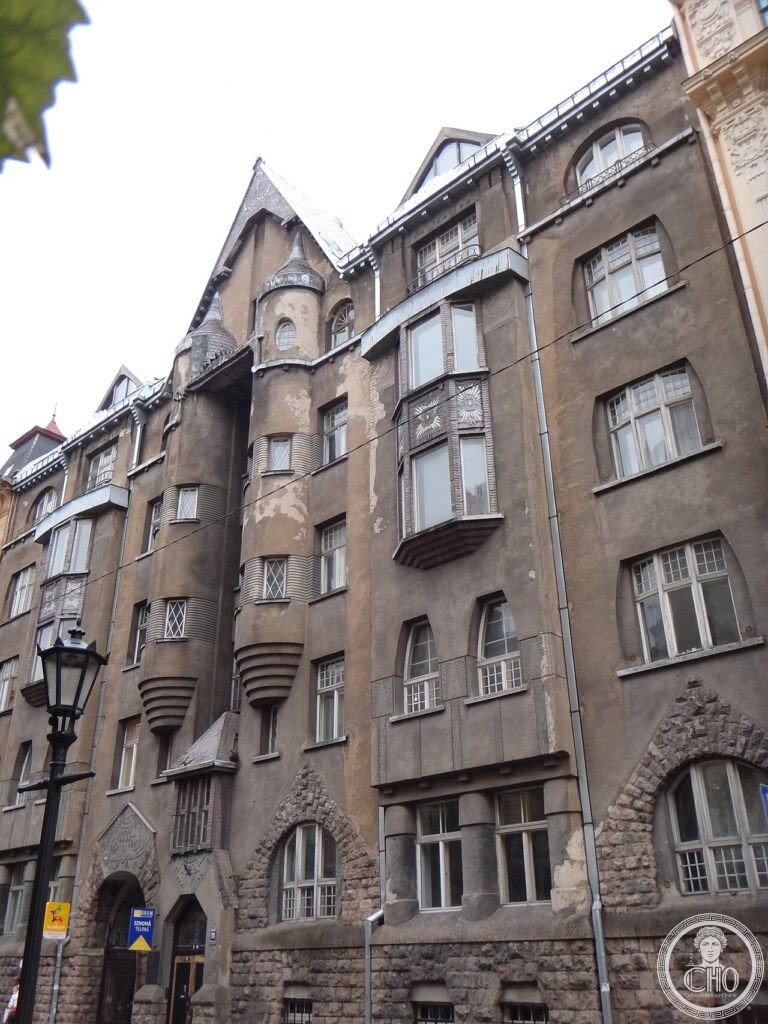
On a street famous for gorgons and lions, Alberta iela 11 speaks quietly: grey natural stone, wood and slate, a copper sun on the bay windows — Latvian National Romanticism answering Eisenstein’s imperial theatre.
At a glance
Completed in 1908 to a design by Eižens Laube, the apartment house at Alberta iela 11 is regarded as one of the masterpieces of National Romanticism — the strand of Riga’s Art Nouveau that turned away from imported ornament toward Latvian ethnographic tradition and honest natural materials. Where the Eisenstein facades across the street shout, Laube’s building is sparingly noble: strongly articulated volumes, a darkish grey palette, and decoration reduced to essentials drawn from folk art.
Key facts
- Built: 1908
- Architect: Eižens Laube
- Style: National Romanticism (Latvian strand of Art Nouveau)
- Materials: Travertine, plaster of different textures, wood and other natural materials; Thuringian slate on the bay windows
- Signature feature: Sun motif in copper strips on the slate surfaces of the bay windows
- Address: Alberta iela 11, Riga
- GPS: 56.9591593, 24.1086584 — View on Google Maps
History
Eižens Laube belonged to the first generation of Latvian architects trained at the Riga Polytechnic Institute, and he became the most prolific designer of the National Romanticist movement that flowered between roughly 1905 and 1911 — years in which national feeling surged after the 1905 revolution. For Latvian architects of Laube’s generation, the ethnographic heritage of the countryside offered an alternative both to German historicism and to the decorative Art Nouveau of the imperial establishment. Number 11 became one of the movement’s defining statements, and Laube found the composition strong enough to repeat it, in variation, in an apartment building at Aleksandra Čaka iela 83/85 the following year.
What you see
The facade rises in a strongly articulated composition of bay windows, recesses and a steep roof zone, all held in the darkish grey tones characteristic of National Romanticism. The materials do the talking: travertine, plasters worked to different textures, and wood used honestly rather than disguised. On the bay windows, look for the sun motif executed in copper strips laid over natural Thuringian slate — the building’s emblem, catching light against the matte grey ground. At the entrance portal, modest ornaments of ethnographic origin have been transformed into the generalised, rounded patterns of Art Nouveau — folk geometry translated into the new style rather than quoted literally.
Practical information
- Private apartment building — viewed from the street
- The copper sun motif is on the bay windows; it reads best in raking afternoon light
- Stand on the odd-numbered side to compare Laube’s restraint with the Eisenstein facades opposite
Getting there
Alberta iela 11 stands on the odd side of the street, in Riga’s Quiet Centre, about 20 minutes on foot from the Old Town. The Riga Art Nouveau Museum at number 12 is directly opposite, making this the natural midpoint of any walk along the street.
Nearby
- Riga Art Nouveau Museum — across the street at number 12, in Konstantīns Pēkšēns’ own 1903 building
- Alberta iela 13 — the Eisenstein facade at the head of the street, now the Riga Graduate School of Law
- Alberta iela — the complete street ensemble
- Elizabetes iela 33 — five minutes away; another face of the district’s Art Nouveau
Sources
- Riga Art Nouveau Centre (jugendstils.riga.lv), building file “Alberta iela 11 (1908)” — architect, materials, sun motif, ethnographic ornament, Čaka iela repetition
- Wikipedia: “Albert Street, Riga” — street context
- Wikidata Q55935720 — coordinates, date and heritage designation
Find it on the map
See this place and what’s around it →Record researched and written by Luigi De Marchi for Cultural Heritage Online, 2026.

📷 Become a Cultural Heritage Online photographer
Share your photos of places: they stay published under your name as the author. The more they're seen, the more you get noticed — and soon a contest will reward the most appreciated photos.
Log in or sign up free to add a photoIs this page about you?
This page is read by travellers and heritage enthusiasts who find it on Google. Tell us how you are connected to this place and we will take it from there.