
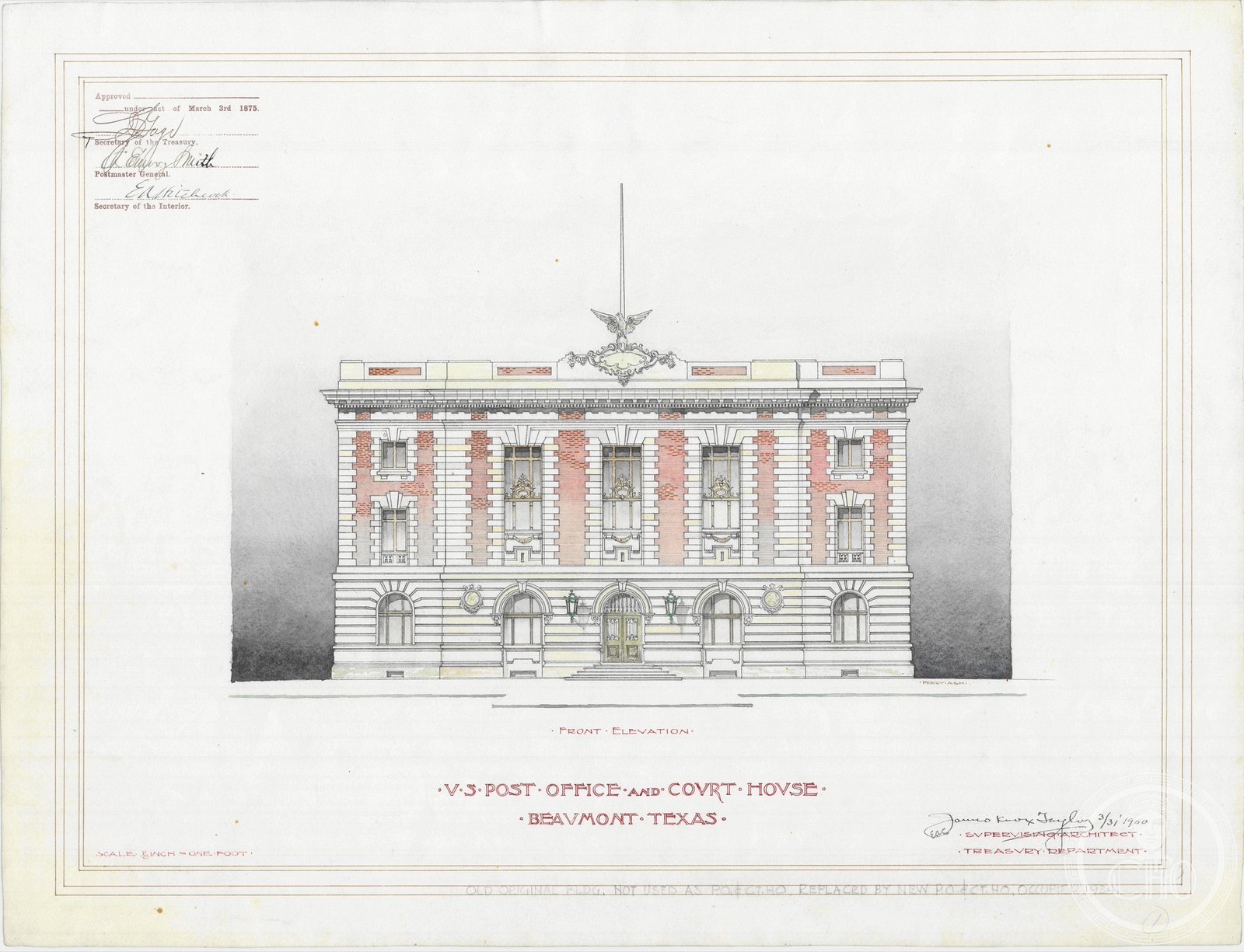
One of Southeast Texas’s finest WPA-era public buildings — a three-story block of buff brick and geometric terra-cotta ornament completed in 1936, still serving as federal offices in a city shaped by oil.
At a glance
The U.S. Post Office and Federal Building at 300 Willow Street in Beaumont was completed in 1936 as part of the Roosevelt administration’s Works Progress Administration (WPA) building program, which placed new federal structures in hundreds of American cities. Beaumont, transformed by the Spindletop oil discovery of 1901 into one of Texas’s major port and industrial centers, received a building commensurate with its importance: a three-story mass of buff brick accented with geometric terra-cotta panels, recessed entrance bays, and a WPA mural cycle in the lobby. The building remains in active federal service and retains much of its original fabric.
Key facts
- Year: c. 1936 (completed)
- Style: WPA Moderne / Art Deco
- Address: Downtown Beaumont, Texas 77701
- Murals: WPA mural cycle in the main lobby
- Status: National Register of Historic Places; active federal use
- GPS: 30.0861°N, 94.1019°W
History
Beaumont’s rise to prominence came with astonishing speed. The Spindletop oil gusher of January 1901 — the first major oil discovery in Texas — transformed a modest lumber and rice-farming town into a boomtown overnight. By the 1930s, Beaumont was a substantial port city with refineries, chemical plants, and an active rail connection linking the Texas oil fields to Gulf Coast shipping. When federal New Deal programs began allocating funds for public buildings, Beaumont qualified for a significant investment.
The WPA federal building program was administered through the Treasury Department’s Procurement Division, which assigned architects and supervised construction of post offices, courthouses, and federal offices across the country. Completed c. 1936, the Beaumont building followed the standard formula for WPA Moderne: planar brick facades with ornamental terra-cotta concentrated at the entrance and cornice, large horizontal window openings, and an interior lobby finished in terrazzo, plaster, and WPA-commissioned art. The mural paintings in the main lobby depicted scenes from the history of Southeast Texas, from its early indigenous communities through the age of oil.
The building has served continuously as a U.S. Post Office and federal court facility since its completion. Its listing on the National Register of Historic Places recognizes both its architectural quality and its role as a tangible artifact of the New Deal’s investment in civic infrastructure.
What you see
The facade is characteristic WPA Moderne: flat, planar surfaces of buff-colored brick with ornament reserved for strategic locations. The main entrance is framed by terra-cotta pilasters with simplified geometric capitals and a recessed portal beneath a flat canopy. Above the entrance bay, the frieze level carries abstract geometric reliefs — stylized eagles, interlocking angular patterns, and foliate details compressed into the shallow bas-relief typical of the period. The cornice is a bold projecting horizontal line that reads strongly from the street, unifying the composition and giving the building its civic weight.
The window openings are large and horizontal, grouped in bands that lighten the masonry and allow generous natural light into the federal offices. Bronze casement frames and original hardware survive in several window bays. Inside, the lobby retains its terrazzo floor in a geometric pattern, plaster ceiling moldings, and the WPA mural panels on the main walls — a rare survival of New Deal interior art in its original setting. Bronze service windows and original counters survive along the post office service corridor.
Practical information
- Open during postal and federal business hours: Mon–Fri, approximately 8:30 a.m.–5:00 p.m.
- The lobby with WPA murals is publicly accessible during business hours (no admission charge)
- Photography of the WPA murals is generally permitted; verify with postal staff
- Exterior viewable at all times from Willow Street and adjacent streets
Getting there
Beaumont is served by Interstate 10 (Exits 853 and 854B) from Houston (approximately 130 km west) and from Louisiana to the east. The Federal Building stands in central downtown Beaumont. Amtrak’s Sunset Limited (Los Angeles–New Orleans) stops at Beaumont’s station on Main Street, approximately 1 km from the Federal Building. By car, parking is available on Willow Street and in adjacent surface lots.
Nearby
- Jefferson County Courthouse (1931) — Art Deco courthouse, 1149 Pearl Street
- Beaumont City Hall (1930s Moderne)
- Edison Museum of Beaumont — regional heritage and local history
- Spindletop–Gladys City Boomtown Museum — replica 1901 oil boomtown, Lamar University campus
Sources
- National Register of Historic Places nomination form, U.S. Post Office and Federal Building, Beaumont, Texas
- U.S. Treasury Department, Procurement Division records (WPA building program, 1933–1942)
- Texas Historical Commission, architectural survey and RTHL documentation
- National Archives, WPA mural documentation and artist records
Find it on the map
See this place and what’s around it →Record researched and written by Luigi De Marchi for Cultural Heritage Online, 2026.
📷 Become a Cultural Heritage Online photographer
Share your photos of places: they stay published under your name as the author. The more they're seen, the more you get noticed — and soon a contest will reward the most appreciated photos.
Log in or sign up free to add a photoIs this page about you?
This page is read by travellers and heritage enthusiasts who find it on Google. Tell us how you are connected to this place and we will take it from there.