
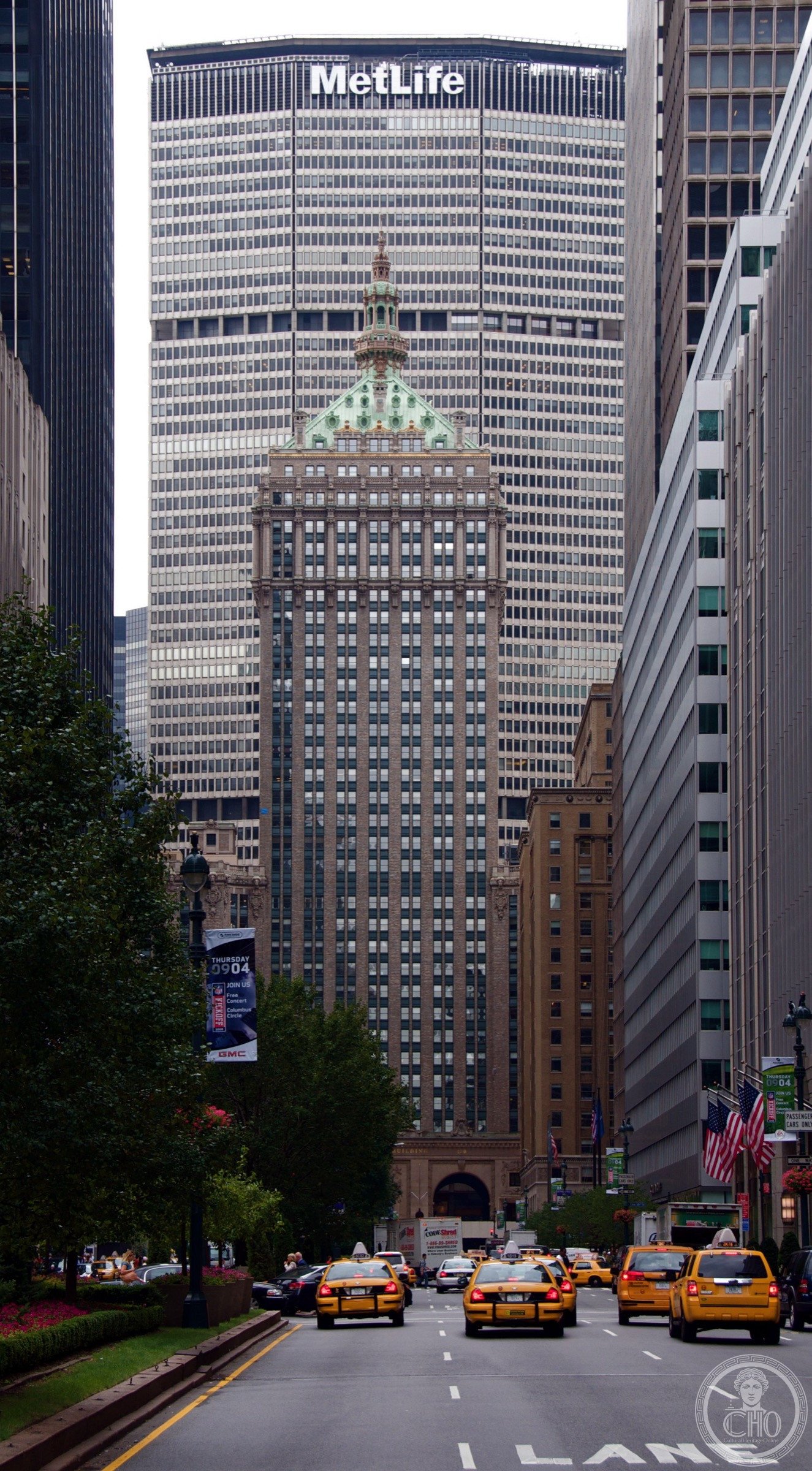

The building that closes the vista of Park Avenue — a 35-story Art Deco tower straddling the world’s most famous urban corridor, designed by Warren & Wetmore to serve as the corporate gateway of the New York Central Railroad.
At a glance
The Helmsley Building at 230 Park Avenue in Midtown Manhattan occupies one of the most dramatically sited positions in American architecture: it straddles Park Avenue at 46th Street, so that traffic on Park Avenue passes directly through two large arched openings cut through the building’s base, and the tower rises above as a framed vertical element visible from both the southern and northern reaches of the avenue. Designed by Warren & Wetmore — the firm responsible for Grand Central Terminal — and completed in 1929, the building served as the headquarters of the New York Central Railroad, whose tracks run under Park Avenue in the tunnel system that begins at Grand Central. The 35-story Art Deco tower with its gilded crown and ornamental facades is a New York City Landmark.
Key facts
- Address: 230 Park Avenue at 45th–46th Street, Midtown Manhattan, New York City
- Completed: 1929
- Architects: Warren & Wetmore
- Original name: New York Central Building
- Current name: Helmsley Building (since 1977)
- Floors: 35
- Designation: New York City Landmark
- GPS: 40.7527°N, 73.9775°W
History
The New York Central Building was commissioned by the New York Central Railroad in the late 1920s as its corporate headquarters and as a visual terminus for the Park Avenue corridor north of Grand Central Terminal, which Warren & Wetmore had also designed in 1913. The site — at the point where Park Avenue divides into two roadways to pass around the MetLife Building’s precursor and reconnects north of 46th Street — created an unusual urban challenge: how to place a large commercial building without severing the avenue’s traffic flow. Warren & Wetmore’s solution was to perforate the building’s base with two large vehicular arches and two smaller pedestrian passages, so that Park Avenue could continue uninterrupted through the building’s footprint.
The building was completed in 1929 and immediately became one of the most recognizable elements of the Midtown skyline. Its gilded Art Deco crown — a stepped pyramidal composition of ornamental metalwork and masonry — was designed to terminate the Park Avenue vista when viewed from the south, creating a focal point for the avenue’s long straight northward run from 23rd Street. From the north, the building forms a distinctive frame around the MetLife Building (then the Pan Am Building, completed 1963), which was controversially inserted directly behind it and dramatically reduced the original vista.
The New York Central Railroad sold the building in 1954, and it passed through several owners before being acquired by Harry Helmsley’s real estate organization in the 1970s and renamed the Helmsley Building in 1977. It was designated a New York City Landmark in 1987. Since 2000 it has been managed and renovated multiple times, with the most recent owners restoring the gilded crown and lobby details to closer to their original condition.
What you see
The building’s most distinctive feature — the two-arch base that allows Park Avenue traffic to pass through — is visible at street level as you walk along the avenue. The vehicular arches are framed in ornamental carved stone, and the pedestrian passages to either side are finished with bronze gates and period ornament. The effect of walking through the building while traffic flows around you is unlike anything else in Midtown: the building simultaneously bridges the avenue and encloses a transitional space that is neither street nor interior.
Looking at the building from Park Avenue South (below 42nd Street), the tower rises above Grand Central Terminal and the intervening buildings as the vanishing-point terminus of the avenue’s long straightaway. The gilded crown — recently restored — catches the afternoon light in a way that makes the tower a distinctive marker from considerable distances. The lobby interior retains its original Art Deco character in the ornamental ceiling, bronze elevator doors, and decorative floor. The building’s base-and-tower composition, with the arches as a visible mechanical necessity turned into an urban design gesture, makes it a paradigm case of Art Deco civic ambition applied to a fundamentally commercial and infrastructural problem.
Practical information
- Access: The pedestrian passages through the building base are publicly accessible at all times
- Lobby: Accessible during business hours; original Art Deco lobby visible from the main entrance
- Best view: From Park Avenue South between 40th and 42nd Streets, looking north — the classic vista of the building closing the avenue
- Time needed: 20–30 minutes for exterior and passage walkthrough
Getting there
The Helmsley Building stands at 230 Park Avenue at 46th Street in Midtown Manhattan, directly adjacent to Grand Central Terminal. By subway, the 4, 5, 6, 7, and S trains stop at Grand Central–42nd Street; the building is a three-minute walk north along Park Avenue. Penn Station is approximately a fifteen-minute walk west on 42nd Street. The Park Avenue corridor between Grand Central Terminal and the Helmsley Building is one of New York City’s most historically dense streetscapes, including Grand Central Terminal (1913), the Chrysler Building (1930), and the MetLife Building (1963) within a two-block radius.
Nearby
- Grand Central Terminal (1913) — directly below/adjacent; Beaux-Arts transportation hub and landmark
- Chrysler Building (1930) — three blocks northeast at Lexington and 42nd; Art Deco peer
- MetLife Building (1963) — directly behind the Helmsley Building; Pan Am Building by Gropius and Pietro Belluschi
- Lever House (1952) — five blocks north at Park and 54th; International Style glass curtain wall landmark
Sources
- New York City Landmarks Preservation Commission — designation report, New York Central Building (230 Park Avenue), LP-1617 (1987)
- Warren & Wetmore firm records — Metropolitan Museum of Art Archives, office drawings and correspondence for the New York Central commission
- New York Landmarks Conservancy — building documentation and restoration history (nylandmarks.org)
- New York Times, coverage of the New York Central Building opening (1929) and landmark designation (1987) — ProQuest Historical Newspapers
- Carol Willis, Form Follows Finance — context of the building in the 1920s Park Avenue development history
Find it on the map
See this place and what’s around it →📷 Become a Cultural Heritage Online photographer
Share your photos of places: they stay published under your name as the author. The more they're seen, the more you get noticed — and soon a contest will reward the most appreciated photos.
Log in or sign up free to add a photoIs this page about you?
This page is read by travellers and heritage enthusiasts who find it on Google. Tell us how you are connected to this place and we will take it from there.