

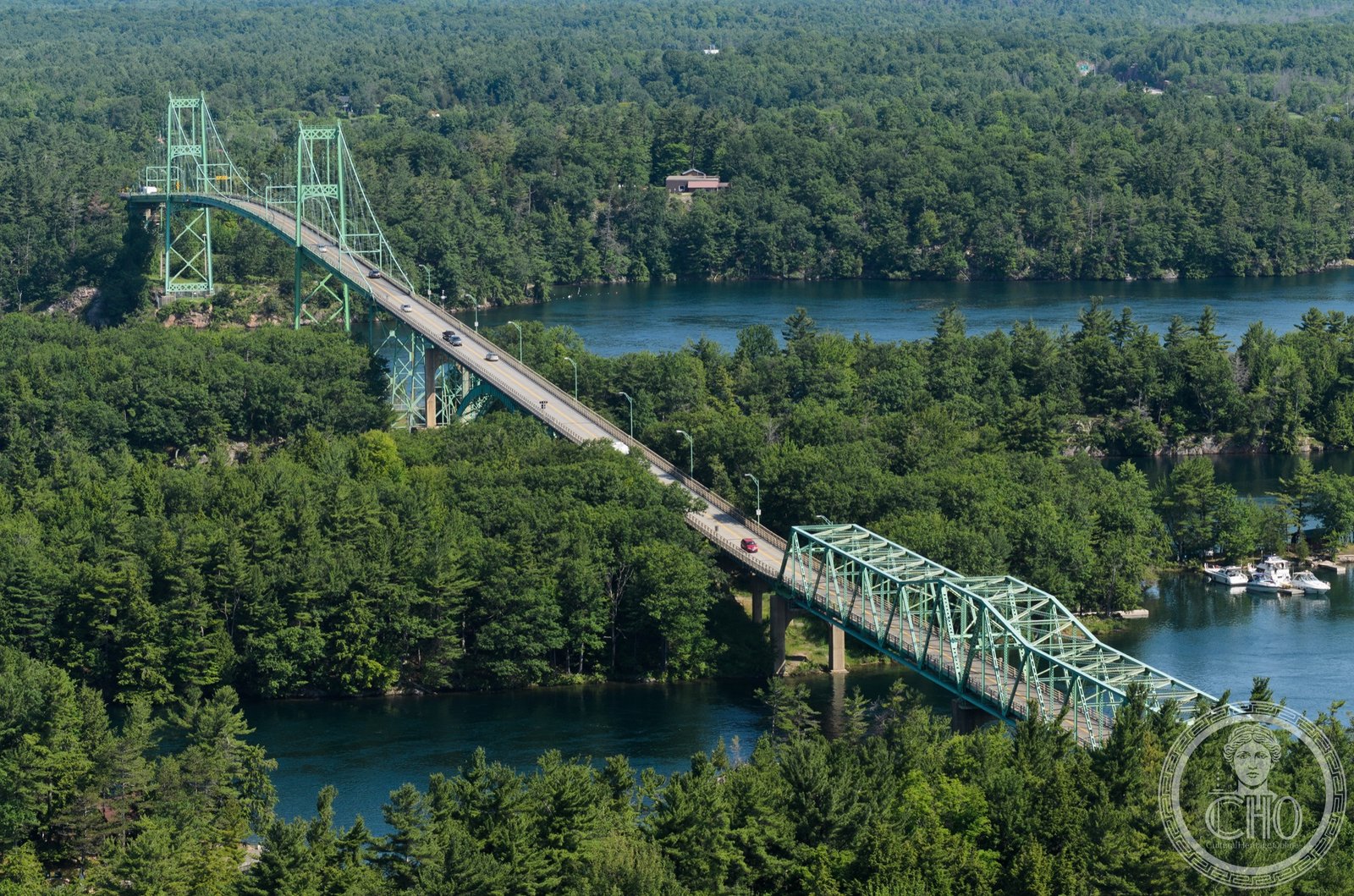
Two Art Deco suspension spans cross the St. Lawrence River here, linking New York to Ontario across one of the most scenic stretches of the American-Canadian border.
At a glance
The Thousand Islands Bridge opened in August 1938, carrying what is now Interstate 81 across the St. Lawrence River between Collins Landing (near Alexandria Bay, New York) and Hill Island, Ontario. Two main suspension spans — the American span from the mainland to Wellesley Island, and the international span from Wellesley Island to Hill Island — are connected by a causeway across Wellesley Island. Both towers rise in stepped Art Deco profiles above the river, their concrete piers sharing the architectural language of the great Depression-era infrastructure projects that redefined the American landscape.
Key facts
- Opened: August 18, 1938
- Engineer: Shortridge Hardesty (Hardesty & Hanover)
- Structure: Two suspension spans plus causeway across Wellesley Island
- Carries: Interstate 81 (originally US Route 81)
- Style: Art Deco concrete pylon towers with chamfered setbacks
- Designation: ASCE National Historic Civil Engineering Landmark
- Operated by: Thousand Islands Bridge Authority
History
For decades, crossing the St. Lawrence between New York and Ontario meant a ferry voyage — reliable in summer, impossible in winter ice. A permanent bridge had been discussed since the late nineteenth century, but the cost and engineering challenge of spanning the fractured Thousand Islands channel deterred every plan. The Depression-era Public Works Administration finally provided the federal framework that made construction possible, with work beginning in 1937.
Shortridge Hardesty of Hardesty & Hanover was the chief engineer, his sensibility shaped by a decade that had produced the George Washington Bridge (1931) and the Golden Gate (1937). The towers he designed speak the same language as those great structures: reinforced concrete, chamfered at every level, abstract and massive, their form derived from structural necessity and refined into architecture. The bridge opened on August 18, 1938, with ceremonies attended by New York Governor Herbert Lehman and Canadian Prime Minister William Lyon Mackenzie King — a bilateral inauguration reflecting the crossing’s symbolic role as a connector of two nations.
The bridge transformed travel through the Thousand Islands region, a stretch of the St. Lawrence dotted with some 1,800 islands — some barely large enough for a single cottage — that had drawn wealthy vacationers since the late Victorian era. What had required a seasonal ferry journey was now a drive across one of the most graceful Art Deco suspension bridges in North America.
What you see
The Art Deco character of the bridge is concentrated in its towers. Each pylon rises from massive concrete anchorages, its face broken into horizontal bands that step back as the tower gains height — a proportioning system borrowed from the skyscraper setback aesthetics of the 1920s and absorbed into the vocabulary of Depression-era bridges and dams. The effect is of controlled mass: the towers are large enough to anchor two suspension spans, but refined enough to read as architecture rather than raw infrastructure.
The American span is the more accessible for visitors on the US side. From Wellesley Island State Park, immediately north of the toll plaza, the full sweep of the mainland span is visible from below — cables curving against the sky, the towers framing the river valley behind. The surrounding Thousand Islands landscape, islands of Precambrian granite worn smooth by glacial action with cedars leaning from every rock face, gives the engineering an unexpectedly pastoral setting that was itself part of the crossing’s appeal when the bridge was new.
Practical information
- Toll: Toll bridge; rates vary by vehicle class (check Thousand Islands Bridge Authority website)
- Border crossing: Valid passport or NEXUS card required; US Customs inspection on Wellesley Island inbound
- Best views: Wellesley Island State Park (US side, immediately off I-81 north) and boat tours that pass beneath the spans
- Season: Open year-round, though winter conditions can affect the St. Lawrence crossing
Getting there
The bridge is reached via Interstate 81 northbound from the New York State interior; Alexandria Bay is the nearest town on the US side, approximately 90 miles northeast of Syracuse. The closest commercial airport is Watertown International (ART), about 30 miles southwest. There is no rail service to the immediate area — the bridge is a driving destination. From the Canadian side, Kingston, Ontario is the nearest city, approximately 90 minutes via Highway 401 and the bridge crossing.
Nearby
- Boldt Castle (1900), Heart Island — The unfinished Gilded Age castle of hotel magnate George Boldt, accessible by boat from Alexandria Bay; one of the defining landmarks of the Thousand Islands
- Wellesley Island State Park — Nature preserve and campground immediately adjacent to the US span, with swimming, hiking, and waterfront views of the bridge towers
- Singer Castle (1905), Dark Island — A turreted Edwardian castle on Dark Island, accessible by private tour boat from Chippewa Bay
- Kingston, Ontario — Historic fortified city at the junction of the St. Lawrence and Lake Ontario, approximately 50 miles by road from the bridge’s Canadian portal
Sources
- Thousand Islands Bridge Authority, official bridge history, thousandislandsbridge.com
- American Society of Civil Engineers, National Historic Civil Engineering Landmark documentation
- Wikipedia, “Thousand Islands Bridge,” en.wikipedia.org/wiki/Thousand_Islands_Bridge
- New York State Office of Parks, Recreation and Historic Preservation
Find it on the map
See this place and what’s around it →Record researched and written by Luigi De Marchi for Cultural Heritage Online, 2026.
📷 Become a Cultural Heritage Online photographer
Share your photos of places: they stay published under your name as the author. The more they're seen, the more you get noticed — and soon a contest will reward the most appreciated photos.
Log in or sign up free to add a photoIs this page about you?
This page is read by travellers and heritage enthusiasts who find it on Google. Tell us how you are connected to this place and we will take it from there.