
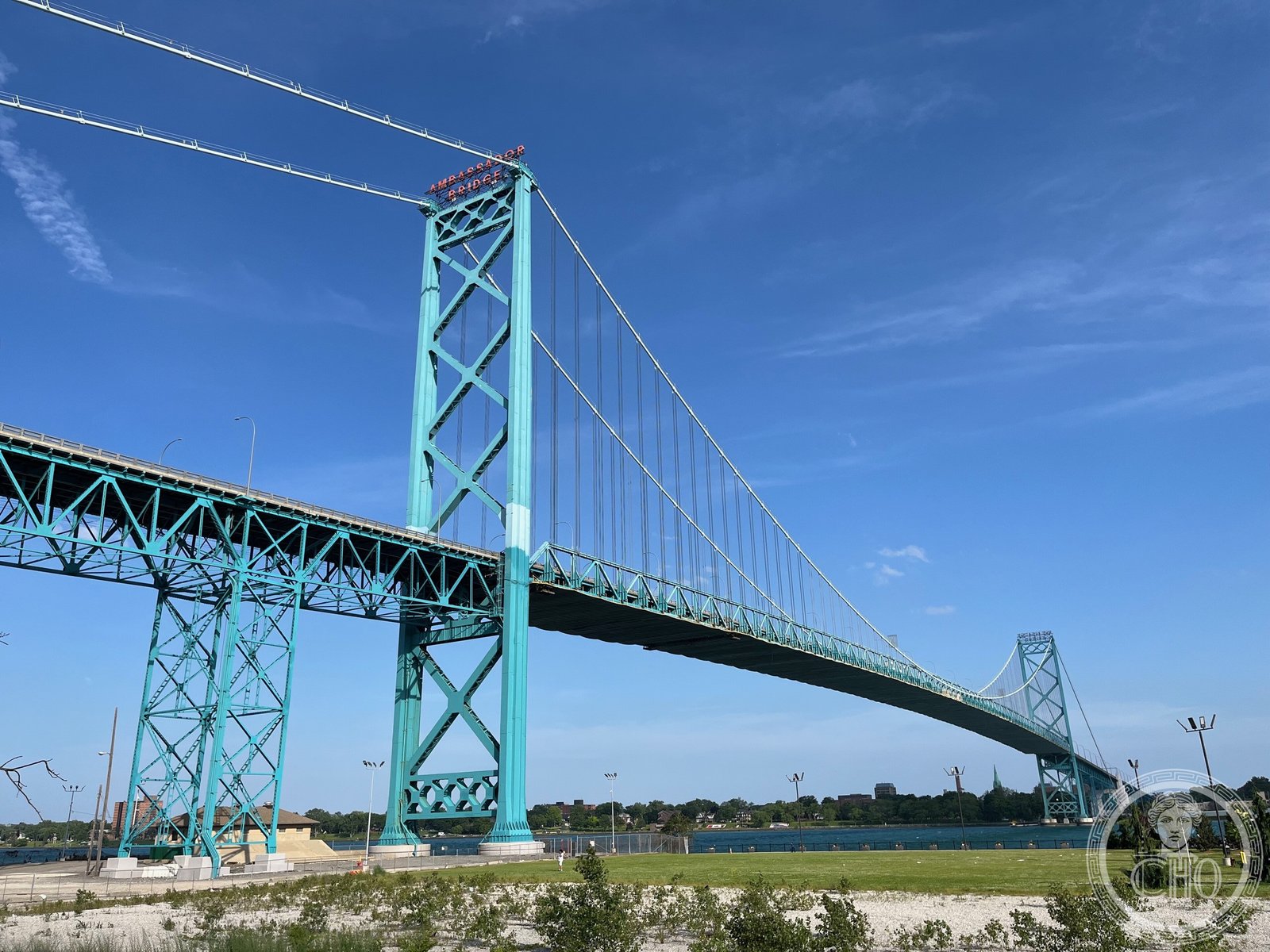
Ambassador Bridge
When it opened in November 1929, the Ambassador Bridge was the longest suspension bridge in the world — a privately built crossing linking Detroit to Windsor that would, for most of the century that followed, carry more international trade than any other border crossing in North America.
At a glance
The Ambassador Bridge spans the Detroit River between the Delray neighbourhood of Detroit, Michigan and the city of Windsor, Ontario. Completed in 1929 by the Detroit International Bridge Company, it is one of the few major American suspension bridges of the Art Deco era to have been built with entirely private capital. Its towers carry the main suspension cables above the deck and are articulated with the stepped, geometric ornament of the Art Deco period — visible from both waterfronts as a twin-towered silhouette against the sky. The bridge remains privately owned and carries a significant share of the road freight crossing between the United States and Canada.
Key facts
- Opened: 11 November 1929
- Type: Suspension bridge
- Connects: Detroit, Michigan (USA) to Windsor, Ontario (Canada)
- Owner: Detroit International Bridge Company (private)
- Style: Art Deco towers
- Distinction: Longest suspension bridge in the world at opening
- Status: National Register of Historic Places (US side); active border crossing
History
Plans for a fixed crossing at Detroit dated back decades before the Ambassador Bridge was built; ferry traffic across the strait — the Detroit River being less than a mile wide at this point — had been a reliable but slow conduit since the nineteenth century. The breakthrough came when the Detroit International Bridge Company secured both American and Canadian approvals for a suspension bridge in the mid-1920s, at a moment when the automotive industry was transforming Detroit into one of the wealthiest cities on the continent.
Construction proceeded from both shores simultaneously over several years. When the bridge opened on 11 November 1929 — Armistice Day — it was celebrated as an engineering triumph and a symbol of the commercial partnership between two nations. The timing was, however, inauspicious: within days of the opening ceremonies, the stock market crash that had begun weeks earlier was reshaping the industrial economy the bridge was built to serve.
Through Depression and war the bridge remained the busiest international crossing in North America, carrying automotive parts, raw materials, and, during the Second World War, strategic supplies moving between Michigan factories and Canadian processing facilities. The bridge changed hands within the Moroun family over subsequent decades and remained a flashpoint in debates about infrastructure ownership, border security, and the Gordie Howe International Bridge — a publicly owned crossing recently completed or nearing completion nearby — which offers a publicly managed alternative.
What you see
The four main cables of the Ambassador Bridge connect two steel towers, each rising to the same height above the river on their respective shores. The towers are constructed in a steel framework sheathed in concrete, with the characteristic Art Deco setbacks at multiple levels — a series of receding planes that gives the tower profile a stepped, almost architectural quality quite different from the plain portal frames of earlier suspension bridges. The ornamental details are restrained: the Art Deco vocabulary of the towers comes from massing and geometry rather than applied decoration.
From the Detroit waterfront at River Town or the riverfront promenade, the bridge reads as a single composition spanning the international strait, its cables cutting diagonals against the open sky. The Windsor side offers a longer approach road that makes the towers appear taller relative to their surroundings. The bridge deck sits high above the water to permit the passage of Great Lakes freighters — the clearance was calculated to remain useful for shipping traffic well into the future, a foresight that proved accurate.
Practical information
- Border crossing: Valid passport (or NEXUS card) required to cross between the US and Canada
- Toll: Charged in both directions; cash and credit accepted; NEXUS lanes available
- Hours: 24 hours, though border wait times vary — longest during morning and evening peak
- No pedestrian access: The bridge is vehicles-only; the nearby Detroit-Windsor Tunnel serves pedestrians and cyclists
- Viewpoints: Detroit RiverFront Conservancy trails and Hart Plaza offer views of the bridge from the US side
Getting there
The US approach to the Ambassador Bridge is via I-75 south from downtown Detroit, following signs for the Ambassador Bridge through the Delray neighbourhood, approximately 5 miles southwest of downtown. The nearest major airport is Detroit Metropolitan Wayne County Airport (DTW), roughly 20 miles from the bridge. From downtown Detroit, the bridge is accessible by car in approximately 10 minutes; the Detroit RiverFront is walkable from the Renaissance Center and offers views of the crossing without requiring a border crossing.
Nearby
- Detroit Institute of Arts — one of the finest art museums in the United States, housing Diego Rivera’s celebrated Detroit Industry murals
- Guardian Building (1929) — Art Deco skyscraper in downtown Detroit, completed the same year as the bridge
- Fisher Building (1928) — Art Deco commercial landmark designed by Albert Kahn, a short distance north of downtown
Sources
- National Register of Historic Places — nomination, Ambassador Bridge
- Detroit International Bridge Company — historical documentation
- Wikipedia — Ambassador Bridge (cross-checked against NRHP and engineering sources)
- US Customs and Border Protection — historical crossing statistics
Find it on the map
See this place and what’s around it →📷 Diventa un fotografo di Cultural Heritage Online
Condividi le tue foto dei luoghi: restano pubblicate con la tua firma come autore. Più vengono viste, più ti fai conoscere — e presto un concorso premierà le foto più apprezzate.
Accedi o registrati gratis per aggiungere una foto