
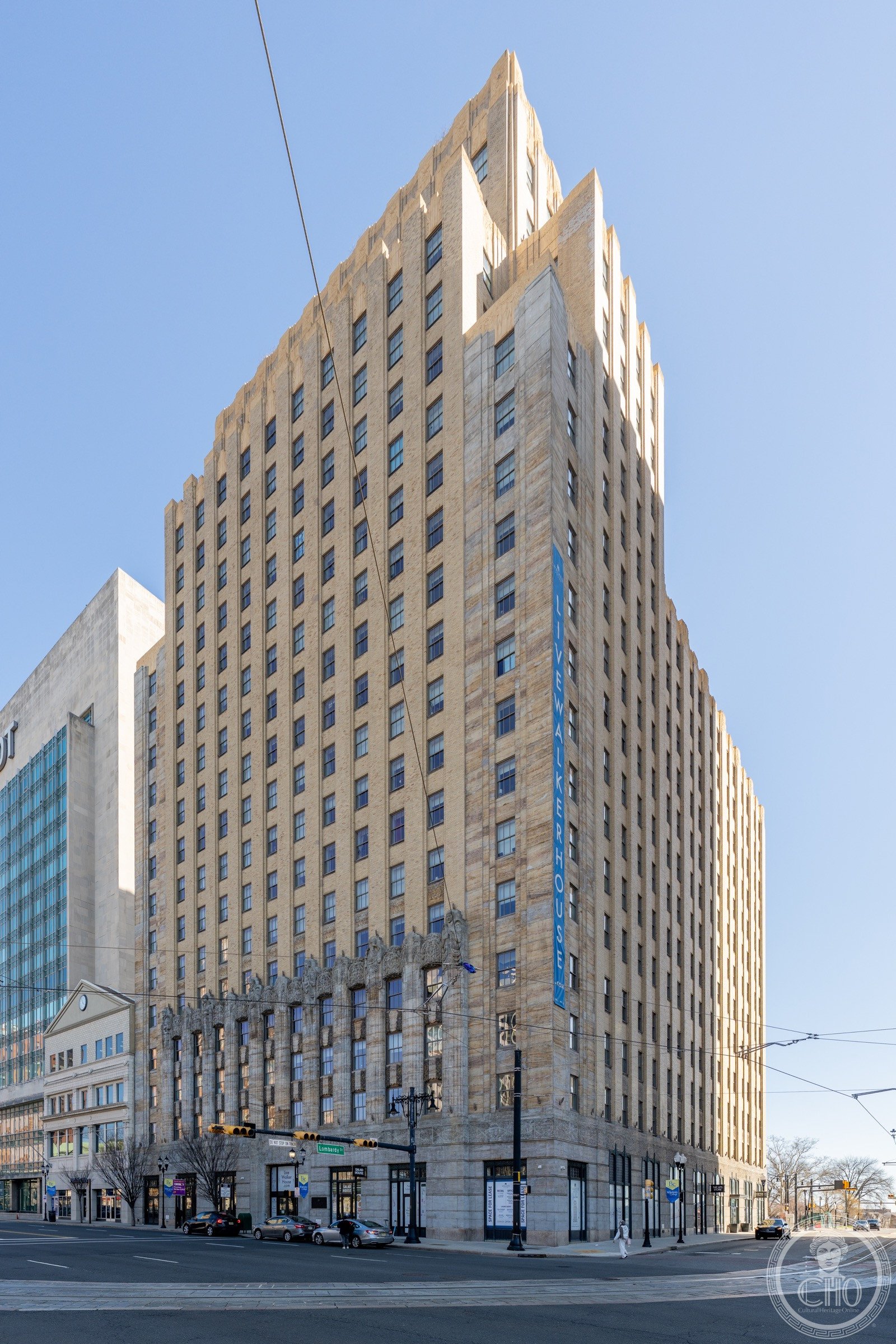
An Art Deco landmark on Broad Street, the New Jersey Bell Telephone Building is Ralph Walker’s masterwork in brick and terra cotta — one of the most richly ornamented telephone buildings of the 1920s, now converted to residences.
At a glance
The New Jersey Bell Telephone Building at 540 Broad Street, completed in 1929, is one of the finest examples of Art Deco commercial architecture in the northeastern United States. Designed by Ralph Walker of Voorhees, Gmelin & Walker, the building is a tour de force of brick and terra cotta ornament: bands of geometric patterning run the full height of the tower, accelerating in density at the upper floors before dissolving into a richly detailed crown. Walker was the most celebrated telephone-building architect of his generation, and this Newark commission followed closely on his success with the Barclay-Vesey Building in Lower Manhattan (1927). Today the building has been converted to residential use, but its exterior survives intact as a landmark of downtown Newark.
Key facts
- Address: 540 Broad Street, Newark, New Jersey
- Completed: 1929
- Architect: Ralph Walker (Voorhees, Gmelin & Walker)
- Style: Art Deco
- Original client: New Jersey Bell Telephone Company
- Current use: Residential (540 Broad Apartments)
- Historic designation: National Register of Historic Places
History
By the late 1920s, the American telephone industry was one of the country’s most capital-intensive institutions, and the Bell System companies had developed a tradition of commissioning buildings that projected technological confidence and civic permanence. Ralph Walker — who had established his reputation with the Barclay-Vesey Building in Lower Manhattan — was the natural choice for New Jersey Bell’s new headquarters. Walker had developed a distinctive approach to the skyscraper: rather than relying on historicist ornament borrowed from Gothic or Renaissance precedent, he treated the brick facade as a surface to be modeled, layered, and animated from base to crown. The New Jersey Bell building is his most sustained exploration of that idea.
The building served as New Jersey Bell’s headquarters through the mid-twentieth century, housing the telephone company’s operations and administrative functions as New Jersey’s telecommunications network expanded. After the breakup of the Bell System in 1984, the building passed through several phases of corporate ownership before eventually being repurposed for residential use. The conversion preserved the building’s ornamental program and original proportions while adapting the interior for modern apartments, a pattern that has become common for architecturally significant early skyscrapers in American cities facing commercial office vacancy.
The American Institute of Architects recognized Walker as one of the most important architects of the first half of the twentieth century. His series of telephone buildings across the Northeast — Barclay-Vesey (1927), New Jersey Bell (1929), and several later commissions — represent a coherent body of work in Art Deco brick construction that has no real parallel in American architectural history.
What you see
Walker’s handling of the facade is what distinguishes the building from the rest of Newark’s commercial skyline. The brick surface is not flat but modeled: recessed and projecting bands of different brick colors create a three-dimensional texture across the full tower height, while terra cotta panels in geometric and floral Art Deco patterns appear at the spandrels, the window surrounds, and the entrance surround at street level. The ornament is densest at the base and the crown, where the building resolves into an intricately worked sequence of setbacks and decorated cornices.
The ground-floor lobby entrance is framed by an elaborately detailed arched portal, a remnant of Walker’s commitment to the entry sequence as a transitional moment between the street and the interior. Inside (now converted to a residential lobby), the original architectural metalwork and some of the decorative finishes from the building’s telephone-company era survive in modified form. The building’s most striking views are from Broad Street looking south, where the full tower profile is visible against the downtown Newark skyline.
Practical information
- Status: Residential building (540 Broad Apartments); lobby not publicly accessible
- Exterior: Freely visible from Broad Street, accessible from the sidewalk
- Historic designation: National Register of Historic Places
- Best views: From Broad Street pedestrian level, looking toward the building’s entrance and crown
Getting there
The building is in downtown Newark at 540 Broad Street, easily reached from Newark Penn Station (NJ Transit and Amtrak), which is about a ten-minute walk south on Broad Street. From New York Penn Station, direct trains to Newark run every few minutes on NJ Transit’s Northeast Corridor line. The Newark Light Rail also stops at Washington Park station, serving the downtown Broad Street corridor. By car, the building is just off the Garden State Parkway and I-78 interchange that feeds downtown Newark from the New Jersey Turnpike system.
Nearby
- Newark Museum of Art — New Jersey’s largest art museum, at 49 Washington Street, with a collection spanning ancient to contemporary art
- Prudential Center — the arena for the New Jersey Devils NHL franchise, in the downtown Newark arena district on Lafayette Street, within walking distance of 540 Broad
- Military Park — the historic public square at the center of downtown Newark, framed by early-twentieth-century commercial buildings
- Newark City Hall (1906) — the Beaux-Arts city hall at Broad and Market Streets, one block north
Sources
- Wikipedia: New Jersey Bell Telephone Building
- National Register of Historic Places nomination documentation
- American Institute of Architects, Ralph Walker papers and citations
- Robert A. M. Stern, Thomas Mellins, David Fishman, New York 1930 (Rizzoli, 1994)
Find it on the map
See this place and what’s around it →📷 Become a Cultural Heritage Online photographer
Share your photos of places: they stay published under your name as the author. The more they're seen, the more you get noticed — and soon a contest will reward the most appreciated photos.
Log in or sign up free to add a photoDo you manage this place?
This page is read by travellers and heritage enthusiasts who find it on Google. Keep it accurate — and make it work for you. Free for non-profit heritage institutions.