
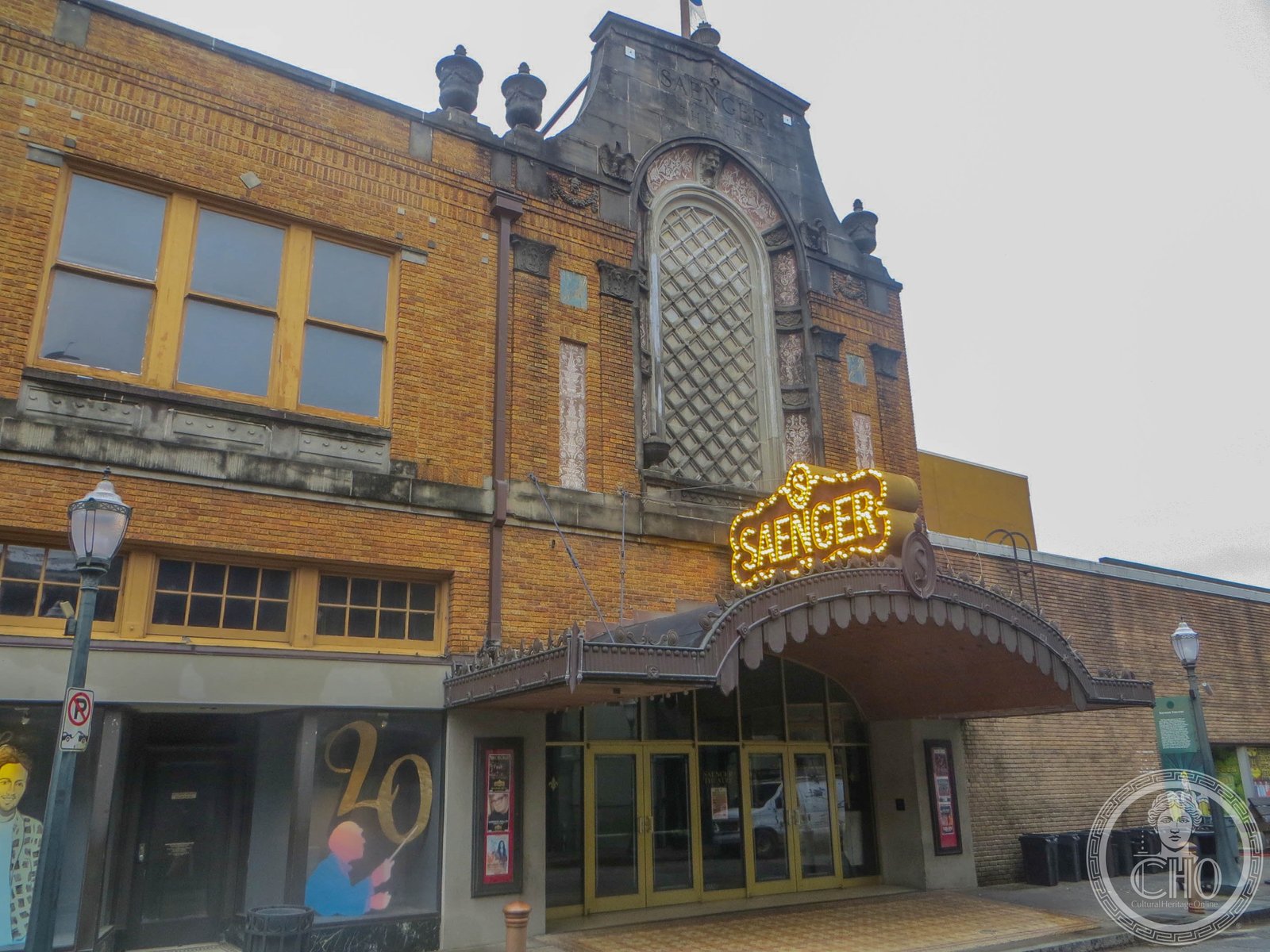
Mobile’s anchor performing arts venue since January 1927, the Saenger Theatre holds down the Lower Dauphin Street Historic District with a Moorish-inflected facade of terracotta ornament — a signature house of the Gulf Coast’s largest theater circuit.
At a glance
Part of the Saenger Amusement Enterprises circuit founded by brothers Julian and Abraham Saenger of New Orleans, Mobile’s house opened in January 1927 as a destination-class movie palace for the northern Gulf Coast. The facade deploys Moorish arches, decorative terracotta panels, and a cantilevered marquee in the warm Mediterranean vocabulary that the Saenger chain used to signal occasion across the Deep South. The theater remained the premier theatrical address in Mobile through the mid-twentieth century, narrowly avoided demolition in the 1970s, and after successive restorations now hosts Broadway touring productions and concerts as the cultural anchor of Mobile’s revitalized downtown arts district.
Key facts
- Address: 6 South Joachim Street, Mobile, AL 36602
- Opened: January 1927
- Circuit: Saenger Amusement Enterprises (Gulf Coast chain founded by Julian and Abraham Saenger)
- Style: Mediterranean Revival with Moorish ornamental detail
- Historic status: Contributing building, Lower Dauphin Street Historic District (NRHP)
- Current use: Active performing arts venue — Broadway touring, concerts, film events
- GPS: 30.6940° N, 88.0431° W
History
The Saenger circuit was the product of New Orleans entrepreneurs Julian and Abraham Saenger, who began building a Gulf Coast theater empire after their first New Orleans movie palace in the 1910s. Mobile, the South’s second-largest port and the commercial capital of the northern Gulf, was a logical expansion point. The 1927 house aligned the city with the circuit’s broader ambition: to bring the architecture and program quality of the country’s premier big-city movie palaces to Southern audiences who had rarely seen anything comparable.
The Moorish ornamental vocabulary chosen for the Joachim Street facade was deliberate. The Saenger chain favored Mediterranean-inflected designs across its portfolio — a theatrical style that telegraphed cosmopolitan aspiration to audiences who associated ornate brickwork and terracotta with wealth and quality. The same design language runs through Saenger houses in New Orleans, Pensacola, and Biloxi, creating a family identity across the Gulf Coast.
By the 1960s and 1970s, suburban multiplex competition had hollowed out Mobile’s downtown theaters. The Saenger closed and faced demolition pressure. Local preservationists mobilized in time; the NRHP listing for the Lower Dauphin Street Historic District protected the facade, and a series of restoration projects — working from surviving photographs and original plasterwork samples — returned the marquee and ornamental exterior to something close to the 1927 original. The theater now operates year-round, drawing audiences from throughout the greater Mobile Bay region.
What you see
The Saenger’s Joachim Street elevation is designed to perform at distance. Terracotta ornament accumulates on the upper stories — Moorish arches, decorative cartouches, foliate borders — in warm ochre tones that stand out against the flat brick facades of neighboring commercial buildings. The principal entry bay is framed by pilasters with stylized capitals and decorated spandrels; the cantilevered marquee projects low enough to shelter arriving audiences from Gulf rain without obscuring the decorated frieze above. The combination of curved lines, ornamental tile, and electric signage was standard for high-tier movie palaces of the late 1920s but remains exceptional for a city of Mobile’s size.
The interior continues the Mediterranean theme — painted plaster ceiling evoking an outdoor courtyard, side walls with decorative niches and wrought-iron grille work — while the restoration preserved original paint schemes and gilt detail to a degree unusual among surviving Gulf Coast theaters.
Practical information
- Performance schedule varies by season; check the box office at saengermobile.com for current productions
- The theater is in the walkable Lower Dauphin Street arts corridor, surrounded by restaurants, galleries, and bars
- Parking: city garages within two blocks on St. Joseph Street and Conti Street
- Accessible seating at orchestra level — contact the box office in advance
- Allow time before showtime to study the terracotta ornament up close; details visible from the sidewalk reward a slow look
Getting there
Mobile Regional Airport (MOB) is approximately 15 miles northwest of downtown via I-65 South. No direct public transit link runs from the airport to the theater district; rideshare or rental car are the practical options. Amtrak’s Sunset Limited — three times weekly on the New Orleans–Los Angeles route — serves Mobile Union Station at 11 Government Street, about ten minutes’ walk from the Saenger. Once downtown, the theater is easily walkable from the Renaissance Mobile Riverview Plaza Hotel on Government Street and from the city’s waterfront Mardi Gras Park.
Nearby
- Fort Condé — reconstructed 18th-century French colonial fort at Royal and Church streets, one block from the theater; Mobile was the first permanent European settlement on the Gulf Coast (1702)
- Museum of Mobile — 111 South Royal Street, two blocks away; traces the city’s French, British, Spanish, and American heritage
- USS Alabama Battleship Memorial Park — approximately 6 miles east on Mobile Bay; WWII battleship and submarine moored permanently as a memorial and museum
- Bellingrath Gardens and Home — 20 miles south via US-90/AL-193; 65 acres of cultivated gardens famous for azalea and rose displays, overlooking the Fowl River
Sources
- National Register of Historic Places — Lower Dauphin Street Historic District nomination, Mobile, Alabama
- Wikipedia: Saenger Theatre (Mobile, Alabama)
- Historic American Buildings Survey (HABS AL-1009) — Library of Congress
- Saenger Theatre Mobile official site: saengermobile.com
Find it on the map
See this place and what’s around it →Record researched and written by Luigi De Marchi for Cultural Heritage Online, 2026.
📷 Become a Cultural Heritage Online photographer
Share your photos of places: they stay published under your name as the author. The more they're seen, the more you get noticed — and soon a contest will reward the most appreciated photos.
Log in or sign up free to add a photoIs this page about you?
This page is read by travellers and heritage enthusiasts who find it on Google. Tell us how you are connected to this place and we will take it from there.