
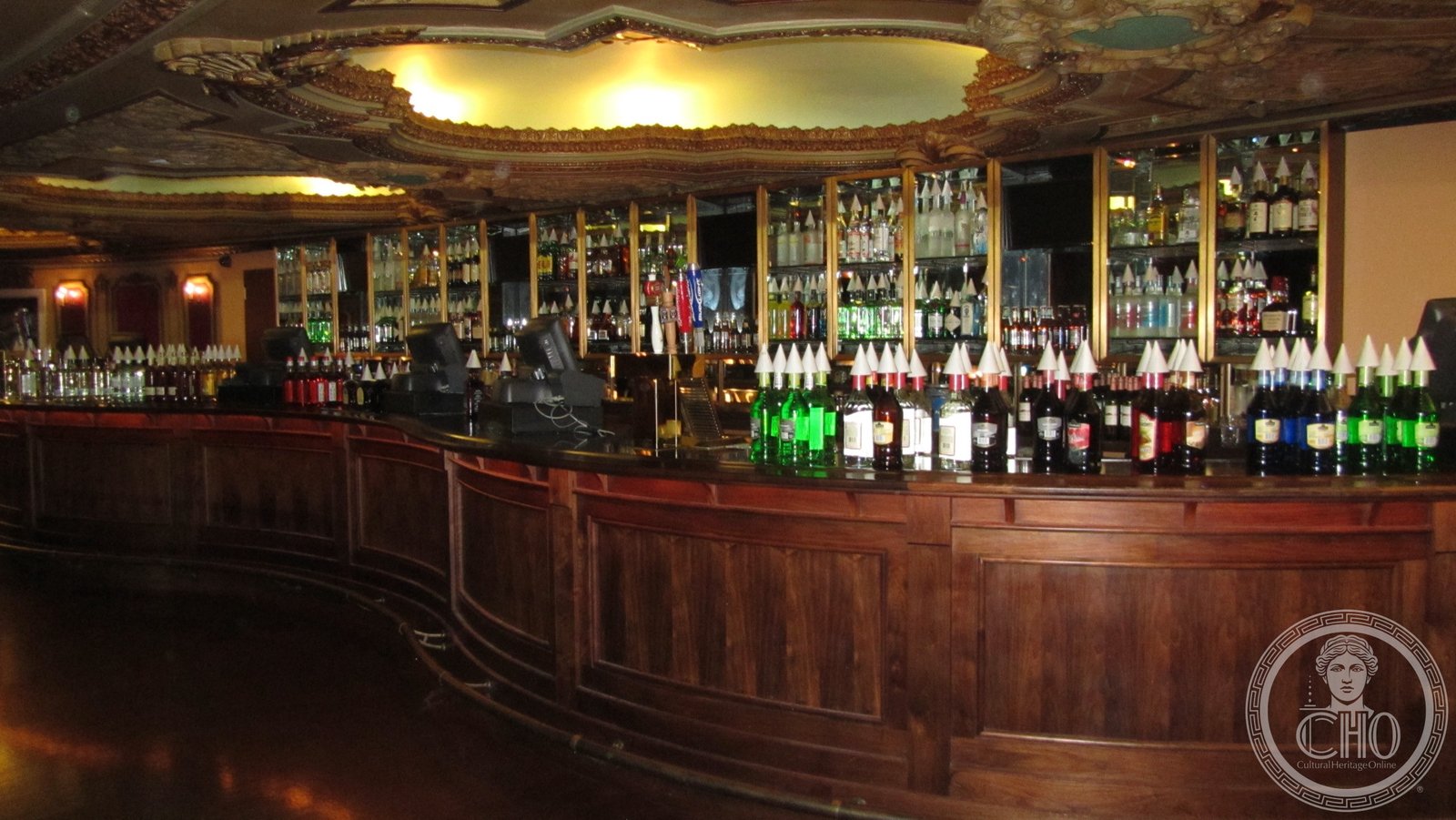
The grandest surviving French Baroque interior in Kansas City, the Midland Theatre opened in 1927 as a Loew’s flagship house — nearly 3,000 seats beneath gilded plasterwork and an ornate painted ceiling that remains largely intact nearly a century later.
At a glance
The Midland Theatre at 1228 Main Street is Kansas City’s largest surviving movie palace and one of the finest ornate theatre interiors in the American Midwest. Built in 1927 for the Loew’s theatrical circuit, the building seats approximately 2,900 in an auditorium whose French Baroque interior — gilded plasterwork, painted ceiling panels, ornamental balconies, and Art Deco lobby details — remains largely original. Listed on the National Register of Historic Places, the Midland remains in active operation today as as the Arvest Bank Theatre at the Midland, it is one of the premier concert and event venues in Kansas City.
Key facts
- Address: 1228 Main Street, Kansas City, MO 64105
- Opened: 1927
- Original circuit: Loew’s theatrical chain
- Style: French Baroque Revival / Art Deco interior detailing
- Status: NRHP Listed; active concert and event venue
- Capacity: approximately 2,900 seats
- Theme: Art Deco USA
History
Kansas City in 1927 was a city of 400,000 at the height of its role as a rail hub and agricultural trading center. Main Street was the commercial spine of a compact but ambitious downtown, and the Loew’s organization chose the site at 1228 Main to build a flagship house that would compete with the best theatres in St. Louis and Chicago. The resulting building — designed on a scale that could absorb the largest film audiences and the most elaborate touring stage productions — opened to critical and popular acclaim as one of the finest theatre interiors west of the Mississippi.
The French Baroque vocabulary of the interior was selected for its associations with the grandeur of European court culture, a deliberate contrast to the commercial Main Street context outside. The ornate plaster cartouches, gilded lunette panels, and painted ceiling tableau created an immersive environment designed to transport audiences from the everyday into a world of fantasy — the same function performed by the atmospheric theatres of the same era, achieved here through historical pastiche rather than illusionistic sky painting. The Art Deco geometry of the lobby and foyer spaces acknowledged the more contemporary aesthetic vocabulary of the moment.
The Midland closed in the 1980s as downtown Kansas City’s entertainment economy declined, but preservation advocacy and subsequent investment by Live Nation Entertainment returned the building to active use. The concert programming model — leveraging the ornate interior as a premium venue for touring artists — has proven highly successful. The theatre draws audiences for national touring acts who prize the intimate acoustic scale and the visual drama of the gilded auditorium.
What you see
The Main Street facade is a composed terracotta front with arched windows and ornamental banding, relatively understated compared to the theatrical elaboration of the interior. The transition from exterior to interior is deliberate: the lobby progresses through a series of increasingly ornate vestibule spaces, each more gilded and detailed than the last, before opening into the full volume of the auditorium.
The auditorium itself is the building’s masterpiece: a 2,900-seat bowl whose walls are covered in deeply modeled Baroque plasterwork, its ceiling an elaborate painted composition in deep blues, ochres, and gilt. The proscenium arch is framed by pilasters and entablature in the Baroque mode, and the balcony fronts carry continuous ornamental friezes. The bar and lounge spaces that adjoin the main auditorium — accessible during events — display the same level of craftsmanship in a more intimate register, with carved woodwork and period fixtures that recall the social spaces of a grand European opera house.
Practical information
- Access: 1228 Main Street, downtown Kansas City; adjacent to the KC Streetcar Main Street stop
- Programming: national touring concert artists, special events; check Arvest Bank Theatre calendar for current schedule
- Time needed: 2–3 hours for a full concert experience; arrive early to appreciate the lobby and auditorium details
- Best season: year-round indoor venue
Getting there
Kansas City International Airport (MCI) is approximately 18 miles northwest of downtown, with connections to major hubs. The KC Streetcar (free) runs along Main Street and stops directly in front of the Midland Theatre. Kansas City Union Station, approximately 1.5 miles south via the Main Street streetcar, is served by Amtrak’s Southwest Chief (Chicago–Los Angeles) and Missouri River Runner (Kansas City–St. Louis).
Nearby
- Kansas City Power & Light Building (1931) — the Art Deco skyscraper at 106 West 14th Street, a terracotta tower with a distinctive illuminated crown, approximately 0.4 miles south on the Main Street corridor
- Crossroads Arts District — the gallery district southwest of downtown, centered on 18th and Vine, approximately 0.8 miles south; the city’s principal contemporary arts venue concentration
- Nelson-Atkins Museum of Art — the encyclopedic art museum with the Bloch Building addition by Steven Holl, approximately 2.5 miles east in the Hyde Park neighborhood
Sources
- National Register of Historic Places — Midland Theatre listing, Missouri State Historic Preservation Office
- Live Nation Entertainment — operational history documentation
- Kansas City Landmarks Commission records
- Wikimedia Commons — Bar at the Midland Theatre, Kansas City.jpg, CC BY 2.0
Find it on the map
See this place and what’s around it →Record researched and written by Luigi De Marchi for Cultural Heritage Online, 2026.
📷 Become a Cultural Heritage Online photographer
Share your photos of places: they stay published under your name as the author. The more they're seen, the more you get noticed — and soon a contest will reward the most appreciated photos.
Log in or sign up free to add a photoIs this page about you?
This page is read by travellers and heritage enthusiasts who find it on Google. Tell us how you are connected to this place and we will take it from there.