
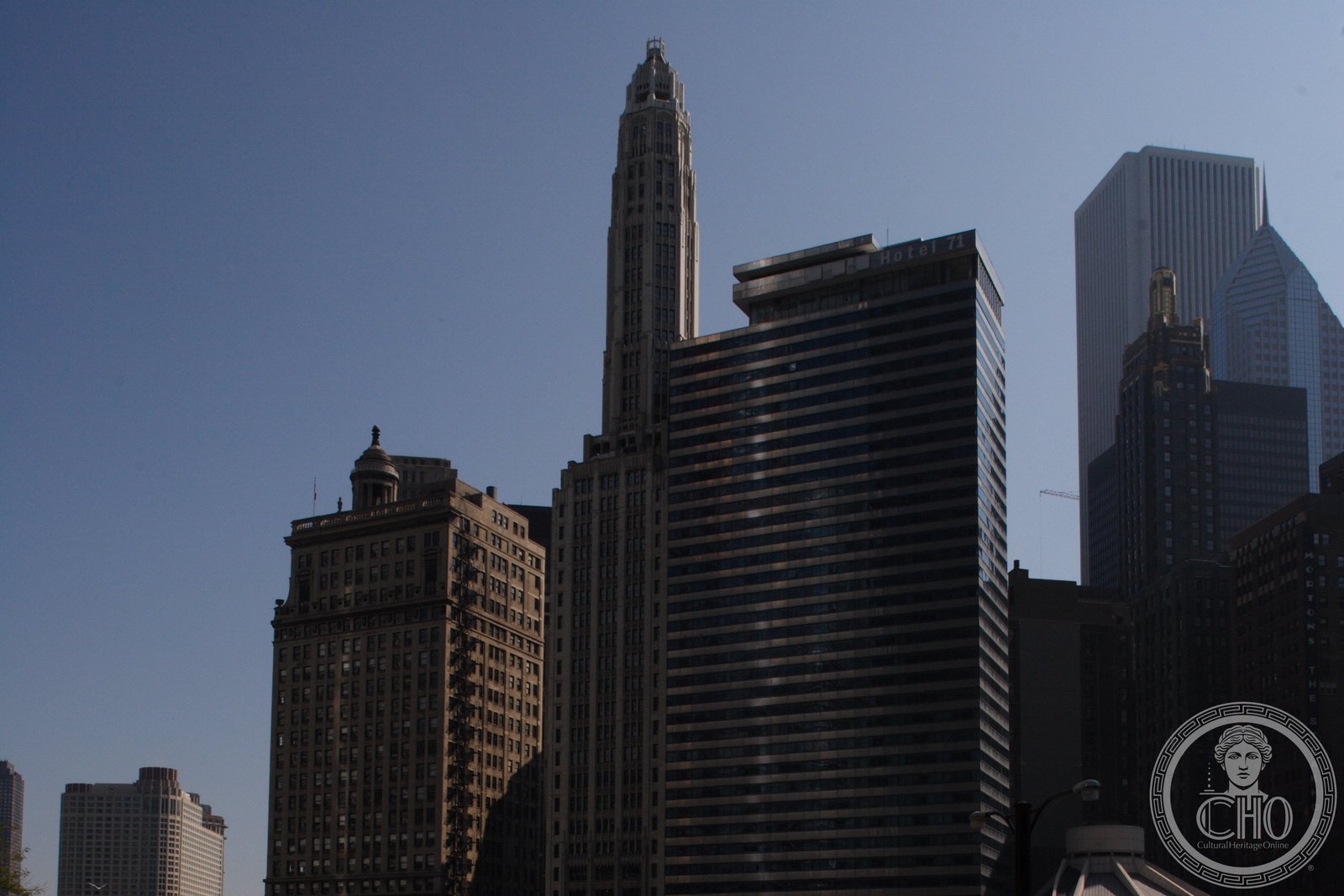
Rising above the Chicago River on East Wacker Drive since 1928, the Mather Tower is the finest example of Art Deco Gothic design in a city that reinvented American architecture — a slender terracotta spire that bridges the Gothic Revival of the previous generation and the modernist verticality to come.
At a glance
The Mather Tower at 75 East Wacker Drive is a twenty-one-story Art Deco Gothic skyscraper on the south bank of the Chicago River, completed in 1928 at the peak of the decade’s building boom. Designed by architect Herbert Hugh Riddle, the building combines Gothic lancet windows, filigree buttresses, and a pointed finial with the rationalized terracotta curtain wall of the Art Deco vocabulary — a synthesis characteristic of the transitional moment between historicist and modernist Chicago architecture. Listed on the National Register of Historic Places, the Mather Tower is one of a cluster of early Art Deco towers that transformed the East Wacker Drive corridor into a continuous composition of layered skyline setbacks.
Key facts
- Address: 75 East Wacker Drive, Chicago, IL 60601
- Completed: 1928
- Architect: Herbert Hugh Riddle
- Style: Art Deco Gothic — lancet ornament in a setback skyscraper form
- Status: NRHP Listed; mixed-use commercial building
- Height: 21 stories with a Gothic finial
- Theme: Art Deco USA
History
The transformation of East Wacker Drive from an industrial riverfront into a unified commercial boulevard began with the 1909 Burnham Plan of Chicago, which called for a double-decked boulevard on the south bank of the Chicago River. By the mid-1920s, the building industry had responded with a series of towers whose setback facades were designed to be seen collectively as a river panorama rather than as isolated structures. The Mather Tower, commissioned in 1925 and completed in 1928, was one of several buildings developed in direct response to this urban design ambition.
The Gothic vocabulary chosen by architect Herbert Hugh Riddle was not an anomaly: the 1920s saw parallel impulses toward Gothic ornament (the Tribune Tower competition of 1922, won by the Gothic Revival design of Howells and Hood) and toward the stripped Deco geometry that would dominate the following decade. The Mather Tower occupies a position between these poles, using Gothic formal elements — buttresses, lancets, a pinnacled finial — as ornamental framing for a structural logic that is entirely of its era. The building reads differently at different scales: from the river, a Gothic spire; from the street, a textured terracotta curtain wall; from close range, an intricate program of carved stone and cast ornament.
The building served office tenants through the mid-twentieth century and underwent updates as the East Wacker corridor redeveloped around it. Its NRHP listing recognized the building’s architectural significance within the broader context of interwar Chicago commercial architecture. Today the Mather Tower operates as a mixed-use property, its Gothic silhouette a distinctive presence on the river skyline.
What you see
The tower’s plan is a narrow rectangle that steps back at the upper floors in the setback pattern required by zoning regulations and favored aesthetically by the architectural avant-garde of the 1920s. From the Chicago River, the building appears as part of a continuous ridge of Art Deco towers including the Wrigley Building (1921–1924), Tribune Tower (1925), and 333 North Michigan Avenue (1928) — a composition that constitutes one of the finest examples of coordinated Art Deco urban design in the world. The Mather Tower’s position on the south bank places it in dialogue with the taller Tribune Tower and Wrigley Building across the river.
The terracotta ornament concentrates at the upper floors, where lancet arches, carved grotesques, and filigree buttresses create a transition from the relatively plain lower shaft to the elaborately detailed crown. The finial extends the building’s vertical emphasis well above the parapet, giving the tower a profile that is recognizable in the Chicago skyline even at a distance where individual ornamental details are no longer legible.
Practical information
- Access: 75 East Wacker Drive, Chicago; best viewed from the north side of the river or from the Michigan Avenue Bridge
- Interior: commercial building; lobby may be viewed during business hours
- Time needed: 15–30 minutes for exterior and riverwalk views; combine with the Wrigley Building, Tribune Tower, and 333 North Michigan on a 2-hour Art Deco walking itinerary
- Best season: year-round; the river views are particularly dramatic in late afternoon light
Getting there
O’Hare International Airport (ORD) is approximately 17 miles northwest; Chicago Midway (MDW) approximately 10 miles southwest. The Mather Tower is within a 5-minute walk of multiple CTA Red, Blue, and Brown Line stops at State/Lake and Grand. Chicago Union Station (Amtrak: Empire Builder, California Zephyr, Lake Shore Limited, Southwest Chief, City of New Orleans, Capitol Limited, and others) is approximately 0.7 miles west, making Chicago one of the best-connected Amtrak hubs in the country.
Nearby
- Wrigley Building (1921–1924) — the gleaming white Beaux-Arts/Gothic Revival landmark by Graham, Anderson, Probst & White directly across the river; a landmark of the Michigan Avenue streetscape
- Tribune Tower (1925) — Howells and Hood’s Gothic Revival skyscraper at 435 North Michigan Avenue, winner of the most famous architectural competition of the decade
- Chicago Riverwalk — the award-winning public promenade along the south bank of the Chicago River, from which the East Wacker Drive Art Deco skyline is best appreciated
Sources
- National Register of Historic Places — Mather Tower listing, Illinois Historic Preservation Agency
- Commission on Chicago Landmarks — architectural history documentation
- Chicago Architecture Foundation archives
- Wikimedia Commons — Mather Tower and Skyline – Chicago01 (3225138758).jpg, CC BY-SA 2.0
Find it on the map
See this place and what’s around it →Record researched and written by Luigi De Marchi for Cultural Heritage Online, 2026.
📷 Become a Cultural Heritage Online photographer
Share your photos of places: they stay published under your name as the author. The more they're seen, the more you get noticed — and soon a contest will reward the most appreciated photos.
Log in or sign up free to add a photoIs this page about you?
This page is read by travellers and heritage enthusiasts who find it on Google. Tell us how you are connected to this place and we will take it from there.