
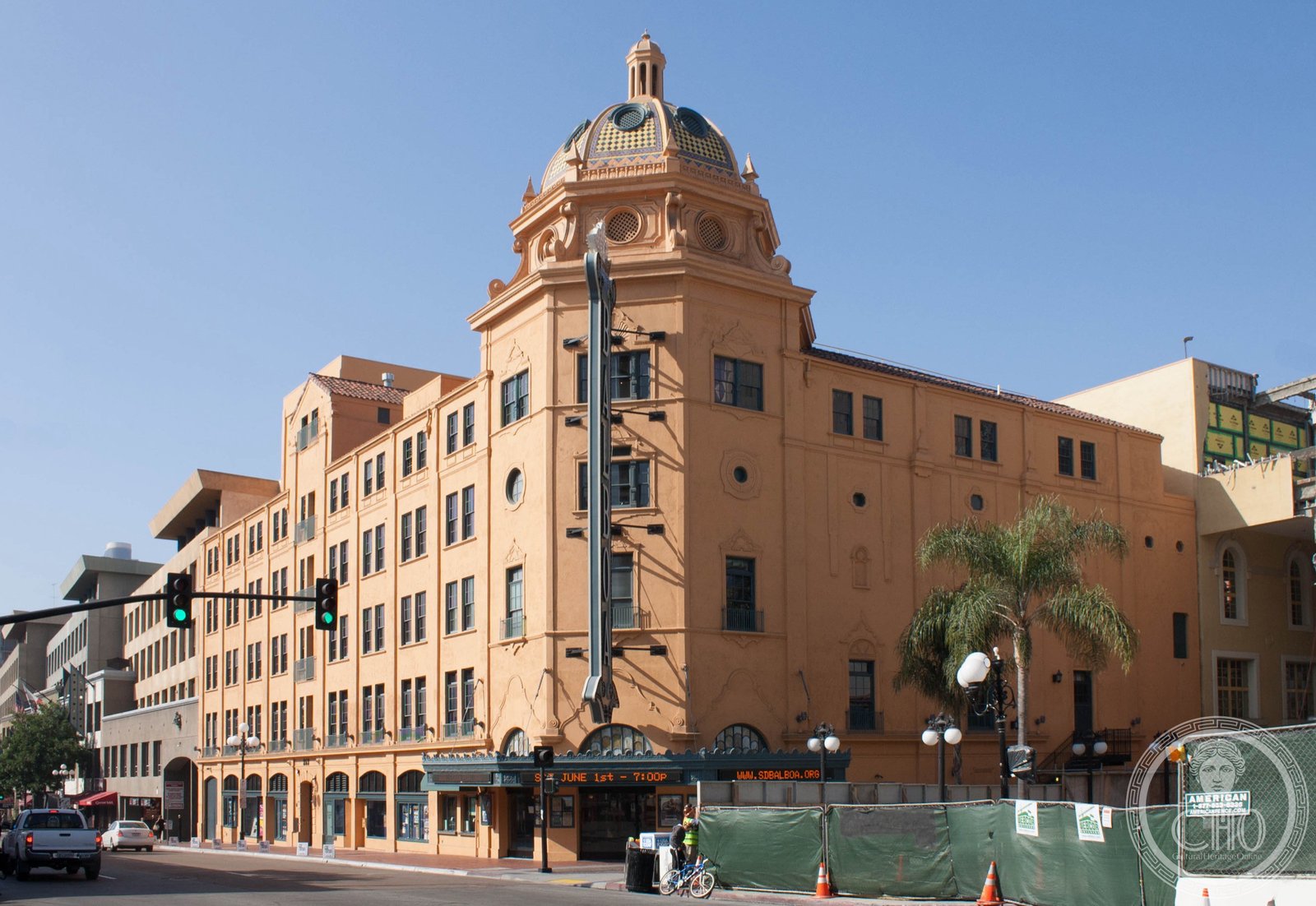
Architect William Wheeler brought Churrigueresque ornament to San Diego’s Broadway corridor in 1924—twin towers above a carved terracotta cornice, a gilt plaster auditorium, and a proscenium whose carved arch survived decades of closure to be fully restored and reopened in 2008.
At a glance
The Balboa Theatre opened in 1924 as one of San Diego’s most elaborate vaudeville and film houses, its Spanish Colonial Revival vocabulary drawn directly from the Churrigueresque buildings that Bertram Goodhue had introduced to the city at the 1915 Panama-California Exposition. Closed in 1986 and acquired by the City of San Diego, the theater underwent a painstaking restoration completed in 2008 that returned its terracotta ornament, gilt plasterwork, and proscenium arch to working condition. It now serves the San Diego Symphony, San Diego Opera, and resident theater companies as a shared performing arts venue.
Key facts
- Address: 868 Fourth Avenue, San Diego, CA 92101
- GPS: 32.7158° N, 117.1611° W
- Built: 1924
- Architect: William Wheeler
- Style: Spanish Colonial Revival / Churrigueresque
- Capacity: approximately 1,300 seats (after 2008 restoration)
- Status: Active performing arts venue (City of San Diego)
- NRHP: Listed on National Register of Historic Places
History
San Diego’s architectural identity after the 1915–16 Panama-California Exposition had cohered around Spanish Colonial Revival—the Exposition buildings in Balboa Park, designed principally by Bertram Goodhue with decorative ornament adapted from Mexican Churrigueresque sources, established the city’s default civic register for the following decade. When William Wheeler received the Balboa Theatre commission in the early 1920s, the stylistic language was already culturally embedded in a way unusual for an American city of San Diego’s size.
Wheeler adapted the Churrigueresque vocabulary to a commercial theater’s program: twin towers marked the Fourth Avenue facade, a carved terracotta cornice in blue, green, and gold defined the entrance cornice, and the auditorium interior deployed gilt plaster cartouches, painted ceiling coffers, and a Churrigueresque proscenium arch across all three levels. The Balboa opened in 1924 as a vaudeville house; the transition to sound film programming followed within a few years.
The theater operated through mid-century as a first-run and subsequently second-run cinema before closing in 1986. The City of San Diego acquired the property and initiated restoration planning that proceeded slowly through budget constraints and structural assessments. The Civic San Diego restoration, completed in 2008, addressed the foundation, rebuilt the seating bowl to a reduced 1,300-seat configuration, and conserved original terracotta and plasterwork. The reopening brought the Balboa into active use as a shared venue for the city’s major performing arts organizations.
What you see
The Fourth Avenue facade presents two flanking towers in white stucco, their upper registers entirely covered in Churrigueresque ornament: stacked pilasters, broken pediments, cartouche reliefs, and panel sequences derived from Mexican baroque church facades. The entrance cornice carries the building’s most visible element—a tile frieze in blue, green, and gold that defines the streetline for half a block and anchors Wheeler’s design identity. The cornice survives from 1924.
The auditorium operates in three levels—orchestra, loge, and balcony—with excellent sightlines from all positions. Gilt plaster cartouches fill the side walls between paired pilasters; the ceiling coffers carry painted panels in ocher and cobalt that reference the Balboa Park Exposition buildings across the city. The proscenium arch—the original structure was retained through the 2008 restoration—rises in carved terracotta to a theatrical mask keystone. The consistency between Wheeler’s exterior and interior decorative programs is unusual for a commercial theater of the period; the building reads as a single unified architectural argument rather than a decorated box.
Practical information
- The Balboa hosts performances by San Diego Symphony, San Diego Opera, and resident theater companies; check the City of San Diego ticketing portal for current events.
- Public architectural tours are occasionally offered; contact the theater office for availability.
- Fully accessible; ADA seating in orchestra and mezzanine levels.
- Metered street parking on Fourth Avenue; parking structures within two blocks on Broadway.
- Allow 45 minutes to study the lobby and exterior cornice before any performance.
Getting there
The Balboa Theatre is at 868 Fourth Avenue, at the intersection of Fourth and E Street, in downtown San Diego adjacent to the Gaslamp Quarter. The Metropolitan Transit System Green and Orange Trolley lines stop at Fifth Avenue/Gaslamp station, two blocks east. By car from San Diego International Airport, take Harbor Drive north to Broadway, then five blocks inland; the drive takes approximately 10 minutes. Parking is available in the Horton Plaza parking structure on Fourth Avenue, one block north.
Nearby
- Gaslamp Quarter Historic District (1 block east): the 16-block Victorian commercial district listed on the National Register holds the highest concentration of 19th-century commercial architecture in California.
- Horton Plaza Park (2 blocks northwest): the redesigned civic park anchors San Diego’s historic city center on Broadway.
- USS Midway Museum (6 blocks southwest): the decommissioned aircraft carrier at the Embarcadero hosts a naval aviation museum with aircraft on the flight deck.
- Balboa Park (2 miles northeast): the 1,200-acre cultural park holds the Museum of Art, Natural History Museum, and the original 1915 Exposition buildings that defined Wheeler’s stylistic context.
Sources
- Civic San Diego, “Balboa Theatre” historic documentation and restoration records
- National Register of Historic Places, “Balboa Theatre San Diego” nomination
- San Diego Architectural Foundation records
- Cinema Treasures, “Balboa Theatre, San Diego” database entry
Find it on the map
See this place and what’s around it →Record researched and written by Luigi De Marchi for Cultural Heritage Online, 2026.
📷 Become a Cultural Heritage Online photographer
Share your photos of places: they stay published under your name as the author. The more they're seen, the more you get noticed — and soon a contest will reward the most appreciated photos.
Log in or sign up free to add a photoIs this page about you?
This page is read by travellers and heritage enthusiasts who find it on Google. Tell us how you are connected to this place and we will take it from there.