
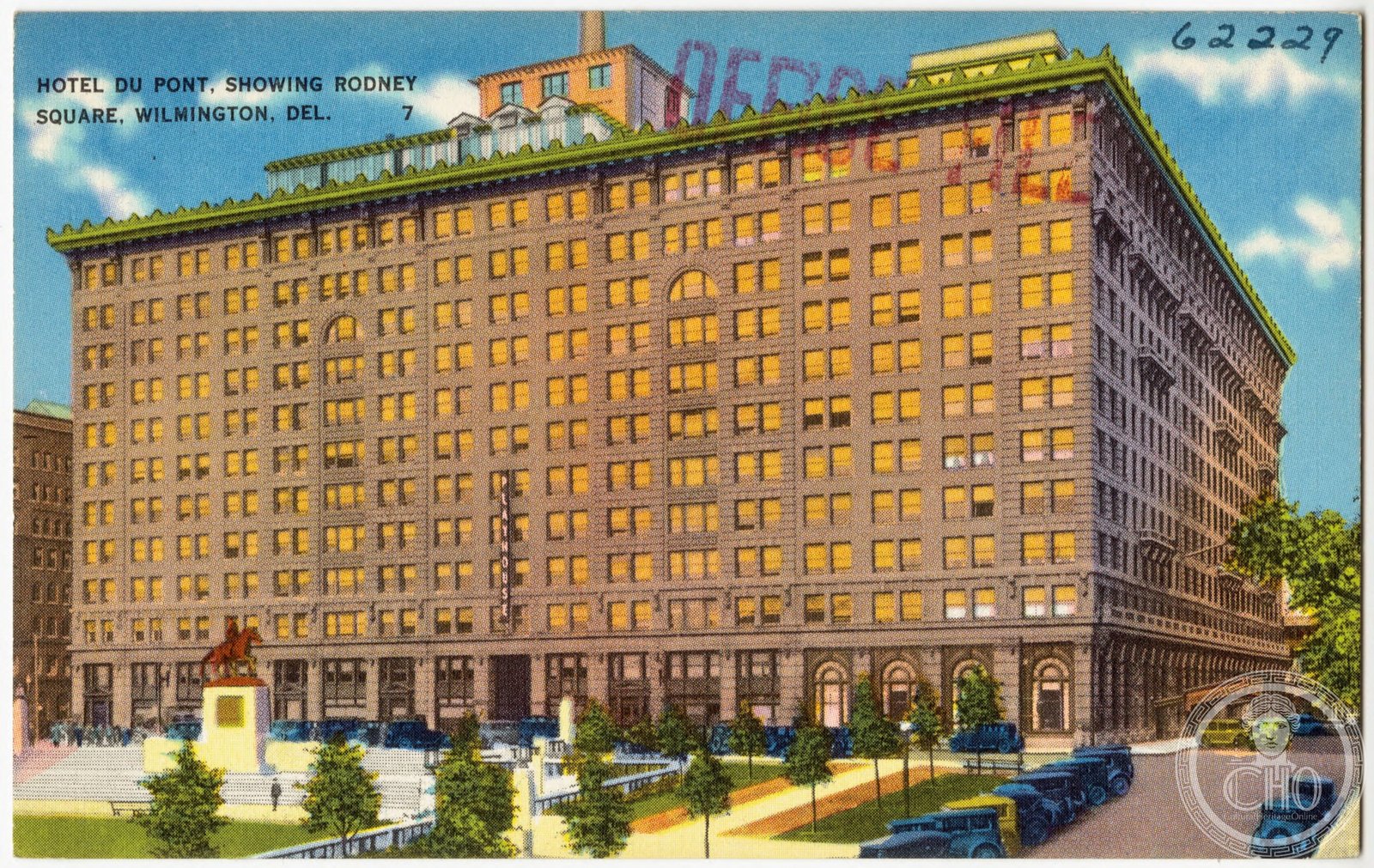
On the corner of 11th and Market Streets in the heart of Wilmington, the Hotel du Pont has defined Delaware’s civic and social life since 1913 — a Beaux-Arts landmark built by the DuPont Company that brought the scale and ambition of the great American hotel tradition to the first state, and whose dining rooms, ballrooms, and public spaces remain among the most distinguished interiors in the mid-Atlantic region.
At a glance
The Hotel du Pont at 42 W 11th Street is the most architecturally significant building in Delaware and one of the finest surviving examples of the Beaux-Arts hotel tradition in the eastern United States. Opened on January 15, 1913, as a project of the E.I. du Pont de Nemours and Company, it was conceived not merely as a hotel but as a statement of civic ambition: the DuPont family’s gift to Wilmington of a building that would situate the city within the tradition of great American commercial hotels and announce the company’s commitment to the physical and cultural development of its home city. The building’s Italian Renaissance Revival interiors — ornate plasterwork, carved mahogany paneling, gilded ceilings, and the grand public rooms that have hosted generations of significant events in Delaware’s political, social, and business life — remain intact and represent one of the most complete expressions of Gilded Age hotel design in the country.
Key facts
- Address: 42 W 11th Street, Wilmington, DE 19801
- Opened: January 15, 1913
- Style: Beaux-Arts / Italian Renaissance Revival
- Designation: National Register of Historic Places
- GPS: 39.7455° N, 75.5481° W
- Famous rooms: Green Room restaurant (since 1913), Gold Ballroom, Brandywine Room
History
Wilmington in 1913 was a city shaped almost entirely by the DuPont Company, which had grown from its origins as a gunpowder manufacturer on the Brandywine River into one of the largest industrial enterprises in the United States. The company’s chemistry and manufacturing had expanded during the first decade of the twentieth century into explosives, dyes, paints, and the beginnings of the plastics and synthetic fiber businesses that would define the mid-century American economy. Pierre S. du Pont, who had reorganized the company after 1902 and would lead it to its peak of twentieth-century power, conceived the Hotel du Pont as part of a broader investment in Wilmington’s urban fabric that included the redesign of Rodney Square directly across 11th Street.
The hotel was designed to match the grandest hotels of New York, Boston, and Philadelphia — a deliberate assertion that Wilmington, despite its small size, was a city of national importance. The Italian Renaissance Revival interior, with its elaborate plasterwork, carved stone details, and painted ceilings, was executed by a team of craftsmen that included Italian artisans brought to Delaware specifically for the project. The Green Room, which opened with the hotel in 1913 and has operated continuously as one of Delaware’s premier dining rooms, features ceiling murals that have been part of the room since its opening.
Through the twentieth century, the Hotel du Pont served as Delaware’s de facto center of gravity for significant social and political events: presidential visits, major business negotiations, state political gatherings, and the social milestones of Delaware’s families all took place within its walls. Its continued operation as a full-service luxury hotel — now managed independently from the DuPont Company but still in DuPont-related ownership — makes it one of the longest continuously operating historic grand hotels in the United States.
What you see
The Market Street facade presents the Hotel du Pont’s classical character: a formal Italian Renaissance Revival composition in stone, with the ornamental details characteristic of the Beaux-Arts tradition — carved stone surrounds, cornice treatments, and the formal fenestration of a building that aspired to the monumental. The entrance opens onto the lobby, whose proportions and detail announce the scale of the rooms within.
The Green Room is the building’s defining interior: a dining room whose painted ceiling, carved paneling, and proportional grandeur have made it the benchmark of Delaware dining since 1913. The Gold Ballroom, used for the hotel’s most significant events, continues the Italian Renaissance program with gilded detail and the scale appropriate to state occasions. These rooms preserve one of the most intact Gilded Age hotel interiors in the mid-Atlantic, a quality increasingly rare as comparable spaces in other cities have been destroyed or altered beyond recognition.
Practical information
- Hotel: Active luxury hotel with 217 rooms; check hoteldupont.com for reservations
- Green Room: The hotel’s formal dining room, open for dinner; reservations recommended
- Galleries: The hotel displays an important collection of works by N.C. Wyeth and other Delaware artists in its public spaces; viewing is open to non-guests
- Rodney Square: The hotel is directly opposite Rodney Square, Wilmington’s central civic space and the location of the Caesar Rodney equestrian statue
Getting there
Wilmington is Delaware’s largest city, at the confluence of the Brandywine and Christina Rivers, approximately 28 miles southwest of Philadelphia via Interstate 95. Wilmington station on Amtrak’s Northeast Corridor is a major stop on the service between New York and Washington, with direct trains to both cities and connections to Philadelphia 30th Street. The Hotel du Pont is two blocks from the Amtrak station via 11th Street. Philadelphia International Airport (PHL), 22 miles north via I-95, is the closest major hub. Wilmington Airport (ILG) serves the immediate region. The hotel has a garage adjacent to the building.
Nearby
- Rodney Square — the civic square directly opposite the hotel, anchored by the equestrian statue of Caesar Rodney (who famously rode through the night to cast Delaware’s decisive vote for independence in 1776); surrounded by the Federal Building, the Wilmington Trust Company tower, and the Grand Opera House on Market Street; one of the best-preserved early twentieth-century civic squares in the mid-Atlantic
- Hagley Museum and Library — the preserved site of the original E.I. du Pont de Nemours gunpowder mills on the Brandywine River, three miles north of downtown Wilmington; the museum documents the history of the DuPont Company and American industrial enterprise from the early nineteenth century, with the millrace, workers’ housing, and the family estate Eleutherian Mills all intact on a landscape of extraordinary historical significance
- Winterthur Museum — the former DuPont estate eight miles northwest of Wilmington, now a museum of American decorative arts housing Henry Francis du Pont’s collection of more than 90,000 objects from 1640 to 1860; the 175-room house and its naturalistic gardens represent the most significant single collection of American decorative arts in existence
- Brandywine Museum of Art — the museum in Chadds Ford, Pennsylvania (twelve miles north), dedicated to the Wyeth family (N.C., Andrew, and Jamie Wyeth) and the Brandywine tradition of American illustration and painting; the DuPont family’s collection of N.C. Wyeth works is represented throughout the region
Sources
- National Register of Historic Places, Hotel du Pont nomination
- Delaware State Historic Preservation Office documentation
- Hagley Museum and Library archives — DuPont Company construction records
- Wilmington Morning News archives — Hotel du Pont history
- Hotel du Pont institutional history and architectural documentation
Find it on the map
See this place and what’s around it →Record researched and written by Luigi De Marchi for Cultural Heritage Online, 2026.
📷 Become a Cultural Heritage Online photographer
Share your photos of places: they stay published under your name as the author. The more they're seen, the more you get noticed — and soon a contest will reward the most appreciated photos.
Log in or sign up free to add a photoIs this page about you?
This page is read by travellers and heritage enthusiasts who find it on Google. Tell us how you are connected to this place and we will take it from there.