

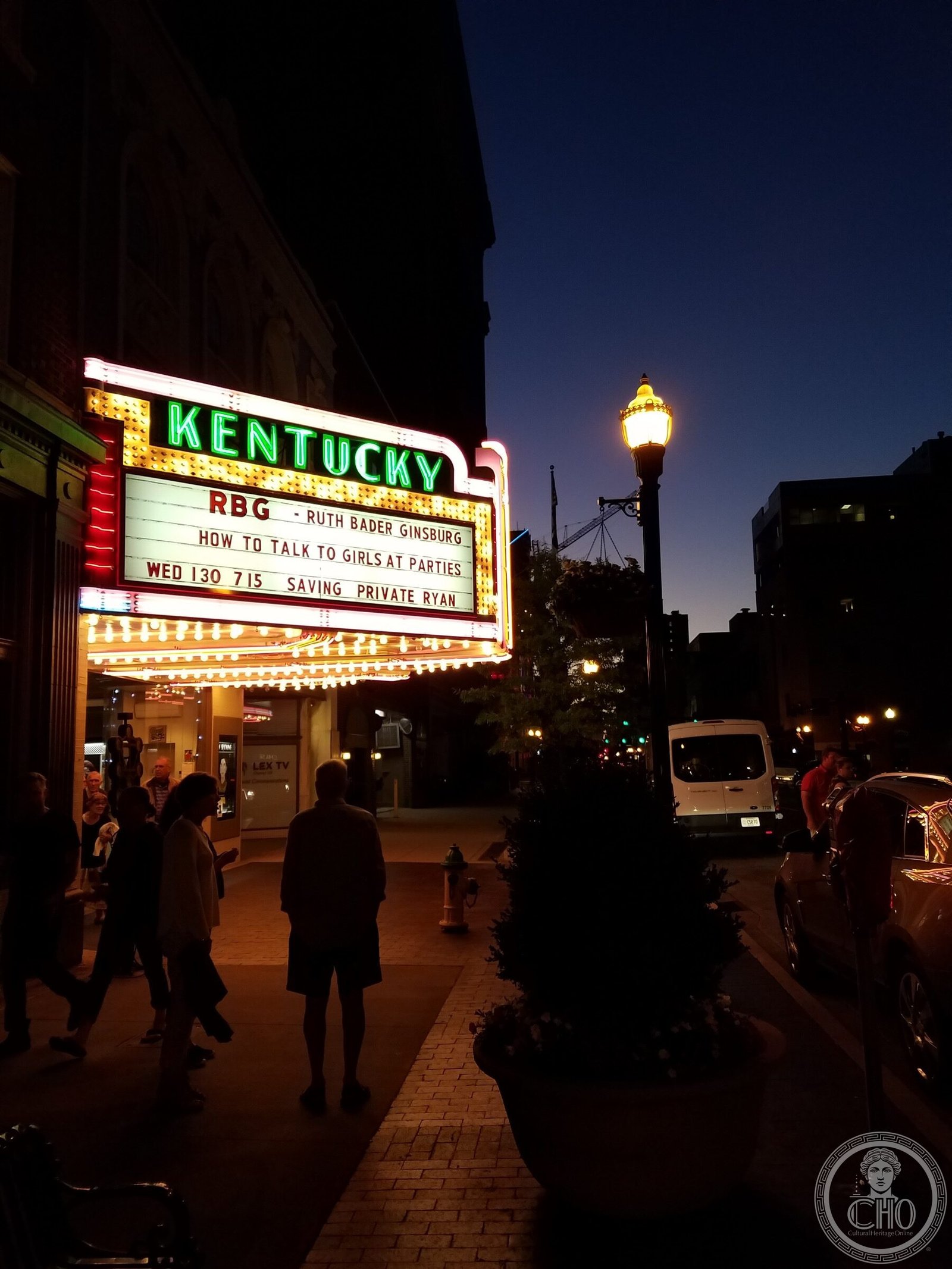
On East Main Street in the heart of Lexington, the Kentucky Theatre has served as the cultural centerpiece of the Bluegrass region since its 1934 Art Deco renovation transformed an earlier movie house into the most elegantly appointed cinema in Kentucky — a building that has outlasted the golden age of moviegoing to become Lexington’s beloved independent cinema and the anchor of a downtown that has reinvented itself around the arts.
At a glance
The Kentucky Theatre at 214 East Main Street is the defining historic cinema of Lexington and the most beautifully preserved example of Art Deco theater design in Kentucky. Originally built in 1922, the building received its current Art Deco character in a 1934 renovation that transformed the facade and interior into one of the finest examples of the style in the American South. Operating continuously as a movie theater through nearly a century of change in the film industry, it now serves as an independent cinema and cultural institution — host to the Kentucky New Filmmakers Film Festival and a range of programming that serves Lexington’s educated, arts-engaged population. The Kentucky Theatre is the rare example of a historic movie palace that has maintained its original function: Lexingtonians still go to the movies in a building that was designed for exactly that purpose nine decades ago.
Key facts
- Address: 214 East Main Street, Lexington, KY 40507
- Original construction: 1922
- Art Deco renovation: 1934
- Style: Art Deco (post-renovation)
- Current use: Independent cinema; Kentucky New Filmmakers Film Festival
- Designation: National Register of Historic Places
History
Lexington in the 1920s was the commercial and social hub of the Kentucky Bluegrass — a region whose thoroughbred horse farms, bourbon distilleries, and University of Kentucky had made it a prosperous and culturally distinctive corner of the American South. The city’s Main Street was lined with the banks, hotels, and entertainment venues of a city that took both commerce and culture seriously, and the 1922 movie theater at 214 East Main was part of a downtown that provided Lexingtonians with access to the full range of popular entertainment of the era.
The 1934 renovation that gave the Kentucky Theatre its current Art Deco character was part of a pattern common to American movie palaces of the era: as the Art Deco style swept American commercial architecture and as competition among cinemas intensified, older theaters were updated with new facades and interiors to signal their modernity and attract audiences who expected the best. The 1934 renovation transformed the building’s exterior into an Art Deco composition of geometric ornament and the stylized lettering characteristic of the period, and updated the interior in the luxurious manner that movie palace audiences had come to expect.
The Kentucky Theatre’s survival as a functioning cinema through the subsequent decades — the rise of suburban multiplexes, the home video revolution, the digital streaming era — is a testament to both the building’s architectural quality and the commitment of its operators and its audience. Where other historic cinemas converted to parking lots, condominiums, or churches, the Kentucky Theatre continued to show movies in an environment that makes the act of going to the cinema feel like an occasion rather than a convenience. Its role as the home of the Kentucky New Filmmakers Film Festival has given it a contemporary cultural relevance beyond nostalgia.
What you see
The East Main Street facade presents the Kentucky Theatre’s 1934 Art Deco character with the confidence of a thorough renovation: geometric ornamental panels, stylized vertical lettering, and the marquee projecting over the Main Street sidewalk that has announced the theater’s programming continuously since the 1930s. The composition announces the building’s identity clearly on a commercial street that has changed substantially around it.
Inside, the auditorium retains the essential character of the 1934 renovation: the decorative plasterwork, the screen configuration, and the overall sense of a room designed to make the experience of watching a film feel elevated above the ordinary. The Kentucky Theatre’s commitment to maintaining this interior — rather than replacing it with the generic design of a contemporary multiplex — is what distinguishes it from most surviving historic movie houses in the United States.
Practical information
- Programming: Current film releases, art house cinema, special events; check kentuckyfilm.com for schedule
- Festival: Kentucky New Filmmakers Film Festival (annual; check website for dates)
- Downtown Lexington: The Kentucky Theatre is in the heart of downtown Lexington, surrounded by restaurants, bars, and galleries; the area has been substantially revitalized around arts and entertainment uses
Getting there
Lexington is Kentucky’s second-largest city, at the intersection of Interstate 75 and Interstate 64, 80 miles east of Louisville and 85 miles south of Cincinnati. Blue Grass Airport (LEX) is 5 miles west. Amtrak does not serve Lexington. The Kentucky Theatre is on East Main Street in the heart of downtown, walkable from downtown hotels and the University of Kentucky campus.
Nearby
- Keeneland Race Course (1936) — the thoroughbred racing track seven miles west of downtown, considered the most beautiful racetrack in America and the home of the Bluegrass Stakes and the Keeneland September Yearling Sale; the limestone and stone architecture of the track buildings reflects the material language of the Kentucky Bluegrass and the historical seriousness with which the region regards the horse industry
- Kentucky Horse Park — the working horse farm and equine museum complex 10 miles north of Lexington on the Iron Works Pike, dedicated to the relationship between humans and horses; the International Museum of the Horse is the world’s largest equine museum
- Ashland, the Henry Clay Estate (1806, rebuilt 1857) — the Italianate house and grounds of Henry Clay, three-time presidential candidate, senator, and architect of the American system of economic nationalism; the estate on Richmond Road preserves Clay’s furniture, library, and the landscape of a nineteenth-century Kentucky gentleman’s farm
- Bourbon Trail — the dozen-plus working distilleries within an hour of Lexington that produce the majority of the world’s bourbon supply; Buffalo Trace (Frankfort), Woodford Reserve (Versailles), Wild Turkey, and Four Roses are among the most visited, and all offer tours and tastings
Sources
- National Register of Historic Places, Kentucky Theatre nomination
- Kentucky Heritage Council architectural survey
- Lexington Herald-Leader archives — Kentucky Theatre history
- University of Kentucky Special Collections, Lexington commercial history
- Kentucky Film Office documentation
Find it on the map
See this place and what’s around it →Record researched and written by Luigi De Marchi for Cultural Heritage Online, 2026.
📷 Become a Cultural Heritage Online photographer
Share your photos of places: they stay published under your name as the author. The more they're seen, the more you get noticed — and soon a contest will reward the most appreciated photos.
Log in or sign up free to add a photoIs this page about you?
This page is read by travellers and heritage enthusiasts who find it on Google. Tell us how you are connected to this place and we will take it from there.