
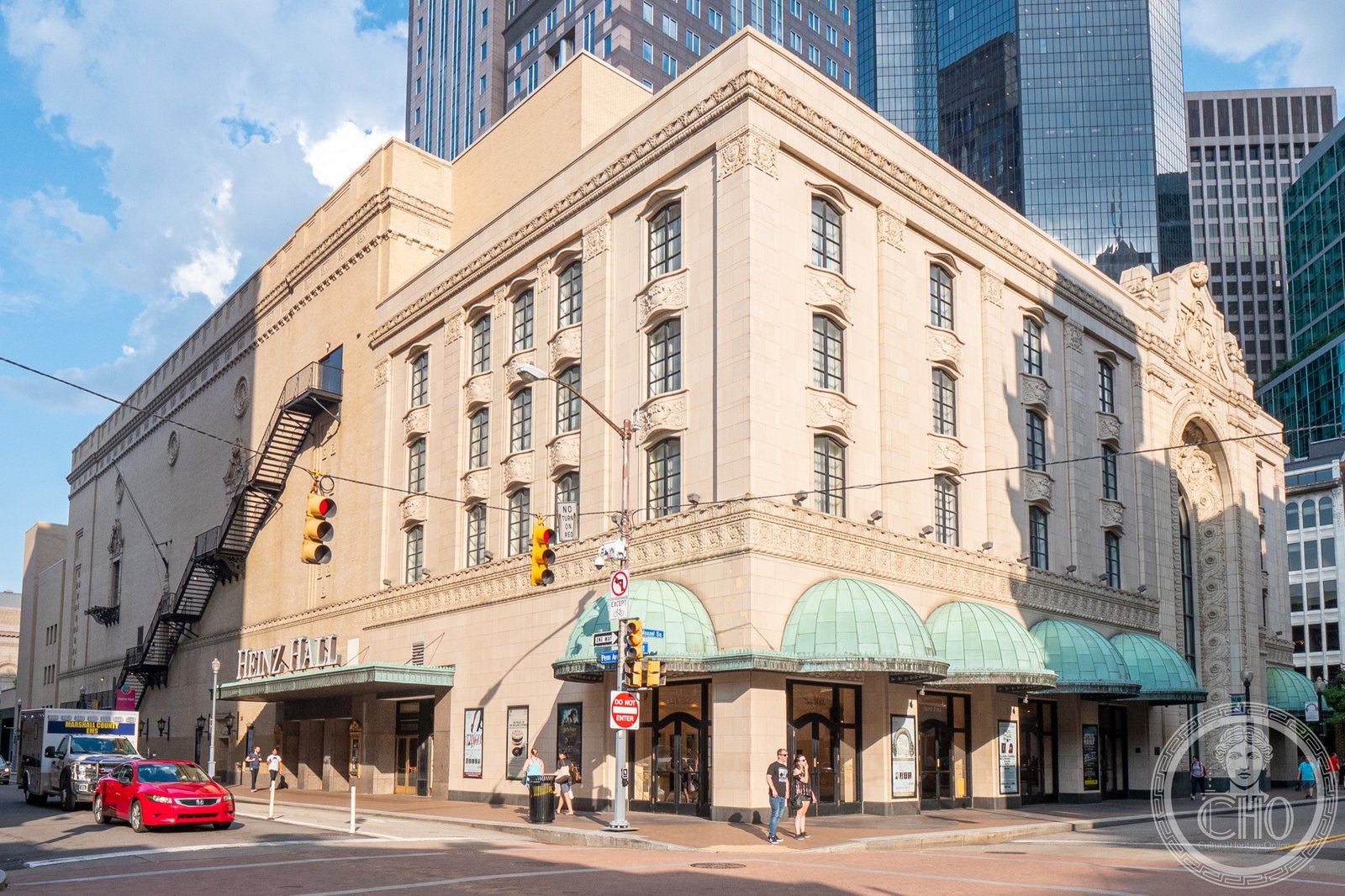
On Penn Avenue in the heart of Pittsburgh’s Cultural District, Heinz Hall has been the home of the Pittsburgh Symphony Orchestra since 1971 — a grandly restored Art Deco movie palace transformed into one of the finest concert halls in America by the city whose industrial ambitions once reshaped the modern world.
At a glance
Heinz Hall for the Performing Arts at 600 Penn Avenue is both the crown jewel of Pittsburgh’s downtown Cultural District and one of the finest examples of the conversion of a great American movie palace into a permanent performing arts home. Opened in 1927 as the Loew’s Penn Theatre, one of the most elaborate and opulent movie palaces built in the 1920s, it was acquired and reimagined as a concert hall by the Howard Heinz Endowment in 1971, which funded a complete interior renovation that preserved the building’s Art Deco character while transforming it from cinema to symphony. The result was christened Heinz Hall in honor of H. J. Heinz II, the philanthropist who made the project possible. The Pittsburgh Symphony Orchestra has performed here ever since, one of America’s great orchestras in a house that matches its ambitions.
Key facts
- Address: 600 Penn Avenue, Pittsburgh, PA 15222
- Opened: 1927 as the Loew’s Penn Theatre
- Renamed: Heinz Hall for the Performing Arts, 1971
- Named for: H. J. Heinz II and the Howard Heinz Endowment
- Style: Art Deco (movie palace)
- Resident company: Pittsburgh Symphony Orchestra
- Designation: National Register of Historic Places
History
Pittsburgh in 1927 was at the peak of its industrial power. The steel mills of the Monongahela and Allegheny river valleys had made the city one of the wealthiest and most economically dynamic in the United States. The Loew’s Penn Theatre was a direct product of that wealth: the Loew’s theater chain brought to Pittsburgh the same spectacular movie palace format it had deployed in New York, Chicago, and other major cities, creating in the Penn a fantasy environment that combined Art Deco ornament, French Second Empire influences, and the elaborate luxury of the grand hotel lobby into a single intoxicating entertainment environment. The Penn held over 3,000 seats when it opened, offering Pittsburgh audiences access to the first-run films and live performances that were the cinema’s golden age.
The decline of the downtown cinema district through the 1950s and 1960s brought the Penn, like so many of its contemporaries, to the edge of demolition. The Howard Heinz Endowment — the Pittsburgh philanthropic foundation established by the family whose name became synonymous with the city’s industrial success — stepped in to save and transform it. The 1971 renovation reduced the seat count to a more intimate 2,676, rebuilt the stage and orchestra pit for symphonic performance, and restored and refinished the Art Deco interior. The result proved that the great movie palaces of the 1920s could be given a second life as performing arts venues, a model that was replicated in cities across the country.
Heinz Hall’s further renovation in 1995 expanded backstage facilities and improved technical infrastructure, ensuring that the Pittsburgh Symphony’s home matched the technical requirements of twenty-first-century concert presentation. The hall has since hosted virtually every major orchestra and soloist in the classical music world.
What you see
The Penn Avenue exterior presents Heinz Hall’s public face: a formal limestone and terra cotta composition with Art Deco ornamental detailing that announces the building’s significance without overwhelming the street. The main entrance canopy leads into a lobby sequence of increasing grandeur — Art Deco ironwork, gilded plasterwork, and the kind of ornamental excess that the movie palace tradition perfected — before arriving in the main auditorium.
The auditorium is the building’s central experience: a vast elliptical room with tiered balconies, ornate plaster reliefs, and a ceiling that draws the eye upward through rings of decorative detail toward the central chandelier. The acoustic design of the 1971 renovation and its subsequent refinements has given Heinz Hall a reputation as one of the finest concert acoustic environments in North America, combining the intimacy of a room designed for close audience-performer connection with the resonance needed for a full symphonic orchestra.
Practical information
- Events: Pittsburgh Symphony Orchestra season runs September through May; check pittsburghsymphony.org for schedule and tickets
- Tours: Building tours are available on select dates; check the PSO website
- Cultural District: Heinz Hall anchors Pittsburgh’s downtown Cultural District on Penn Avenue; the surrounding blocks include the Benedum Center, Pittsburgh Public Theater, and several galleries
- Dress code: No formal requirement; business casual to formal dress is typical for evening symphony performances
Getting there
Pittsburgh International Airport is 17 miles west of downtown. The Pittsburgh T (light rail) runs to the Cultural District; the Wood Street and Steel Plaza stations are the nearest stops, each about six blocks from Heinz Hall. Amtrak’s Cardinal and Capitol Limited trains serve Pittsburgh Penn Station, six blocks west on Liberty Avenue. Multiple parking garages are available in the Cultural District.
Nearby
- Benedum Center for the Performing Arts — the former Stanley Theatre (1928), another great Art Deco movie palace conversion, now home of Pittsburgh Opera, Pittsburgh Ballet Theatre, and Pittsburgh CLO; a block south on 7th Street in the Cultural District
- Pittsburgh Public Theater at O’Reilly Theater — the contemporary home of Pittsburgh’s leading resident theater company, in a striking modern building at the center of the Cultural District
- Andy Warhol Museum — the most comprehensive single-artist museum in the world, dedicated to the Pittsburgh-born artist who defined American pop culture; across the Allegheny River on the North Shore, a 15-minute walk via the Seventh Street Bridge
- Point State Park — the historic confluence of the Allegheny, Monongahela, and Ohio rivers where Fort Pitt once stood; the park and its fountain mark the geographic heart of Pittsburgh; a 10-minute walk west along Penn Avenue
Sources
- National Register of Historic Places, Heinz Hall nomination
- Pittsburgh Symphony Orchestra, institutional history
- Howard Heinz Endowment archives
- Pittsburgh History and Landmarks Foundation records
- Cultural District Pittsburgh, architectural documentation
Find it on the map
See this place and what’s around it →Record researched and written by Luigi De Marchi for Cultural Heritage Online, 2026.
📷 Become a Cultural Heritage Online photographer
Share your photos of places: they stay published under your name as the author. The more they're seen, the more you get noticed — and soon a contest will reward the most appreciated photos.
Log in or sign up free to add a photoIs this page about you?
This page is read by travellers and heritage enthusiasts who find it on Google. Tell us how you are connected to this place and we will take it from there.