
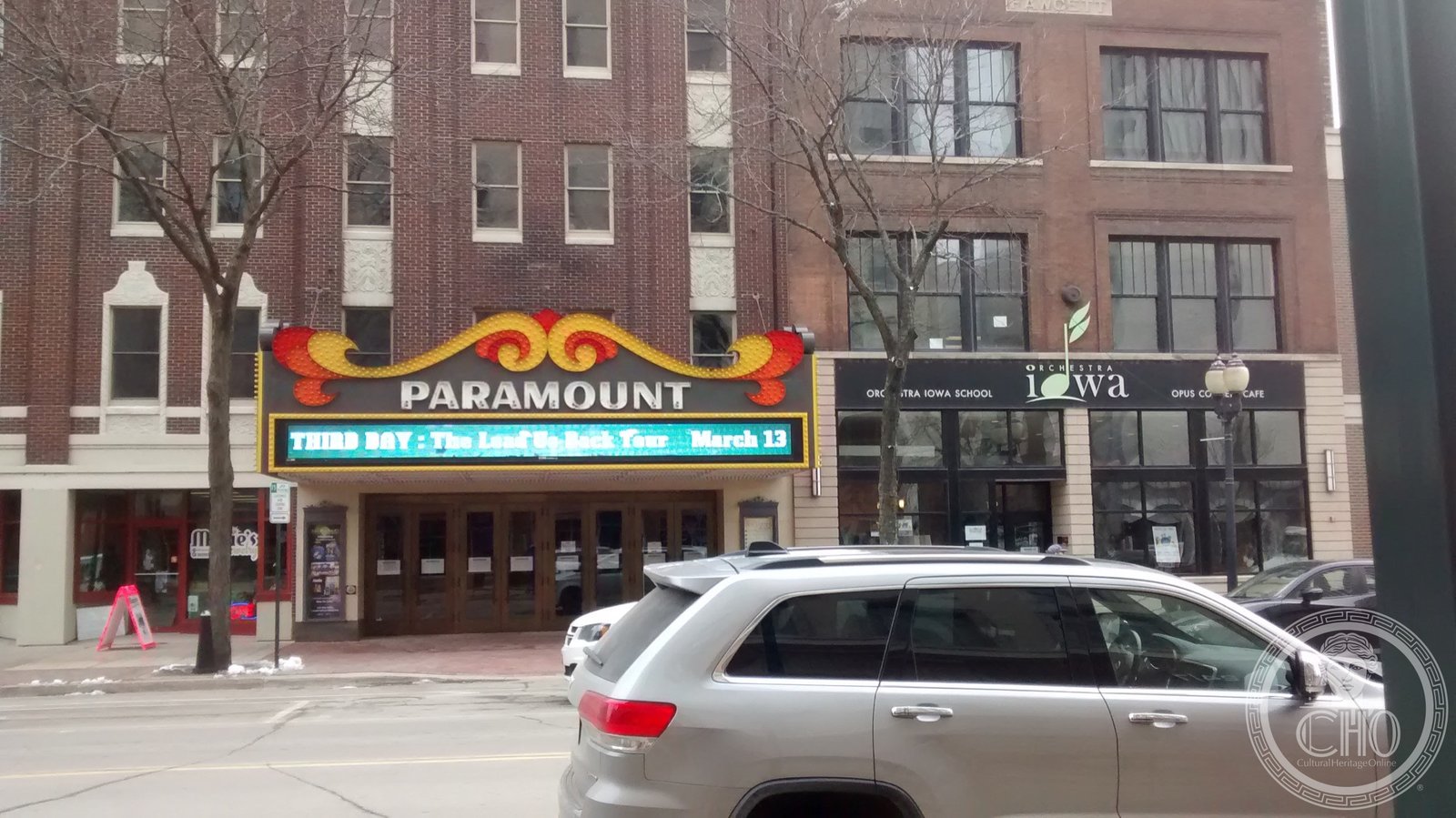
The grandest building on Third Avenue when it opened in 1928, Cedar Rapids’ Paramount Theatre brought the full spectacle of the American movie palace to the Midwest’s most industrious small city — and still does, now as a performing arts venue for the region.
At a glance
The Paramount Theatre on Third Avenue SE in downtown Cedar Rapids is the finest surviving example of movie palace architecture in Iowa and one of the best-preserved Art Deco theaters in the American Midwest. Opened in 1928 to serve Cedar Rapids’ prosperous industrial-era population, it offered a level of architectural and cinematic spectacle unprecedented in the region. Its ornate facades and richly decorated auditorium reflected the conviction that Cedar Rapids — a city known for its mills, meatpacking plants, and diverse immigrant communities — deserved as magnificent a setting for entertainment as any major American city. Restored and now operating as a performing arts center, the Paramount continues to serve as the cultural anchor of Cedar Rapids’ downtown.
Key facts
- Address: 123 Third Avenue SE, Cedar Rapids, IA 52401
- Completed: 1928
- Style: Art Deco movie palace
- Current use: Live performing arts venue; concerts, theater, community events
- Operated by: City of Cedar Rapids through the Paramount Theatre management
- Designation: National Register of Historic Places
History
Cedar Rapids in 1928 was one of the most economically productive small cities in America. Its Quaker Oats factory — the largest cereal mill in the world at the time — filled the city with the smell of cooking oats and employed thousands. The city’s Czech and Slovak immigrant communities had built neighborhoods with their own churches, halls, and cultural institutions. And its commercial downtown, organized around Third Avenue and First Street SE, had the energy and density of a city larger than its population suggested.
Into this environment, the Paramount Theatre arrived as a deliberate statement of civic ambition. The large-scale movie palace was a form invented for major American cities but increasingly deployed in regional centers by the exhibition chains that controlled access to Hollywood’s first-run films. To show Paramount Pictures in Cedar Rapids required a Paramount Theatre worthy of the brand. The result was a building that surpassed anything Cedar Rapids had previously attempted in terms of architectural splendor.
The theater operated through the studio system era, the postwar transition to television, and the eventual suburban exodus that hollowed out downtown theaters across America. Cedar Rapids preserved and restored the Paramount through a sustained community effort, recognizing that the building’s loss would have been irreplaceable. It reopened as a performing arts center and has since served the city in a function well-suited to its design — presenting large-scale performances to large audiences in a space that makes every event feel significant.
What you see
The Paramount’s facade on Third Avenue SE presents the vocabulary of the American movie palace in its Iowa iteration: a prominent marquee and sign tower rising above a street-level entrance colonnade, flanked by decorative panels in the Art Deco idiom of geometric ornament and stylized figures. The composition reads well from across the street or from a moving car — everything scaled and positioned for the visual field of a pedestrian downtown that expects spectacle.
The auditorium interior follows the grand tradition of the American movie palace: ornate plasterwork, tiered balconies, and a proscenium arch designed to frame screen and stage alike as a world apart from daily life. The restoration preserved the period decorative fabric while updating the technical systems necessary for contemporary performances. The theater today communicates directly with its 1928 origins — a sense of occasion and ceremony inseparable from the building itself.
Practical information
- Events: Check paramountcr.com for the full calendar of concerts, Broadway touring productions, and community events
- Seating: The restored auditorium holds approximately 1,800 seats; good sightlines from most positions
- Downtown context: Third Avenue SE is Cedar Rapids’ main commercial street; restaurants, bars, and the Czech Village neighborhood are within walking distance
Getting there
Cedar Rapids is in east-central Iowa, roughly 30 miles north of Iowa City and 200 miles from Chicago. The Eastern Iowa Airport (CID) provides regional airline connections; the downtown theater is 15 minutes from the terminal. Amtrak does not serve Cedar Rapids, but the drive from Chicago via Interstate 80 takes about three hours. Downtown parking is available in municipal garages within a block of the theater.
Nearby
- Cedar Rapids Museum of Art — the only art museum in Iowa with a dedicated focus on Iowa artists; the collection includes major works by Grant Wood, including preparatory studies for American Gothic; a block from the Paramount
- National Czech & Slovak Museum and Library — in the Czech Village neighborhood west of downtown; Cedar Rapids has one of the largest Czech-American communities in the United States
- Grant Wood Studio — the carriage house where Grant Wood lived and painted American Gothic and Midnight Ride of Paul Revere, preserved as a museum; accessible via appointment
- Iowa City — 30 miles south, home of the University of Iowa and a bookstore- and gallery-dense downtown; the Iowa Writers’ Workshop is based here
Sources
- National Register of Historic Places, Paramount Theatre Cedar Rapids nomination
- Paramount Theatre Cedar Rapids, institutional history
- Iowa Historic Preservation Alliance records
- Cedar Rapids Public Library, local history collection
- State Historical Society of Iowa, architectural survey
Find it on the map
See this place and what’s around it →Record researched and written by Luigi De Marchi for Cultural Heritage Online, 2026.
📷 Become a Cultural Heritage Online photographer
Share your photos of places: they stay published under your name as the author. The more they're seen, the more you get noticed — and soon a contest will reward the most appreciated photos.
Log in or sign up free to add a photoIs this page about you?
This page is read by travellers and heritage enthusiasts who find it on Google. Tell us how you are connected to this place and we will take it from there.