
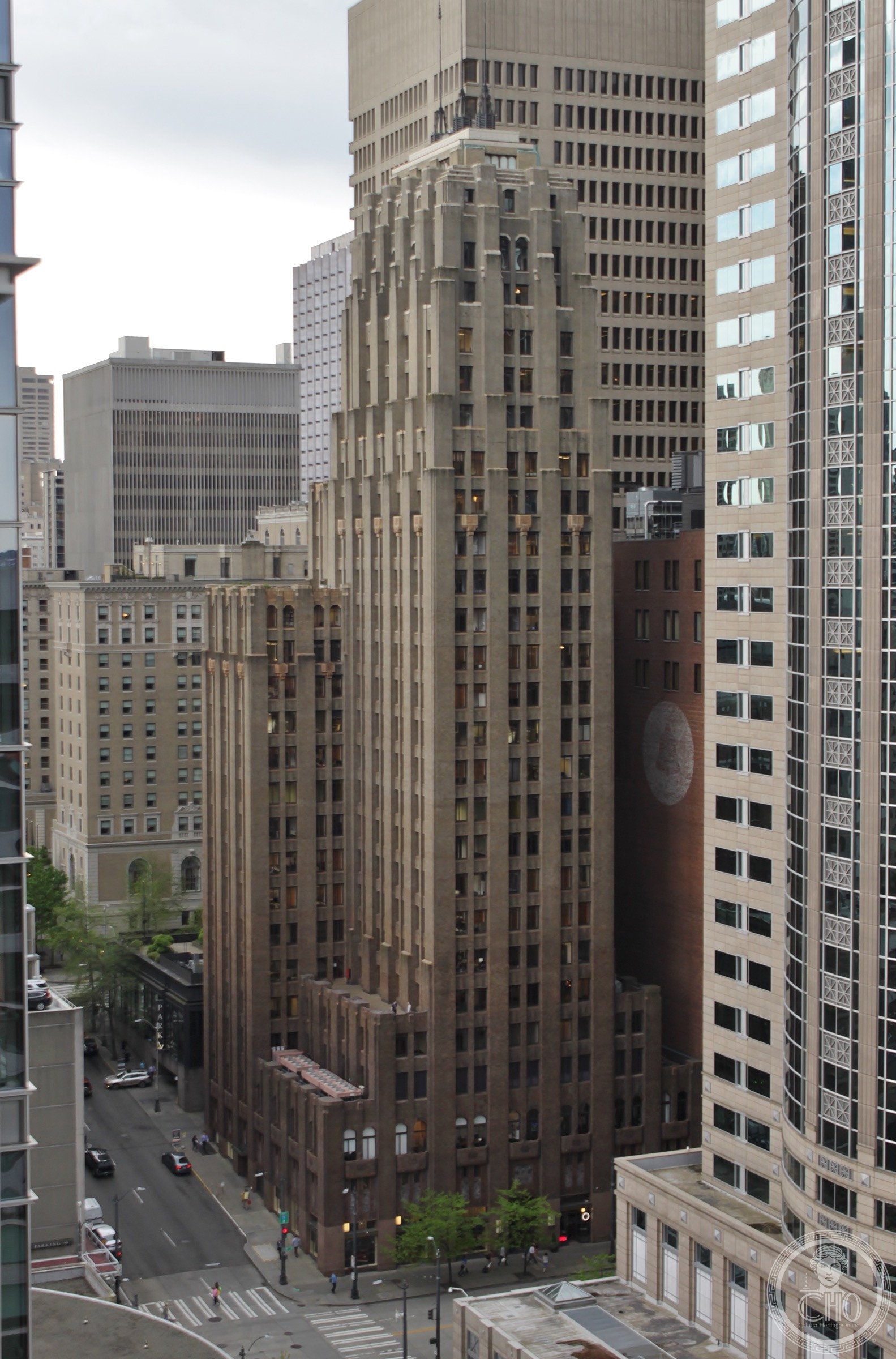

Rising above Third Avenue in graduated shades of brick — dark at the street, pale at the crown — the Seattle Tower is one of the most sophisticated Art Deco skyscrapers on the Pacific Coast, an exercise in using colour itself as ornament.
At a glance
The Seattle Tower at 1218 Third Avenue rises 303 feet (92 m) over downtown Seattle in 27 stories of Gothic-inflected Art Deco, its most distinctive feature being a deliberate gradient in the brick colour: deep brown at the base, lightening through a spectrum of intermediary tones to an almost cream finish at the crown. The effect — achieved by specifying a carefully graduated sequence of brick tones for the exterior cladding — gives the building an atmospheric quality at dusk and in overcast light that suits the city’s famously grey skies. Opened in 1929 as the Northern Life Tower, the building is listed on the National Register of Historic Places and remains one of the defining landmarks of Seattle’s pre-war skyline.
Key facts
- Address: 1218 Third Avenue, Seattle, WA 98101
- Original name: Northern Life Tower (1929)
- Height: 303 feet (92 m), 27 stories
- Completed: 1929
- Style: Art Deco with Gothic influences; graduated brick coloration
- Status: National Register of Historic Places
- Current use: Commercial office building
History
Seattle’s commercial core was expanding rapidly in the late 1920s, fuelled by growth in the timber, fishing, and shipping industries and by the Pacific Rim trade that would define the city’s economy for a century. The Northern Life Insurance Company commissioned the tower as its Pacific Coast headquarters, seeking a building that would project stability and modernity in equal measure. The resulting design, executed in the Art Deco Gothic style then sweeping American commercial architecture, was notable above all for its handling of the exterior brick — a decision to express height through colour rather than through sculptural setbacks alone.
The tower opened in 1929, weeks before the stock market crash, and like many of its contemporaries it was conceived in one economic world and immediately occupied in another. Northern Life Insurance maintained its presence in the building through the Depression years and the building remained a prestigious address in downtown Seattle. It changed names and owners several times over the following decades — the name “Seattle Tower” came into common use later and eventually became official — but the exterior has been carefully preserved.
The building was listed on the National Register of Historic Places and has been recognised as one of Seattle’s principal Art Deco landmarks. Seattleites have historically been attentive to their pre-war architecture, and the Seattle Tower has benefited from that civic instinct: the lobby retains its original bronze and marble detailing, and the brick gradient remains intact and unaltered.
What you see
Standing on Third Avenue looking up, the gradient is immediately apparent: the base courses are laid in a rich brown-red brick, and as the eye climbs the building’s surface the colour softens almost imperceptibly through reddish-buff, then warm buff, then a pale cream at the uppermost stories. The transition is never abrupt; it unfolds over the full 27-story height in a way that reads differently from ground level than from across the street or from a higher vantage point. On overcast days — of which Seattle has many — the tower seems to dissolve at the crown into the sky.
The Gothic influences appear at the parapet, where pointed arches and carved stone ornament crown the setback transitions, and at the entrance portal on Third Avenue, where the bronze surround and lobby ceiling carry elaborate geometric reliefs. The lobby is a complete Art Deco interior: brass elevator doors, terrazzo floors with geometric inlays, and pendant light fixtures in frosted glass that fill the narrow space with diffused light.
Practical information
- Access: Lobby open weekdays during business hours
- Admission: Free to view exterior and lobby
- Photography: The gradient brick is best observed from across Third Avenue; morning light from the east shows the pale upper floors at their most luminous
- Time needed: 15–20 minutes for exterior and lobby
Getting there
The Seattle Tower stands on Third Avenue between Union and Pike Streets in downtown Seattle’s retail and financial core. The nearest Link Light Rail station is Westlake, two blocks north. Several bus routes stop directly on Third Avenue. The building is within a five-minute walk of Pike Place Market and a ten-minute walk of the Seattle Art Museum.
Nearby
- Rainier Tower (1977) — Minoru Yamasaki’s inverted-pyramid office tower at 1301 Fifth Avenue, two blocks east, a striking structural counterpoint to the Seattle Tower’s conventional masonry silhouette.
- Pike Place Market (1907) — Seattle’s oldest farmers’ market, two blocks west on Pike Street at the waterfront bluff, where the original flying fish tradition has been a city institution for over a century.
- Smith Tower (1914) — Seattle’s first skyscraper and once the tallest building west of the Mississippi River, ten blocks south in Pioneer Square, with an original Chinese Room at the 35th floor.
Sources
- National Register of Historic Places nomination, Seattle Tower (Northern Life Tower), Seattle, Washington.
- Ochsner, Jeffrey Karl, ed. Shaping Seattle Architecture: A Historical Guide to the Architects. Seattle: University of Washington Press.
- Seattle Landmarks Preservation Board — individual landmark designation records.
- Wikimedia Commons — Seattle Tower photograph (SounderBruce, CC BY-SA 4.0).
Find it on the map
See this place and what’s around it →📷 Become a Cultural Heritage Online photographer
Share your photos of places: they stay published under your name as the author. The more they're seen, the more you get noticed — and soon a contest will reward the most appreciated photos.
Log in or sign up free to add a photoIs this page about you?
This page is read by travellers and heritage enthusiasts who find it on Google. Tell us how you are connected to this place and we will take it from there.