
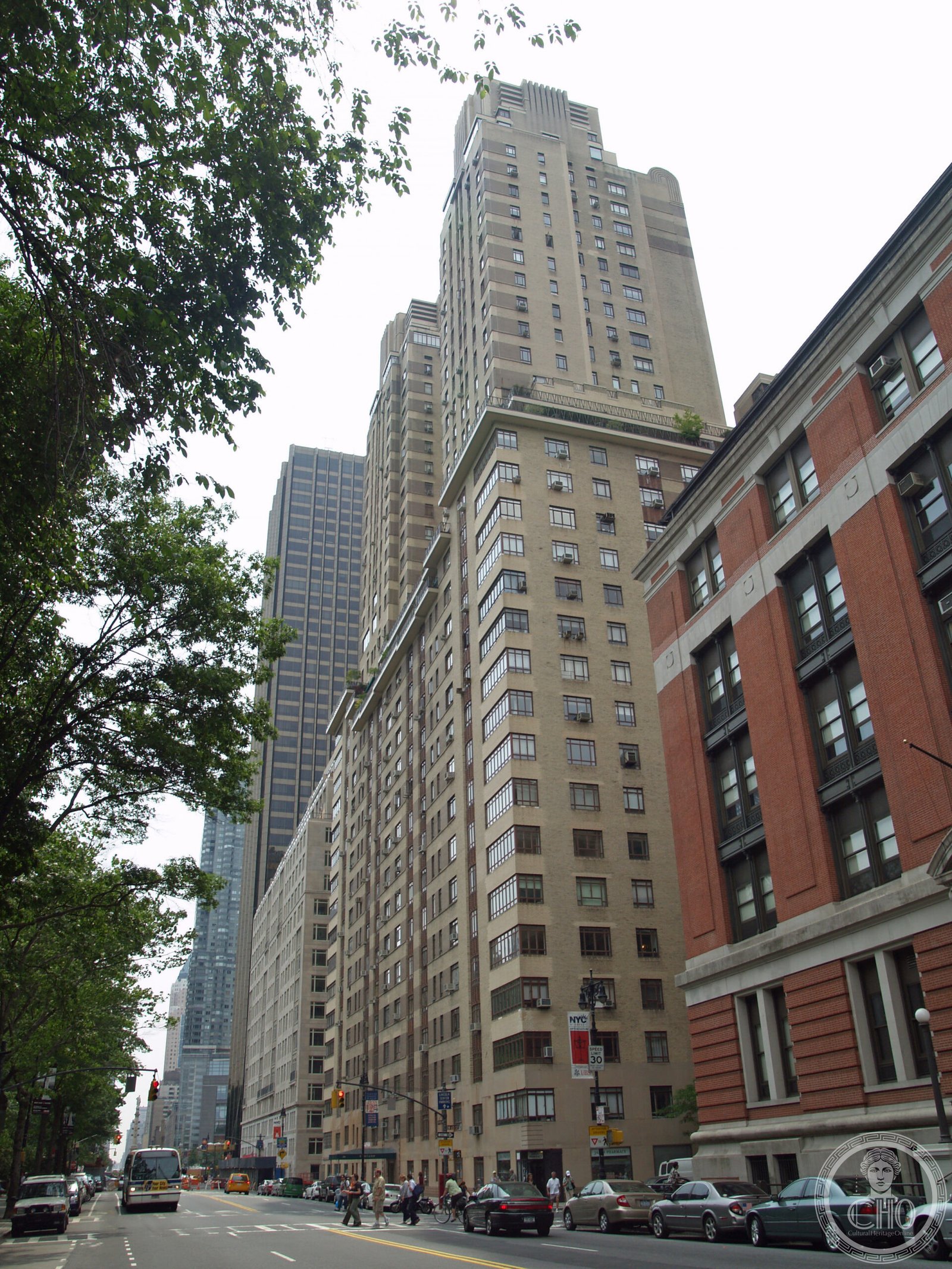
The fourth and southernmost of Central Park West’s great twin-tower Art Deco residential buildings, The Century at 25 CPW completed in 1931 the ensemble that defines the park’s western urban frame — a group unprecedented in the history of any city’s park-edge architecture.
At a glance
The Century stands at 25 Central Park West, occupying the block front between West 62nd and West 63rd Streets at the southern anchor of the Central Park West skyline ensemble. Built by the Chanin organization and completed in 1931 — the same year as The Majestic on the same avenue — it rises thirty stories in twin towers from a shared lower base, its buff-brick facades organized with the vertical pilasters and geometric spandrel ornament that Jacques Delamarre deployed consistently across Chanin’s Central Park West commissions. With its site directly south of Columbus Circle and the Lincoln Center neighborhood, The Century occupies an urban hinge between the formal park edge and the mid-Manhattan street grid below 59th Street.
Key facts
- Completed: 1931.
- Address: 25 Central Park West, between West 62nd and West 63rd Streets, Manhattan.
- Developer: Chanin Construction Company (Irwin Chanin).
- Architect: Jacques Delamarre.
- Height: 30 stories (twin towers).
- Style: Art Deco — buff brick with limestone detailing, vertical pilasters, twin-tower setback profile.
- Current use: Private cooperative residential apartments.
- Designation: National Register of Historic Places (Central Park West Historic District).
History
The site at 25 Central Park West had been occupied by an earlier residential building before the Chanin organization acquired it in the late 1920s as part of the campaign to modernize the southern stretch of Central Park West. Irwin Chanin, the Brooklyn-born builder whose firm transformed large sections of Midtown Manhattan in the 1920s and 1930s, saw in the park’s western edge an opportunity to redefine urban residential prestige: the view was unobstructed and protected, the address prestigious, and the emerging taste for Art Deco allowed his architect Jacques Delamarre to produce designs that felt simultaneously modern and monumental. The Century was the last of the four twin-towered Chanin and Emery Roth buildings to be completed on the avenue.
Construction proceeded through the early years of the Depression, a period that dramatically slowed the initial cooperative conversion sales and forced Chanin, as with The Majestic, to hold apartments as rentals until the market recovered. By the mid-1930s the building had found its footing as a desirable address for professionals, entertainers, and arts figures — the cultural life of Lincoln Center’s neighborhood before Lincoln Center existed. The building has been a cooperative for most of its history and has housed a variety of prominent tenants across the performing arts, business, and public life.
The Chanin–Delamarre partnership produced all four twin-tower CPW buildings in rapid succession between 1929 and 1931, a concentrated burst of large-scale residential development that permanently altered the character of the western edge of Central Park. The Century, the most southerly, anchors the sequence between Columbus Circle and the park’s formal entrance at 72nd Street, a distance of about ten city blocks that contains four Art Deco towers each between 29 and 32 stories — a skyline density unmatched by any comparable park-edge development in the world.
What you see
The Century’s facades on Central Park West present the by-now-familiar Chanin/Delamarre formula: buff brick with limestone pilasters between windows that emphasize the vertical, spandrel panels with shallow geometric relief ornament, and a stepped-back profile that gives each tower its characteristic silhouette. The building’s most distinctive compositional move is the relative compactness of the lower base compared to the towers above: where The Majestic and The San Remo have lower bases that fill much of the lot’s width, The Century’s towers sit on a base that steps back quite sharply at the lower floors, giving the building a slimmer overall profile than its neighbors.
Because the building fronts Columbus Circle as well as Central Park West, the southern facade presents a curved corner treatment that mediates between the two street alignments — a relatively unusual urban condition in the otherwise grid-aligned repertory of CPW Art Deco architecture. From inside Central Park opposite 62nd Street, the view of The Century against the sky is partially obscured by the park’s Scholars Gate entrance planting, but from the intersection of CPW and Columbus Circle the two towers read clearly as a vertical pair framing the park’s southern corner.
Practical information
- Access: Private cooperative residential building; no public interior access.
- Best view: From inside Central Park via the 62nd Street entrance on Central Park West, looking northwest; also from Columbus Circle looking north along CPW.
- Photography: Morning light from inside the park gives the best angle; at Columbus Circle the curved corner is well-lit in the afternoon.
- Combine with: Walk north along CPW to The Majestic (115), San Remo (145), and Eldorado (300) for a complete survey of the twin-tower Art Deco ensemble — approximately 1.5 miles one way.
Getting there
The Century is at 25 Central Park West, at the intersection of CPW and 62nd Street, immediately north of Columbus Circle. The nearest subway station is Columbus Circle (A/B/C/D/1 trains), directly adjacent at 59th Street and Eighth Avenue — approximately two minutes’ walk south. From Grand Central Terminal, take the S shuttle to Times Square and the 1 train to 59th Street/Columbus Circle, or the A/C/D train uptown. Lincoln Center (64th Street and Broadway) is three blocks west; the Tavern on the Green entrance to Central Park is two blocks north along the park perimeter.
Nearby
- The Majestic (1931) — the first of the Chanin CPW twin-tower sequence at 115 Central Park West (71st–72nd Streets), about a fifteen-minute walk north; directly facing the Dakota and Strawberry Fields.
- Lincoln Center for the Performing Arts — the 16-acre performing arts campus at 64th Street and Broadway, three blocks west, with the Metropolitan Opera House, Avery Fisher Hall (David Geffen Hall), and the New York State Theater.
- Columbus Circle — the formal gateway to Central Park at the intersection of Broadway, 8th Avenue, and CPW; the Maine Monument (1913) and the Time Warner Center (now Deutsche Bank Center) frame the south entry to the park.
- Museum of Arts and Design — at 2 Columbus Circle, five minutes’ walk south; the gallery’s 2008 redesign of Edward Durell Stone’s original 1964 building is itself a subject of ongoing architectural debate.
Sources
- Stern, Robert A.M., Gregory Gilmartin, and Thomas Mellins. New York 1930. Rizzoli, 1994.
- National Register of Historic Places, Central Park West Historic District nomination, 1986.
- New York City Landmarks Preservation Commission records, 25 Central Park West.
- Chanin, Irwin. Building documents and contemporary accounts, 1929–1931.
Find it on the map
See this place and what’s around it →📷 Become a Cultural Heritage Online photographer
Share your photos of places: they stay published under your name as the author. The more they're seen, the more you get noticed — and soon a contest will reward the most appreciated photos.
Log in or sign up free to add a photoIs this page about you?
This page is read by travellers and heritage enthusiasts who find it on Google. Tell us how you are connected to this place and we will take it from there.