
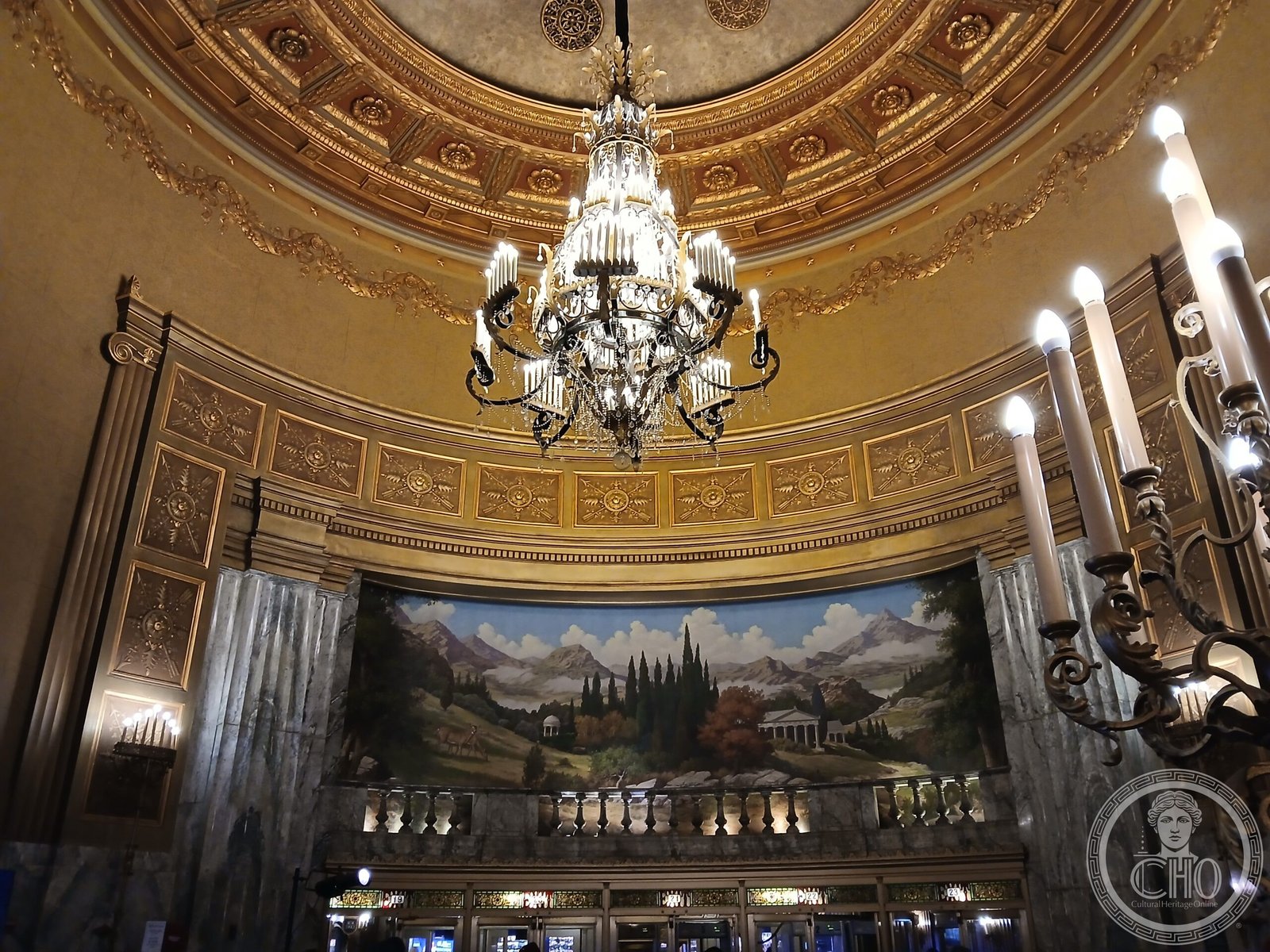
Walter W. Ahlschlager’s 1929 grand movie palace on Broadway fuses Byzantine gold and Greco-Moorish ornament with the Art Deco structural vocabulary of its era, creating one of New York City’s most extraordinary interior spaces — now the Upper West Side’s premier 2,800-seat concert hall.
At a glance
The Beacon Theatre at 2124 Broadway opened in December 1929, weeks after the stock market crash that ended the golden age of grand movie palace construction in America. Designed by Chicago architect Walter W. Ahlschlager, whose commissions included several large entertainment buildings across the Midwest, the Beacon brought to the Upper West Side a level of interior luxury that had previously been concentrated in the Times Square and Brooklyn movie palace districts. The auditorium’s Byzantine-inspired decorative program — gold mosaic medallions, Moorish star-pattern wall panels, polychrome plaster ornament in terracotta, cream and gold — created an interior that has been described as one of the finest rooms in New York City. Listed on the National Register of Historic Places and designated a New York City Landmark, the Beacon has operated since the 1970s as a premier live music venue, hosting residencies and concerts for some of the most significant touring acts in rock, jazz and classical music.
Key facts
- Opened: December 1929
- Architect: Walter W. Ahlschlager, Chicago
- Style: Art Deco with Byzantine and Moorish ornament — gold mosaic, polychrome plaster, marble lobby
- Capacity: approximately 2,894 seats
- Address: 2124 Broadway, New York, NY 10023 (between West 74th and 75th Streets)
- GPS: 40.7813°N, 73.9804°W
- Status: National Register of Historic Places; New York City Interior Landmark; active concert venue
History
The Beacon Theatre opened on 24 December 1929, a building conceived and executed at the precise moment when the economics of grand movie palaces were about to change irreversibly. The stock market crash of October 1929 had already signaled the end of the boom that had produced hundreds of extraordinary entertainment buildings across America in the preceding decade. The Beacon’s promoters pressed ahead regardless, and the building opened to a neighborhood that was one of the densest and most affluent in Manhattan: the Upper West Side of the late 1920s, stretching along Broadway from Columbus Circle to the 90s, was a corridor of apartment buildings, department stores and cultural institutions whose residents supported multiple entertainment venues of the grandest kind.
The Beacon operated as a movie house through the golden age of Hollywood and into the television era, presenting first-run films and eventually transitioning to second-run and art house programming as the entertainment landscape shifted. Like many large-format movie palaces, it found a second life in live music when the cinema business no longer required buildings of this scale. The conversion to a concert venue in the 1970s proved permanently successful: the Beacon’s combination of size, acoustic character, and visual splendor made it one of the most sought-after mid-sized venues on the touring circuit. The Allman Brothers Band established a famous multi-year residency at the Beacon in the 1990s and 2000s, running for more than a decade. The building was designated an Interior Landmark by the New York City Landmarks Preservation Commission for the quality of its extraordinary auditorium.
The theatre is currently operated under a Live Nation agreement, presenting an annual season of concerts across rock, jazz, soul, classical and world music. Its position on the Upper West Side — a neighborhood of concert-goers and music lovers stretching from Lincoln Center to Columbia University — has made it a natural home for residencies and album-anniversary tours.
What you see
The Broadway facade is a three-bay composition in cream and buff terra cotta, with the central entrance bay marked by a classical stone surround and a projecting canopy of ornamental ironwork. The marquee sign, in tube lighting and Art Deco lettering, reads from both directions on Broadway. The building’s exterior is restrained compared to what awaits inside: a lobby of marble columns, decorative mosaic floor medallions, and ornamental plaster vaults in polychrome that introduce the Byzantine theme before the auditorium doors open.
The auditorium is the building’s masterwork: a gilded space of approximately 2,894 seats whose walls and ceiling are covered in Byzantine-inspired ornament at a density rarely seen in American entertainment architecture. The side walls carry tiers of Moorish star-pattern panels in gold and terracotta plaster, surmounted by arched panels containing mosaic roundels. The ceiling descends in a series of shallow domes articulated by gilded ribs and medallions. The proscenium arch carries a fully developed Byzantine order — engaged columns with mosaic capitals, arched surround in polychrome plaster — that frames the stage as if it were the apse of a Ravenna basilica. The lighting fixtures are original: ornate lanterns in bronze and colored glass suspended from the main ceiling and the box level.
Practical information
- Access: 2124 Broadway, New York NY 10023; concert tickets via Live Nation and the box office
- Programming: rock, jazz, classical, soul and world music concerts; check the website for current schedule
- Transit: 1, 2, 3 subway trains at 72nd Street station, two blocks south; B, C trains at 72nd Street, two blocks south on Central Park West
- Time needed: 2.5–3.5 hours for an evening show; exterior photography 15 minutes
Getting there
The Beacon Theatre is on the Upper West Side of Manhattan, two blocks north of the 72nd Street subway station (1/2/3 trains on Broadway; B/C trains on Central Park West). From Grand Central Terminal, take the 2 or 3 train uptown to 72nd Street — approximately 10 minutes. From Penn Station, take the 1 train to 72nd Street — approximately 12 minutes. JFK Airport is approximately 20 miles southeast — 50–70 minutes by subway via the A train + AirTrain or LIRR to Penn Station then the 1 train. Central Park is one block east. The American Museum of Natural History is three blocks east on Central Park West. Lincoln Center is 12 blocks south on Broadway.
Nearby
- American Museum of Natural History — the natural history museum and Rose Center for Earth and Space, two blocks east on Central Park West at 77th Street — one of the largest natural history museums in the world.
- Central Park — one block east at 74th Street; from the 72nd Street entrance, the Strawberry Fields memorial and the Bethesda Fountain are within a 15-minute walk north.
- Lincoln Center for the Performing Arts — the cluster of halls (Metropolitan Opera, Avery Fisher Hall, Alice Tully Hall) 12 blocks south on Broadway at 65th Street.
- The Ansonia (1904) — the Beaux Arts hotel at 2109 Broadway, just south of the Beacon, whose original restaurant served the music world of the early twentieth century.
Sources
- New York City Landmarks Preservation Commission designation report, Beacon Theatre Interior Landmark
- National Register of Historic Places nomination, Beacon Theatre, New York City
- New York Times archives — 1929 opening coverage; residency reviews
- Ben A. Swett / Library of Congress HABS documentation, Beacon Theatre
- Tim Moore, The Allman Brothers Band at the Beacon Theatre — residency documentation
Find it on the map
See this place and what’s around it →📷 Become a Cultural Heritage Online photographer
Share your photos of places: they stay published under your name as the author. The more they're seen, the more you get noticed — and soon a contest will reward the most appreciated photos.
Log in or sign up free to add a photoIs this page about you?
This page is read by travellers and heritage enthusiasts who find it on Google. Tell us how you are connected to this place and we will take it from there.