
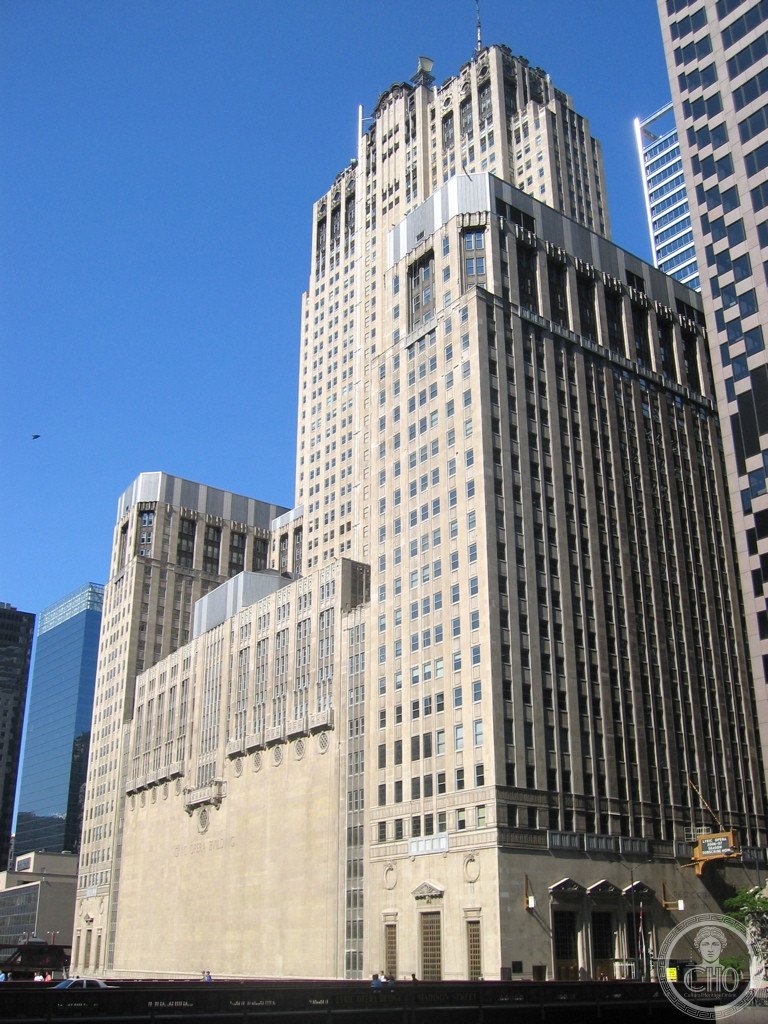
Samuel Insull’s 44-story Art Deco tower on the Chicago River opened on 4 November 1929 — one week after the stock market crash — and has anchored Chicago’s lyric tradition ever since as the home of what is now the Lyric Opera of Chicago.
At a glance
Graham, Anderson, Probst & White — the firm that designed Union Station and the Merchandise Mart — conceived the Civic Opera House as a vertical hybrid: a 44-story commercial office tower whose lower levels contain one of the largest opera houses in North America. The river-facing facade steps back in a series of Art Deco terraces that, viewed from the Chicago River, resemble an enormous armchair — earning the building its durable nickname, “Insull’s Throne.” Samuel Insull, the utility magnate who bankrolled the $20 million project, ensured that income from the upper floors would cross-subsidise opera production costs indefinitely. The arrangement worked; it still does.
Key facts
- Opened: 4 November 1929, Chicago, Illinois
- Architect: Graham, Anderson, Probst & White
- Style: Art Deco — stepped massing, limestone cladding, French Renaissance decorative detail
- Building height: 601 feet; 44 stories
- Main auditorium: Civic Opera Theater, 3,563 seats — second largest opera house in North America
- Secondary auditorium: Civic Theater (now Lyric Theater), 920 seats
- Client: Samuel Insull, chairman, Chicago Civic Opera
- Address: 20 N Wacker Drive, Chicago, IL 60606
- GPS: 41.8838°N, 87.6355°W
- Status: National Register of Historic Places; current home of Lyric Opera of Chicago (since 1954)
History
Samuel Insull arrived in Chicago as Thomas Edison’s private secretary and built one of the largest utility empires in American history. By the 1920s he controlled electricity distribution across 39 states from a Chicago headquarters and channelled a portion of his fortune into civic culture. The Chicago Civic Opera, which he chaired from 1910, needed a permanent home worthy of a world-class company. In 1927 Insull announced a building that would solve the problem commercially: a skyscraper whose rental income would fund opera seasons in perpetuity.
Graham, Anderson, Probst & White delivered the building in the autumn of 1929. It opened on 4 November, eleven days after Black Thursday had triggered the collapse of the financial markets. Within three years Insull’s utility empire had disintegrated; he fled to Europe in 1932 to escape prosecution, was extradited from Greece, tried for mail fraud and securities violations, and acquitted in 1934. He died in Paris in 1938. The opera company, however, survived the Depression and its patron’s disgrace, operating from the building under successive names until the Lyric Opera of Chicago took possession in 1954 and has remained there since.
The building’s commercial tower, now known as the Civic Opera Building, remained a premier Chicago office address through the twentieth century. A major restoration of the auditorium interior in the 1990s and 2000s returned the gilded plasterwork and original colour scheme to their opening-night condition.
What you see
The Wacker Drive elevation presents a symmetrical Art Deco facade in Indiana limestone, stepping back in four distinct terraces as the tower rises. The base — two stories of arcade arches framing the opera house entrance — is detailed in French Renaissance ornament: cartouches, keystones and classical mouldings applied within a rigidly geometric composition. The vertical piers of the tower are decorated with stylised foliate panels that thin as they ascend, emphasising height. Viewed from the river to the east, the profile is unmistakably throne-like: wide low wings flanking the main auditorium block, with the slender tower rising from the centre back.
Inside the Civic Opera Theater, a horseshoe auditorium seating 3,563 faces a stage 108 feet wide — one of the largest in the country. The ceiling is a coffered barrel vault in ivory and gold, with a central sunburst chandelier of Venetian glass. The side boxes are framed by pilasters of fluted plaster, each capital gilded and leaf-carved. The orchestra-level floor is raked below street level, so that the full acoustic depth of the room lies underground along the Chicago River wall — an engineering solution that accounts for the building’s extraordinary resonance.
Practical information
- Access: 20 N Wacker Drive, Chicago IL 60606 — between Madison and Washington Streets, on the Chicago River
- Tours: Lyric Opera of Chicago offers backstage tours on selected dates; check the Lyric website
- Performances: Lyric Opera season runs September–April; occasional chamber and community events year-round
- Transit: Washington/Wells CTA station (Blue/Green/Orange/Purple/Pink lines), 3 blocks east; Madison/Wacker bus stops at the door
- Time needed: 2–3 hours for a backstage tour; 3–4.5 hours for a full opera performance
Getting there
The Civic Opera Building occupies the west bank of the Chicago River at 20 N Wacker Drive, in the Loop’s western edge. O’Hare International Airport (ORD) is 17 miles northwest via I-90/94; Midway Airport (MDW) is 10 miles southwest via I-55. The CTA Blue Line runs directly to O’Hare and stops at Washington/Dearborn, three blocks from the building. Metra commuter trains serve the nearby Ogilvie Transportation Center on Madison Street, one block west. The Chicago Riverwalk, directly outside the eastern entrance, provides a scenic pedestrian route linking the building to Millennium Park in 20 minutes on foot.
Nearby
- Chicago Board of Trade Building (1930) — Holabird & Root’s 44-story Art Deco landmark at the foot of LaSalle Street, a short walk southeast of the Civic Opera, capped by the famous goddess-of-grain figure.
- Union Station (1925) — Burnham and Graham’s Beaux-Arts terminal, one block west on Canal Street, serving six Amtrak routes and all Metra corridors.
- Chicago Riverwalk — Pedestrian promenade along the south bank of the Chicago River, directly east of the building, connecting to the Loop and Millennium Park.
- 333 North Michigan Avenue (1928) — Holabird & Roche’s Art Deco tower at the Michigan Avenue Bridge, visible from the Riverwalk. See the CHO guide.
Sources
- Lyric Opera of Chicago official site — history and tour information
- National Register of Historic Places nomination, Civic Opera Building, Chicago
- Harold M. Mayer and Richard C. Wade, Chicago: Growth of a Metropolis (1969)
- Forrest McDonald, Insull (1962) — biography of Samuel Insull
- Chicago Tribune archives — opening night and Insull bankruptcy coverage
Find it on the map
See this place and what’s around it →📷 Become a Cultural Heritage Online photographer
Share your photos of places: they stay published under your name as the author. The more they're seen, the more you get noticed — and soon a contest will reward the most appreciated photos.
Log in or sign up free to add a photoIs this page about you?
This page is read by travellers and heritage enthusiasts who find it on Google. Tell us how you are connected to this place and we will take it from there.